Binance Commands 65% of CEX Stablecoin Reserves – The Liquidity Power Play Unpacked

One exchange holds the keys to nearly two-thirds of all stablecoin liquidity parked on centralized platforms. That's not a hypothetical—it's the current market structure.
The Concentration Conundrum
When a single entity controls 65% of any critical resource, the entire ecosystem's resilience gets tied to its operational integrity. For traders, this means execution speeds, slippage, and arbitrage opportunities often flow through one primary gateway. It creates a de facto liquidity backbone that others either plug into or compete against.
Liquidity's New Geography
This isn't just about trading volume. It reshapes how capital moves. New projects seeking deep, immediate pools gravitate toward this nexus. Competing exchanges must work harder—offering incentives or forging unique partnerships—to siphon off even a fraction of that reserve dominance. It turns liquidity into both a weapon and a moat.
The Systemic Ripple Effects
Such concentration introduces a single point of potential friction—or failure. A hiccup in one system can send tremors across global markets, tightening spreads and freezing capital flows faster than you can say 'risk-off.' It forces everyone, from institutional desks to retail holders, to have a contingency plan that doesn't rely on a single channel.
The Bottom Line: Adapt or Get Left Behind
The market has voted with its wallets, placing an overwhelming share of its stablecoin trust in one vault. This centralization brings efficiency but also underscores a fragile dependency—a classic finance tale where convenience quietly builds systemic risk, one seamless transaction at a time.
Key Takeaways
- Dominant Market Share: Binance now holds $47.5 billion in stablecoins, representing 65% of all CEX liquidity.
- Outflows Stabilize: Monthly stablecoin outflows have slowed to $2 billion, a sharp drop from the $8.4 billion seen in late 2025.
- Competitors Trail: Nearest rival OKX holds just 13% of reserves, highlighting a widening gap in exchange liquidity depth.
Why is Capital Consolidating?
Money is not running away from crypto. It is moving to where it feels safest. At the peak of the late 2025 panic, redemptions hit $8.4 billion. Now outflows have cooled to around $2 billion this month. That shift suggests rotation, not abandonment.
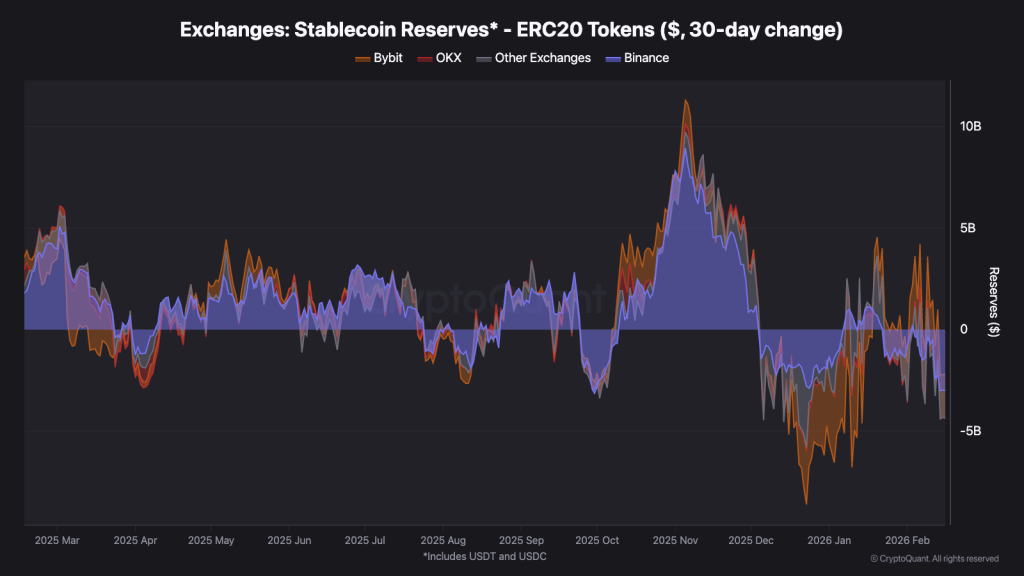
Instead of exiting the ecosystem, investors appear to be consolidating around deeper liquidity and faster execution. In tight conditions, traders care more about slippage and reliability than spreading funds across smaller venues.
That is why capital is clustering on the biggest platforms. When uncertainty rises, perceived SAFE havens attract the bulk of the flow.
Binance Stablecoin Data Breakdown
The scale of Binance lead is hard to ignore. Data shows the exchange now holds about $47.5 billion in stablecoins, up from $35.9 billion a year ago.
That is a 31% jump in twelve months. The growth followed a clear pivot after the BUSD wind down, with liquidity rotating heavily into USDT and USDC.

Meanwhile, rivals are far behind. OKX holds around $9.5 billion. Coinbase sits NEAR $5.9 billion. Bybit trails with roughly $4 billion. The gap is not small. It is structural.
Recent reserve reports show Binance total reserves, including crypto assets, above $155 billion. When liquidity shifts on Binance, it tends to Ripple across the market. That is how dominant its position has become.
