Bitcoin ETFs Bleed $410M as BTC Plunges Below $66K: A Temporary Shakeout or Warning Sign?

Money's on the move. US spot Bitcoin exchange-traded funds just witnessed a massive $410 million exit as the flagship cryptocurrency took a dive below the $66,000 threshold. It's the kind of headline that sends traditional finance analysts scrambling for their 'I told you so' memos.
The Great Unwind
Let's cut through the noise. This isn't about small-time traders cashing out weekend profits. We're talking institutional-grade capital making a coordinated retreat. The flow reversal hits right as Bitcoin's price action turns shaky—a classic correlation that highlights how tightly these new financial instruments are now grafted onto crypto's volatile core.
Reading the Tape
Forget the panic. Real players see this differently. Major outflows often create the liquidity vacuum needed for the next leg up. It's a brutal, efficient cleansing of weak hands—mostly the fast-money crowd who treat crypto like just another risky asset on their Bloomberg terminal. Their exit, while noisy, paves the way.
The Institutional Endgame Remains
Here's the kicker: one week of outflows doesn't unravel a multi-year institutionalization trend. The pipes are built. The regulatory hurdles (mostly) cleared. This is a price correction within a structural bull market, not a structural failure. The digital gold narrative isn't dented by a single bad trading session, no matter what the talking heads on financial news claim.
Bottom Line: Volatility is the price of admission. Today's $410 million exit is tomorrow's re-entry at a better average cost. The traditional finance world loves to point and laugh at crypto's dips from their glass houses built on quantitative easing and negative real yields—a truly cynical bit of theater. The ETF framework is doing exactly what it was designed for: providing a regulated pressure valve. The future still flows through digital assets.
Is the Institutional Floor Collapsing?
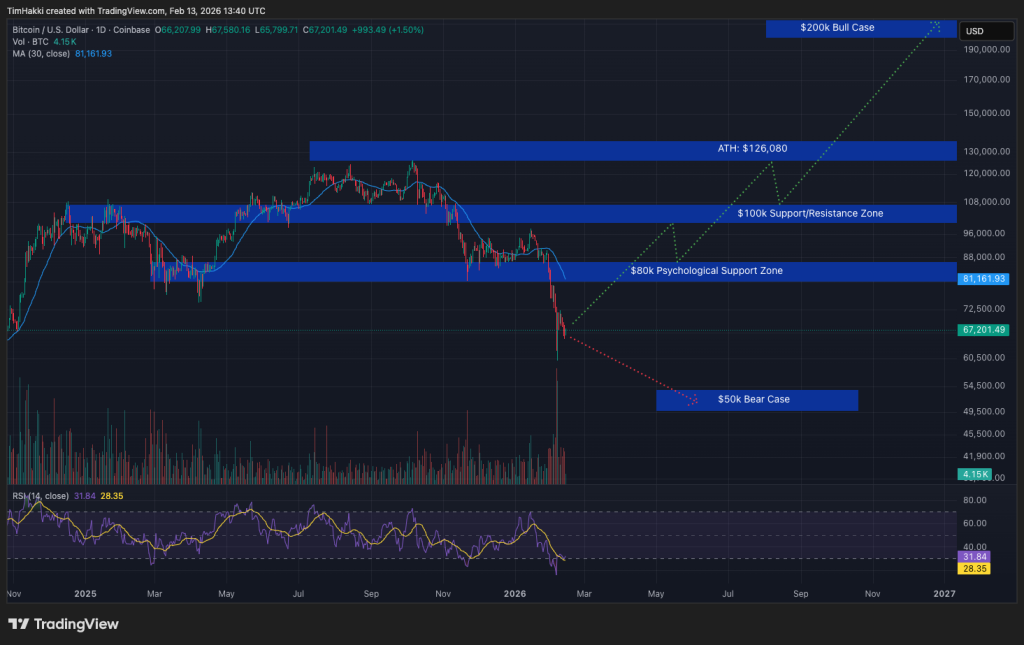
Let’s look at the charts. Bitcoin is trading just above $67,000, a brutal 47% drop from its October 2025 all-time high of $126,080.
The macro picture is getting ugly, prompting major banks to slash their targets. Standard Chartered now sees BTC potentially diving to $50,000. Meanwhile, JP Morgan cut its production cost estimate to $77,000, citing declining hashrate and mining difficulty.
It’s not just spot markets flashing warnings. We’re seeing alarming signals in derivatives, reminiscent of recent whale perp spikes that suggest big money is hedging hard against further downsides.
When whales start protecting their downside this aggressively, you need to pay attention.
Adding fuel to the fire, alarming new research regarding systemic risks has surfaced, leaving retail traders wondering if their assets are safe. The fear is palpable, creating a feedback loop that drives prices lower.
Even Bitcoin’s most notorious bull, Michael Saylor, the founder of the largest Bitcoin treasury company, Strategy, appears to be uncertain about where Bitcoin is headed next.
First time I’ve seen Saylor look nervous speaking publicly.
He can’t say anything else, but deep down he knows extreme downside scenarios aren’t impossible.$BTC pic.twitter.com/PS3NDZhYao
What You Should Watch Next
If you’re looking for entries, proceed with caution. The $60,000 psychological level is now the line in the sand. If that breaks, the $50,000 bear target becomes a scary reality almost overnight.
Watch the Flow data closely on trackers like SoSoValue. Until we see positive inflows return, catching this falling knife is risky.
However, for the brave contrarians, this dip might look like an opportunity similar to the best crypto plays identified earlier this week.
Volatility cuts both ways. Keep your eye on the upcoming inflation prints. If data cools, flows could reverse. But right now? Cash could remain king for a while yet.
