Extreme Fear? Institutions See a Floor While Retail Panics - Here’s Why

Markets tremble, but smart money stays put. That's the disconnect playing out right now across crypto exchanges.
The Fear-Greed Paradox
Sentiment gauges flash red—'extreme fear' dominates headlines. Retail traders hit sell buttons, driven by short-term volatility and doom-scrolling narratives. Yet institutional order books tell a different story. Major inflows continue into regulated products, and OTC desks report steady accumulation from familiar, deep-pocketed clients. It's the classic divide: emotion versus execution.
Building on Shaky Ground
This isn't 2018's capitulation or even 2022's leveraged implosion. Infrastructure is stronger. Regulatory perimeters, though frustrating, are clearer. Institutional custody solutions now hold more assets than ever before. The fear today feels more technical—a liquidity squeeze—than existential. It's the market equivalent of a controlled demolition, making way for the next build cycle.
When Everyone's Scared, Look for the Bids
The 'extreme fear' reading itself has become a contrary indicator for seasoned players. It signals maximum pain, not permanent loss. History shows these periods often precede major re-ratings. The institutions aren't buying because they're brave; they're buying because their models see value where others see vapor. They're playing a different game—one measured in quarters, not minutes.
The Cynical Take
Of course, Wall Street loves a good fire sale—it's easier to hit return targets when everyone else is too scared to pick up the assets they dropped. Fear, for them, isn't a signal to run; it's a sourcing opportunity.
So, is this the floor? Nobody rings a bell at the bottom. But when the crowd is terrified and the whales are quietly feeding, it's usually not the time to follow the crowd off the cliff.
Key Takeaways
- JPMorgan maintains a bullish 2026 outlook despite the total market cap falling from $3.1T to $2.3T.
- The Crypto Fear & Greed Index is pinned at 12 (“Extreme Fear”), levels historically associated with bottom formation.
- Bitcoin is trading at $67,610, significantly below its estimated production cost of $77,000.
- Whale activity in perpetual markets suggests complex institutional hedging is dominant over spot selling.
Is This Institutional Hedging or Strategic Accumulation?
So let’s pause for a second.
Who is buying when the market feels this terrified? bitcoin price is around $67,610 and Ether near $1,950, both down heavily this month.
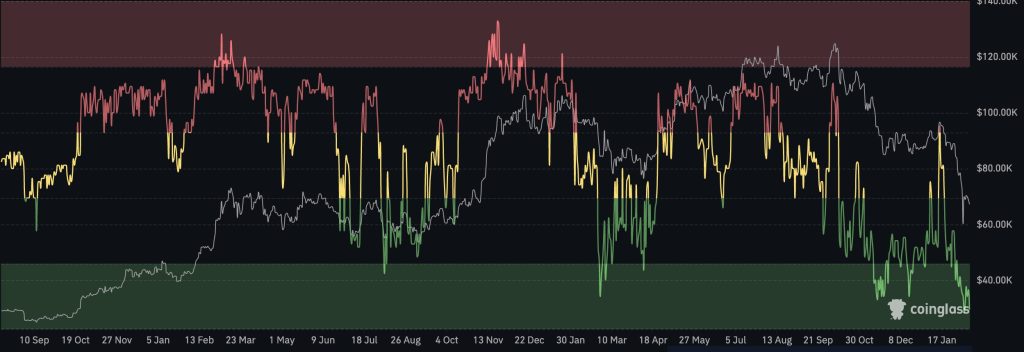
Spot charts look rough and retail is clearly panicking. Yet, Perpetual futures volume is climbing fast, which usually signals sophisticated players stepping in with structured positions, not emotional longs.
This isn’t what speculative euphoria looks like. When retail piles in, funding spikes positive. Instead, BTC funding is nearly flat and ETH funding is negative.
There are only two real explanations here: institutional hedging… or strategic positioning ahead of a larger move.
Will Bitcoin Price $50K Floor Hold?
The charts look terrible right now, no doubt about it. However, fundamentals wise it might leaning bullish good long term.
JPMorgan estimates Bitcoin’s production cost sits around $77,000. BTC is trading well below that.
Historically, when price drops under production cost, it does not stay there long. Miners either shut off machines or pressure builds for a rebound.
Bitcoin mining is entering a tough phase.
Electricity costs are rising while the Bitcoin price has dropped.
There is now a huge gap between hashrate and BTC price
The global average power cost is around $0.17 per kWh.
At that level, many miners are operating at a massive… pic.twitter.com/rlCKTpb8Ss
Still, the downside risk is not gone. Chief equity strategist John Blank warned Bitcoin could slide to $40,000 within 6 to 8 months.
That WOULD be a full blown capitulation scenario. All Traders are now locked on $60,000 as the key support to watchout for.
