Tom Lee-Backed Bitmine Seizes 3.6% of Ethereum Supply in Post-Crash Power Move

When prices plummet, the sharks start circling. Bitmine—the crypto mining firm with backing from Wall Street bull Tom Lee—just executed a staggering accumulation play, grabbing a 3.6% slice of the entire Ethereum supply. That's not a dip-buy; that's a statement.
The Strategic Pounce
Market crashes separate tourists from institutions. While retail panic-sells, entities with deep pockets and longer time horizons see fire-sale prices. Bitmine's move reads like a textbook case of contrarian conviction, leveraging the fear of others to build a foundational position. Controlling nearly 4% of a major asset's circulating supply isn't just an investment—it's a strategic foothold that grants outsized influence over network dynamics and future governance.
What a 3.6% Stake Really Means
In the concentrated world of crypto ownership, this isn't a trivial number. It positions Bitmine as a mega-whale within the Ethereum ecosystem. This level of ownership brings tangible power: the ability to sway validator votes, impact staking yields, and potentially influence the direction of protocol upgrades. It turns a mining operation into a core network stakeholder overnight.
The Tom Lee Factor
Having a figure like Fundstrat's Tom Lee in your corner isn't just about capital—it's about credibility. Lee's perennial bullishness on crypto's structural thesis provides a veneer of Wall Street validation. His backing suggests this isn't a speculative gamble, but a calculated allocation based on a long-term valuation model. Of course, in finance, sometimes the loudest bulls are just selling shovels.
The Bigger Picture: Accumulation Amidst Fear
Bitmine's aggressive accumulation highlights a classic market cycle phase: smart money builds while weak hands fold. This scale of purchasing during a downturn signals a fundamental belief in Ethereum's utility beyond price volatility. It's a bet on the network's enduring role in decentralized finance, digital ownership, and the next iteration of the web.
One firm's crisis is another's cornerstone. While headlines scream about losses, Bitmine just quietly built a fortress—proving once again that in crypto, the real money is made when you buy the fear nobody else wants. Just don't ask what happens if the 'fundamentals' turn out to be a collective hallucination.
Bitmine Ethereum Accumulation Strategy Explained
Led by Chairman Tom Lee, Bitmine pivoted from mining for bitcoin to an Ethereum-exclusive treasury strategy in mid-2025 with a goal to eventually acquire 5% of the total ETH supply.
The company sees temporary market downturns as acquisition opportunities rather than setbacks, mirroring high-conviction plays seen in broader crypto selloff contexts.
“Bitmine has been steadily buying Ethereum… given the strengthening fundamentals,” Lee stated in a press release, countering concerns about the firm’s $7.8 billion paper loss.
Lee argues that current prices do not reflect Ethereum’s utility as the “future of finance,” positioning the firm for long-term dominance despite the immediate pain on its balance sheet.

1/
BitMine provided its latest holdings update for February 9th, 2026:
$10.7 billion in total crypto + "moonshots":
– 4,325,738 ETH at $2,125 (@coinbase)
– 193 Bitcoin (BTC)
– $200 million stake in Beast Industries @MrBeast
– $19 million stake in Eightco Holdings (NASDAQ:… pic.twitter.com/MR6hWu8lio
What 3.6% Supply Control Means for Ethereum Markets
Bitmine’s total stack now sits at approximately $8.7 billion based on current prices hovering just above $2,000.
On-chain data indicates the firm bought the latest tranche of 40,613 tokens as ETH plunged from $2,300 to lows of $1,700.
Unlike purely speculative holders, Bitmine leverages its position for yield; nearly 2.9 million of its tokens are currently staked, generating an estimated $202 million in annualized rewards at current prices.
While investors continue pouring capital into the sector despite the wipeout, Bitmine’s sheer scale allows it to absorb significant liquidity during panic events.
The company plans to launch MAVAN, a proprietary U.S.-based validator network, to potentially stake its entire holding and maximize yield generation.
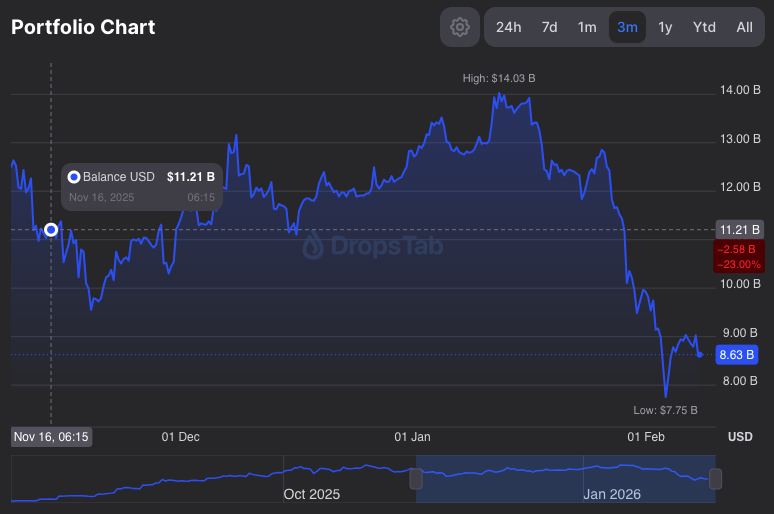
How Bitcoin’s Concentration of Ethereum Could Affect ETH Price
The concentration of such a vast amount of Ether in a single corporate entity raises questions about market influence and liquidation risks.
While Lee predicts a V-shaped recovery, the firm remains deeply underwater with an average purchase price of $3,826. This resilience stands in stark contrast to other institutional players; for instance, Trend Research slashed Ether holdings to cover loans during the same market crash.
If Bitmine sustains its position without forced selling, it removes substantial supply from the market, potentially accelerating price appreciation if demand returns.
