Tether’s Open-Source MiningOS Declares War on Bitcoin Mining Giants

Tether just threw a grenade into the mining pool. The stablecoin behemoth—yes, the one that prints digital dollars—has open-sourced its proprietary mining software, MiningOS. This isn't an update; it's an ambush.
Democratizing the Hashrate
For years, Bitcoin mining consolidated into the hands of a few industrial-scale players. They ran on custom, closed-loop systems that smaller operators couldn't touch. Tether's move cuts the lock off that gate. MiningOS gives any miner with rigs a suite of tools for fleet management, efficiency optimization, and pool selection that rivals the big boys'. It's a direct challenge to the established mining software oligopoly.
Why Open Source? The Strategic Gambit
Releasing the code for free seems counterintuitive for a profit-driven company. But the play is transparent: strengthen the network's decentralization to strengthen its own foundational asset, USDT. A more resilient, distributed Bitcoin mining network means a more secure Bitcoin. A more secure Bitcoin bolsters the entire crypto ecosystem where Tether reigns. They're not just building a tool; they're fortifying their kingdom. A classic case of 'what's good for the network is good for our balance sheet'—the kind of symbiotic, self-serving logic that would make any cynical finance bro smirk.
The New Mining Arms Race
This changes the battlefield. It's no longer just about who has the cheapest power or the newest ASICs. Now, operational intelligence and software agility become critical. Smaller, nimble miners can potentially outmaneuver lumbering giants by optimizing faster. The hashrate distribution could see a significant shift away from concentrated geographic and corporate control.
Tether isn't entering the mining game; it's rewriting the rules. By weaponizing open-source collaboration against proprietary silos, they're betting on a more fragmented, and arguably more robust, mining future. Whether this sparks a renaissance for the independent miner or just reshuffles the deck among a different set of powerful players remains to be seen. One thing's certain: the quiet hum of mining rigs just got a lot more interesting.
 Bitcoin Mining is complex.
 Mining OS by Tether (MOS) makes it simple.
Introducing MOS — the open-source operating system for real mining infrastructure.
Modular. Scalable. Built for energy + hardware + data.
Explore the Documentation: https://t.co/3zcBHFFzRp
Join our… pic.twitter.com/G0GwbtfLKT — Tether (@tether) February 2, 2026
Tether claimed MOS would be used to control, observe, and automate Bitcoin mining through a single control layer by integrating hardware performance, energy consumption, site infrastructure, and operational data.
Tether’s MOS Replaces Patchwork Mining Software With a Single System
Mining of Bitcoin usually uses disjointed software Stacks to manage machine usage, power infrastructure, cooling, and logistics of the site.
MOS seeks to replace that patchwork by treating each component as a coordinated “worker” within one operating system, allowing operators to see and manage their entire setup in real time.
The company claimed that the system monitors more than just hashrate but also monitors energy efficiency, device health, and site-level infrastructure.
The company also noted that it has a peer-to-peer and modular architecture that can be deployed on lightweight hardware in small deployments or on industrial sites with hundreds of thousands of machines.
Tether characterized MOS as robust and adaptable, and not dependent on the centralized third-party software providers.
Tether also announced a Mining Software Development Kit, or Mining SDK, which is the base of MOS, that will be released together with the open-source community in the NEAR future, alongside the operating system.
Tether CEO Paolo Ardoino observed that the MOVE to open-source the mining stack was to minimize the barriers to entry as well as lessen its reliance on proprietary platforms.
Bitcoin Miners Struggle for Breathing Room After 2025 Downturn
The launch comes at a difficult moment for the Bitcoin mining sector.
Miners experienced one of the most severe profitability squeezes in the industry’s history as the bitcoin price continued to experience a downturn since 2025.
Network hashrate climbed from around 800 exahash per second at the start of the year to a peak of roughly 1.15 zettahash per second in October, pushing mining difficulty to record levels.
 Bitcoin’s network hashrate has slipped below 1,000 exahash per second (EH/s) for the first time since mid-September.#Bitcoin #Mininghttps://t.co/yF5wm7389Z
At the same time, the post-halving block reward of 3.125 BTC and declining transaction fees reduced revenue per unit of hash.
By late 2025, the hash price had fallen to around $35 to $40 per petahash per second per day, while the average cash cost for public miners was estimated near $44.
All-in production costs, including depreciation, were importance higher.
Even operators with efficient fleets and low-cost power were operating close to breakeven, and debt levels ROSE as companies financed new hardware and infrastructure upgrades.
Entering early 2026, some pressure has eased. Network hashrate has fallen below 1,000 EH/s for the first time since September, dipping to 870 EH/s at points following winter storms and reduced profitability.
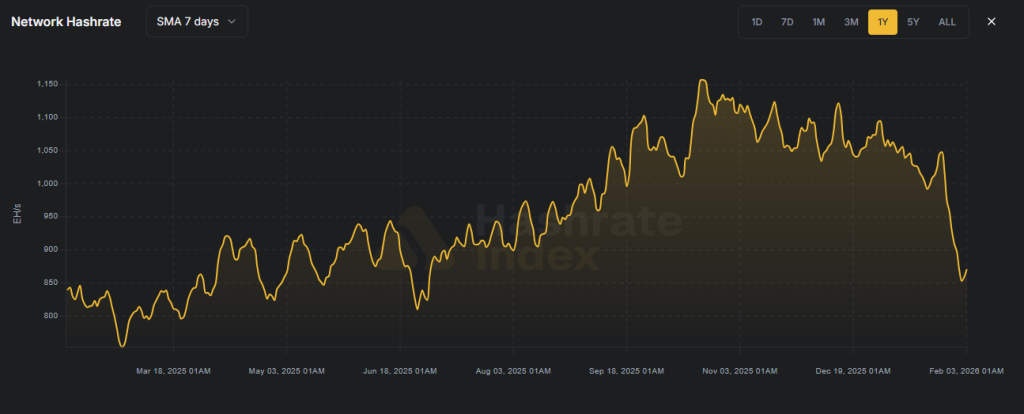
Difficulty has adjusted downward several times, and hashprice has shown modest improvement.
Analysts have said the pullback could temporarily improve margins for remaining miners, though competition remains intense.
Against this backdrop, Tether’s move into mining software adds to its expanding footprint across the digital asset ecosystem.
Best known as the issuer of USDT, Tether reported more than $10 billion in net profit in 2025 and has expanded into tokenized gold through XAUT, and payment partnerships like Opera’s MiniPay wallet.
