BMIC’s Security-First Gambit: Can It Actually Challenge XRP and Top Altcoins in 2026?

Security is the new battleground. As the crypto market matures beyond its speculative infancy, a fresh contender is betting everything on a fortress-first philosophy. BMIC enters the arena not with promises of astronomical yields, but with a foundational pledge: institutional-grade security for the decentralized age.
The Core Proposition: Trust Through Technology
While established giants like XRP focus on cross-border settlement speed and Ethereum on smart contract ubiquity, BMIC's entire architecture is engineered from the ground up to mitigate the hacks and exploits that still plague the sector. It's a direct challenge to the 'move fast and break things' ethos—arguing that what gets broken is often user trust and billions in assets. The thesis is simple: in a world increasingly wary of digital risk, the most secure chain could become the most valuable.
A Crowded Field of Titans
The ambition is staggering. Toppling XRP's payment network or outpacing the developer momentum on other leading altcoins requires more than just robust code. It demands ecosystem adoption—exchanges, wallets, and crucially, institutional partners who have been burned before. BMIC must convince a skeptical market that its security-first approach isn't a niche feature, but the primary utility for the next wave of real-world asset tokenization and compliant DeFi.
The Verdict: A Necessary Hedge
BMIC’s rise won't happen overnight. Network effects are crypto's moat, and incumbents have deep trenches. Yet, its emergence signals a pivotal shift. As regulatory scrutiny intensifies globally, a protocol that can credibly claim to be the 'Swiss vault' of blockchains may find its moment. It appeals directly to the institutional money currently sitting on the sidelines, terrified of headlines about another nine-figure exploit. In the end, the market will decide if security sells—or if, like in traditional finance, everyone just chases the highest nominal return until the music stops.
XRP: Fast, Cheap, and Proven
XRP has been moving money across borders for years. Transactions clear in 3 to 5 seconds. Fees stay under a cent. The supply is locked at 100 billion tokens, and Ripple controls releases through escrow. Banks like that predictability.
Ripple’s On-Demand Liquidity product already handles real settlement volume. XRP bridges fiat currencies without needing pre-funded accounts in every country. The partial win against the SEC also cleared up some regulatory fog in the U.S. For payment networks, XRP works.
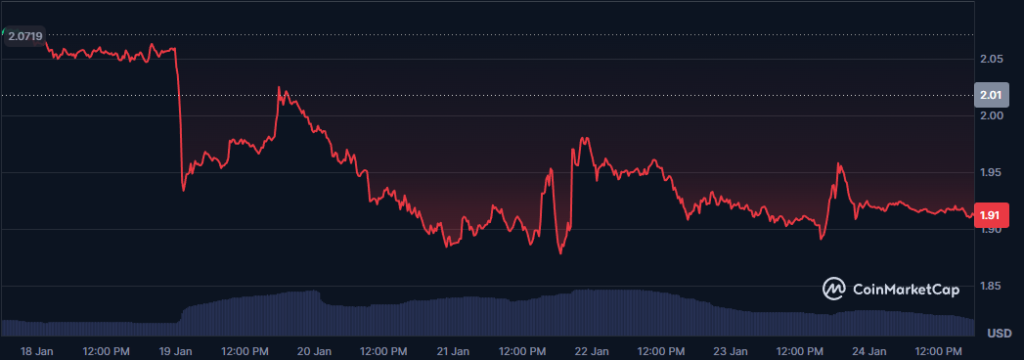
Source: CoinMarketCap/XRP
But XRP runs on classical cryptography. Quantum computers will break those signatures eventually, BMIC says. Upgrading a global payment network to post-quantum standards means coordinating migrations, risking downtime, and hoping nothing breaks. That’s not a small task.
So there’s a gap. Projects built quantum-resistant from the start skip all that mess. The question is whether fast payments alone stay competitive once the cryptographic ground starts shifting.
HBAR, ADA, and DOT: Different Paths to Security
Hedera, Cardano, and Polkadot each built their own version of security. Hedera uses hashgraph consensus for fast finality and wraps it in enterprise governance. The council structure makes it appealing to banks and regulated companies, even if it sacrifices some decentralization.
Cardano took the academic route. Formal verification, peer-reviewed research, and Haskell-based smart contracts mean fewer bugs and more predictable behavior. It ships slowly, but teams building high-stakes applications appreciate the rigor.

Polkadot went modular. The Relay Chain secures all parachains, and each parachain runs in isolation. One compromised chain doesn’t infect the rest. It’s infrastructure thinking applied to blockchain.
All three are strong in their lanes. However, BMIC argues, none of them started with quantum resistance as a Core feature. They’ll all need to retrofit post-quantum cryptography eventually. That means hard forks, compatibility issues, and execution risk. BMIC says it doesn’t have that problem because it was designed quantum-native from day one.
BMIC: One Of the Best Altcoins for Post-Quantum Protection
BMIC is the first wallet built with signature-hiding smart accounts on ERC-4337 and PDA architecture. Public keys never touch the blockchain. That removes the exact vulnerability quantum computers will target first. The hybrid post-quantum signatures also upgrade automatically as standards change.
The wallet is just the entry point. BMIC also offers quantum-secure staking. Validator keys stay hidden inside the same signature-private infrastructure, so stakers don’t expose themselves to future attacks. There’s also a quantum-secure credit card system that uses PQC authentication and private routing to stop cloning and key-recovery exploits.
Enterprises tap into this through Quantum Security-as-a-Service APIs. Banks, fintechs, and healthcare companies can add custody, key management, and encrypted messaging without tearing apart what they already use. AI runs in the background, flagging threats before they become real problems, the team says.
The roadmap includes a Quantum Meta-Cloud that connects different quantum hardware providers into one decentralized network. No vendor lock-in. No corporate gatekeepers. BMIC becomes both a security LAYER and a compute access point as AI demands grow. Per BMIC, the crypto presale gives early participants a way in before broader adoption kicks off.
BMIC Presale: Tokenomics and Growth Plan
The presale runs 50 phases, starting at $0.049474 per token. Total supply is fixed at 1.5 billion. Distribution: 50% presale (750M), 12% rewards and staking (180M), 10% liquidity and exchanges (150M), 10% private sale (150M), 9% ecosystem reserve (135M), 6% marketing (90M), and 3% team (45M).
The token model is deflationary. Part of the platform revenue goes toward buybacks and burns. As usage grows, supply shrinks. BMIC is required to use wallet features, enterprise APIs, and compute workloads. Staking rewards participants and strengthens the network with quantum-secure validator setups.
The roadmap moves fast but stays realistic. Phase 1 builds the wallet and integrates post-quantum cryptography. Phase 2 launches the alpha and rolls out institutional pilots with QSaaS APIs. Phase 3 opens the beta with full asset support, governance activation, and the first burn events.
Phase 4 opens up the Quantum Meta-Cloud and switches on burn-to-compute, turning tokens into compute credits. Phase 5 rolls out the mainnet, bringing decentralized governance, AI security patches, and enterprise deals across finance, insurance, and healthcare.
Presale buyers who get in early pay less before the price steps up. This is a crypto to buy before quantum becomes a front-page problem.
Visit BMIC Presale
Why BMIC Has the Edge
Overall, XRP owns speed and institutional traction. Hedera, Cardano, and Polkadot each bring something different: governance, formal verification, and shared security. But none of them were built quantum-resistant from scratch. BMIC was, the team says.
It protects wallets, staking, and payments without exposing public keys. Enterprises add quantum security without expensive migrations. The deflationary model and compute utility keep demand steady. The roadmap scales from wallet launch to full quantum infrastructure.
Anyone looking for the best crypto to buy in 2026 should ask what happens when quantum computing actually arrives. Most networks will be racing to fix their code. BMIC says it already handled that part. The crypto presale is live at $0.049474 per token. Getting in now means better pricing before the next phase kicks in.
Discover the future of quantum-secure Web3 with BMIC:
Website: https://bmic.ai/
Social: https://x.com/BMIC_ai
Telegram: https://t.me/+6d1dX_uwKKdhZDFk
