Strongest PMI Since 2022 Meets Crypto’s Sharpest Spot Volume Drop – Why Analysts See Bitcoin Upside Explosion

Economic engines roar while crypto spot markets whisper – and that divergence spells opportunity.
Manufacturing data just hit its highest watermark in over three years. The Purchasing Managers' Index (PMI), that classic gauge of industrial health, surged to levels not seen since 2022. It's a clear signal that traditional economic machinery is humming, the kind of news that usually sends institutional capital scrambling for growth assets.
Meanwhile, in the digital trenches, a curious quiet has descended. Spot trading volume across major cryptocurrency exchanges has taken its sharpest dive in recent memory. The usual frenzy of buys and sells has muted to a murmur. For the uninitiated, that sounds like trouble. For seasoned crypto watchers, it smells like a coiled spring.
The Contrarian Signal: Calm Before the Storm
Historically, severe volume contractions in crypto aren't death knells; they're often consolidation phases. They represent a washout of weak hands, a moment where speculative noise fades and the underlying asset's true value proposition gets a chance to breathe. With macro tailwinds building from the traditional sector, this volume vacuum may be the perfect vacuum for a powerful rally to fill.
Bitcoin, the perennial bellwether, sits at the eye of this storm. Its network remains robust, its hash rate near all-time highs, and its institutional adoption pipeline still clogged with pending ETF applications and corporate treasury announcements. The fundamental story hasn't changed—only the short-term trading sentiment has.
Where's the Smart Money Looking?
Analysts aren't staring at the empty volume charts with despair; they're mapping upside trajectories. The logic is brutally simple: strong PMI data suggests economic resilience, which curbs aggressive monetary tightening fears. A stable-to-dovish macro backdrop is the petri dish in which risk assets like Bitcoin thrive. The dramatic spot volume drop, therefore, isn't a red flag—it's a potential clearing event, stripping away leverage and setting a cleaner stage for the next leg up.
Of course, on Wall Street, they'd call this 'idiosyncratic risk' and charge you a 2% management fee to explain it. In crypto, it's just Tuesday.
Watch for a surge to validate the thesis. When spot volume rushes back in, it likely won't be a trickle. The combination of positive macro impulses and a technically oversold spot market creates a potent mix. The fuse is lit; the only question is the length of the burn.
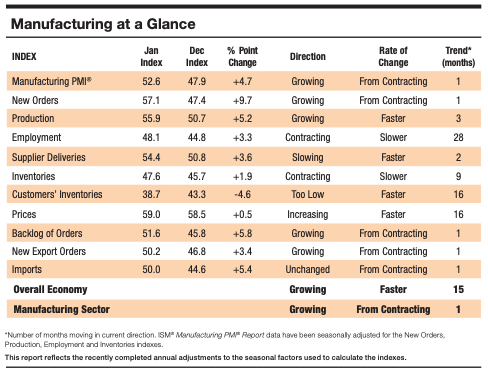 Source: ISMWorld
Meanwhile, $2.56 billion in crypto liquidations and spot volumes at their lowest since 2024 is hinting at a possible drained out liquidity, as the total crypto market cap sank to $2.58 trillion.
Manufacturing Rebound Ends a Historic Drought
U.S. Commerce Secretary Howard Lutnick credited the expansion directly to trade policy, framing it as validation of the administration’s tariff strategy.
“For the first time in over two years the United States has delivered manufacturing expansion, all thanks to President Trump’s trade policies,” he stated, adding that “tariffs are working as we said.“
For the first time in over two years the United States has delivered manufacturing expansion, all thanks to President Trumps trade policies.
Tariffs are working as we said strengthening American manufacturing while reducing imports. Once again, the so-called experts were… https://t.co/GugpuucKvq
The sub-indices reinforced the optimism. Production reached its highest since February 2022, Backlogs of Orders expanded to 51.6, and nine of eighteen manufacturing industries reported growth, with the Prices Index holding at 59%.
New Export Orders crossed into expansion at 50.2 for the first time since December, deepening the recovery signal across the sector.
Economist James E. Thorne firmly rejected inflation fears surrounding the data. “Expanding the Supply Side of the economy is NOT inflationary,” he wrote, a stance supported by Truflation’s real-time U.S. CPI reading of 0.95%, well below the 2% target.
US inflation today, in our independent real-time price data:
Truflation US CPI: 0.95%
Truflation US PCE: 1.25%
Truflation US Core PCE (excl food and energy): 1:46%
Truflation US BLS Comparison (using the BLS weights): 0.46%
Truflation Aggregated CPI: 27.68%
We calculate… pic.twitter.com/0sgwHc0P5m
Spot Demand Collapse Raises Alarm Bells
CryptoQuant analyst Darkfost flagged a dramatic retreat in spot activity since October, with Binance volumes tumbling from nearly $200 billion to $104 billion.
“The current environment remains uncertain and does not encourage risk-taking,” he wrote, warning that a durable recovery requires spot volumes to return.
 Spot demand Is drying up : bitcoin enters its 5th month of correction
We are now entering the 5th consecutive month of correction for Bitcoin.
This correction has been largely driven by the October 10th event, which led to a massive destruction of liquidity, particularly in… pic.twitter.com/rX2keResNG
Speaking with Cryptonews, SwapSpace CBDO Vasily Shilov sharpened the picture with exchange flow data, noting that “the volume of Bitcoin transferred to exchanges has fallen to around $10 billion per month” against “$50–80 billion” at past price peaks.
SwapSpace data also showed weekend exchange volumes surging 43% above typical benchmarks amid thin liquidity
He attributed the weakness to a demand vacuum compounded by geopolitical pressure around Iran.
On-chain metrics deepened the concern. CryptoQuant’s Supply in Loss ROSE sharply to 44%, a pattern historically associated with early bear-market phases rather than healthy pullbacks.

The Puell Multiple also remained in its discount zone for the third consecutive month, with miner reserves at roughly 1.8 million BTC under mounting revenue pressure as smaller operators begin to capitulate.
Bulls and Bears Clash Over the ISM Signal
Joe Burnett, VP of Bitcoin Strategy at Strive, framed the PMI breakout as a historic catalyst.
“Past breakouts in 2013, 2016, and 2020 served as key catalysts for Bitcoin’s major bull runs,” he wrote.
One of the longest ISM Manufacturing PMI contraction periods in U.S. history ended this morning with a breakout to 52.6, up 4.7 points from December.
Past breakouts in 2013, 2016, and 2020 served as key catalysts for Bitcoin's major bull runs.
This ends 26 consecutive months of…
Analyst Benjamin Cowen pushed back sharply, citing 2014 ( when the ISM climbed from 52.5 to 55.7 while Bitcoin dropped from $737 to $302), and cautioned that ““
Leo Lanza countered Cowen directly, arguing the real trigger is not ISM hovering above 50, but specifically crossing back above 50 after prolonged contraction, which is the exact pattern now in play.
Analyst Jesse Eckel built on that thesis, declaring that “every single crypto bull run ever — 2013, 2017 and 2021 — happened when the ISM moved up above 50,” and adding that “our DOT com moment is still firmly ahead of us.“
Shilov, however, closed with a measured warning, projecting a near-term dip below $70,000 before any sustained recovery materializes.
The worst case, he cautioned, could drag total crypto market cap toward $1.8–2.0 trillion, making ETF flows, corporate holder decisions, and the evolving geopolitical landscape the defining forces shaping Bitcoin’s path forward.
