Crypto Exchanges’ Stock Plunges 60% as Trading Volumes Vanish – Is the Crash Over or Just Beginning?

Exchange stocks just got a brutal reality check—trading volumes evaporated, share prices cratered 60%, and investors are scrambling for the exits. The party's over, but is this a healthy correction or the start of something uglier?
When the Music Stops
For years, exchange stocks rode the crypto wave, their valuations untethered from traditional metrics. Now, with volumes vanishing, that disconnect is painfully clear. The 60% plunge isn't just a number—it's a market calling time on speculative excess. Analysts who once cheered every rally are now whispering about 'fundamental repricing.'
The Volume Vanishing Act
Empty order books tell the real story. Retail traders stepped back, institutional flows slowed to a trickle, and the high-margin fee revenue that fueled those stock prices simply disappeared. It's a classic case of the chicken and the egg—did falling prices kill volume, or did dying volume trigger the crash?
Regulatory Headwinds Mount
Global watchdogs aren't helping. From the SEC's relentless enforcement to Europe's MiCA rules tightening compliance costs, exchanges face a regulatory squeeze just as revenues dry up. One cynical fund manager quipped, 'They built billion-dollar businesses on regulatory arbitrage. Now the arbitrage is gone, and so are the billions.'
Is This the Bottom or a Trap Door?
Some see a buying opportunity in the 60% wreckage, betting on a long-term crypto adoption story. Others see a value trap—a broken business model exposed. The truth likely lies in the middle: the era of easy exchange money is over, but the infrastructure built during the boom isn't going away. Survival now depends on diversification, real compliance, and weathering a storm that separates the resilient from the reckless.
The crash has spoken. The question is whether anyone's still listening.
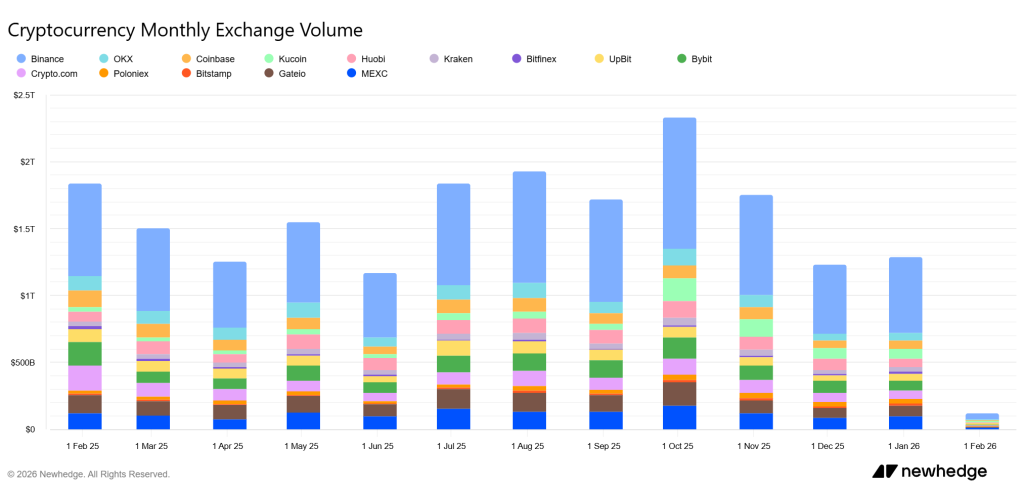 Source: Newhedge
Newhedge data indicate that centralized exchange spot trade volumes were the highest in January 2025 and then in October, when the overall monthly activity ROSE to approximately $2.3 trillion.
Crypto Spot Volume Falls Nearly 90% From October Peak
Binance transacted nearly $1 trillion in October, over 40% of all volume, before total spot trading across exchanges plunged to about $1.7 trillion in November.
Trading continued to decline, reaching $1.2 trillion in December and plummeting to $120-150 billion in January 2026, nearly 90% less than in October.
Binance was the biggest exchange, with only $70 billion to $80 billion in trades, with the vast majority of other exchanges only registering in single- to low-two-digit billions.
CoinGecko data reveals that Binance held the same position in December with a 38.3% market share, but with spot trading volume decreasing by over 40% month-on-month to $361.8 billion.
Other large platforms, such as Bybit, MEXC, and others, also posted double-digit drops.

Although the total spot trading volume across the top 10 exchanges had increased marginally on a full-year basis in 2025, the second half of 2025 was characterized by an evident slowdown, with a number of key platforms recording annual decreases.
The slowdown in trading activity has translated directly into pressure on exchange stocks.
Shares of Coinbase, Gemini, and Bullish have all underperformed broader equity markets since October, falling far more sharply than bitcoin itself, which is down about 35% from its peak.
Coinbase shares fell 40.4% over the past six months to $189.62, sharply following the shrinking exchange volume. Bullish also posted a steep decline, dropping 56.7% over the same period to $29.43.
Robinhood Markets proved more resilient, with its shares down 16.0% over six months to $89.37, significantly outperforming crypto-native peers during the period.
After $19B Liquidation, Traders Step Back and Volumes Slide
Market observers say the dynamic is typical of crypto downturns.
When prices rise, trading volumes expand as investors chase momentum, and when sentiment turns, participation drops quickly, amplifying revenue declines for exchanges.
The latest slump follows a record liquidation event on October 10, when roughly $19 billion in positions were wiped out, dampening risk appetite across both retail and institutional traders.
 Over 1.66 million crypto traders were liquidated as the market experienced a sharp downturn, wiping out $19.33 billion in positions.#Trump #Bitcoinhttps://t.co/7PNRagvFrx
Meanwhile, this cycle has varied from the previous crashes in some significant aspects.
There has been no failure of exchange and a wave of regulatory crackdown like during previous fall seasons.
Rather, the pullback is seen as fueled by exhaustion following a sharp rally, a restrictive financial situation, and wider risk-off action in world markets.
In January, Bitcoin dropped by almost 11%, the most in months since 2018, and investors diverted to perceived safer assets or exited completely.
 Bitcoin spot ETFs see $817M outflow as $BTC crashes to $81,315, its nine-month low, driven by Fed uncertainty, tech-sector weakness, and macro risks. #Bitcoin #ETFshttps://t.co/e157j5VJoV
Historically, such contractions of volumes have followed crypto winters after notable booms, such as the downfall of Mt. Gox in 2014, the bursting of the ICO bubble in 2018, and the liquidity crisis of 2022.
Recoveries have typically taken years and were driven by new structural catalysts rather than a quick return of speculative enthusiasm.
