Hong Kong’s First Stablecoin Licenses Drop in March — Who’s Leading the Charge?

Hong Kong's financial regulators are poised to greenlight the city's inaugural stablecoin licenses next month, marking a watershed moment for Asia's crypto hub.
The Regulatory Gate Opens
March isn't just another month on the calendar—it's when Hong Kong's financial authorities flip the switch on a licensed stablecoin ecosystem. This move formalizes what was once a regulatory gray area, bringing dollar-pegged digital assets under the watchful eye of the Securities and Futures Commission (SFC) and the Hong Kong Monetary Authority (HKMA). The goal? To cement the city's status as a compliant digital asset gateway.
Who's Making the Shortlist?
The race isn't for the faint-hearted. Applicants face rigorous capital, reserve, and operational scrutiny. While names remain confidential, speculation swirls around entities with existing sandbox participation or deep banking ties. The licenses will likely tier participants, separating issuers from distributors—a structure familiar to traditional finance but new to crypto's wilder west.
Why This Changes Everything
Licensed stablecoins cut through the trust deficit that plagues the sector. For institutions, it means an on-ramp that doesn't keep compliance officers awake at night. For retail, it's a safer harbor during market storms. Hong Kong's playbook could become the template for other financial centers sitting on the crypto fence—always a step behind, of course.
The Ripple Effect
Expect a reshuffle in regional crypto flows. A regulated Hong Kong dollar-pegged stablecoin could challenge the dominance of offshore USDT in Asian markets. It also pressures mainland China's digital yuan project by offering an externally accessible, dollar-linked alternative right on its doorstep. Traditional banks, meanwhile, face the classic innovator's dilemma: adapt or watch their lunch get eaten.
So, as March approaches, the real question isn't just who gets a license—it's whether traditional finance will finally admit that the future of money isn't theirs to control anymore. After all, nothing disrupts like a regulated disruptor.
Hong Kong’s Stablecoin Era Begins Slowly as Regulators Tighten the Bar
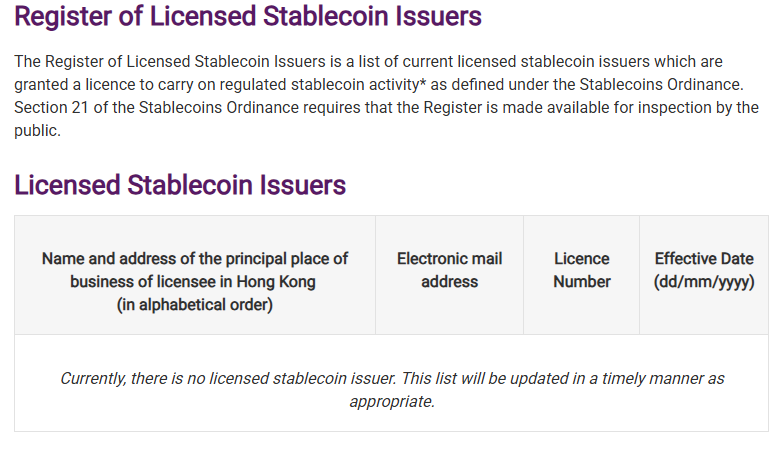
As of early February, no stablecoin issuer has yet been approved under Hong Kong’s new regime.
The HKMA has indicated that it is assessing 36 applications in the first round, though the wider industry interest had more than 40 prospective applicants at one point.
The regulator has so far been cautious and in July 2025 introduced a public registry to monitor licensed issuers, but the registry is currently empty.
The licensing regime implemented in August covers all issuers of fiat-referenced stablecoins in Hong Kong, as well as foreign issuers of tokens pegged to the Hong Kong dollar.
The rules permit licensed issuers to issue, administer, and redeem stablecoins, as long as they have full 1:1 reserve support of high-quality, liquid assets under trust arrangements with approved custodians.
Issuers must honor redemption requests at par value within one business day and are prohibited from paying interest to stablecoin holders.
Governance and compliance are also given great focus by the regime.
According to the rules, issuers should be locally incorporated or authorized organizations that have strong internal controls and have boards that have independent directors with specific compliance functions.
They must perform due diligence of customers, adopt the use of wallets, and adhere to anti-money laundering and counter-terrorist financing requirements.
HKMA has a wide range of supervisory authority and can add further terms to the license, introduce managers, or cancel the license in case of breach of requirements.
Hong Kong Sandbox Draws Banks, Tech Giants, and Web3 Firms
A number of high-profile companies have already become the major participants by applying to the regulatory sandbox of the HKMA.
These include a joint venture between Standard Chartered’s Hong Kong arm, Animoca Brands, and telecoms provider HKT, operating under the name Anchorpoint Financial.
@StanChart, @animocabrands, and HKT team up to launch a Hong Kong dollar-backed stablecoin. #Stablecoin #HongKonghttps://t.co/6eWEGHcKCz
— Cryptonews.com (@cryptonews) February 17, 2025Ant Group’s digital technology unit has confirmed it is pursuing a license, while Bank of China Hong Kong has been reported as an applicant.
HSBC and ICBC also signaled their intention to apply last year, although the HKMA has not confirmed the identities of any applicants and has warned that early approvals should not be seen as endorsements of specific business models.
The stablecoin rollout sits within a broader regulatory and strategic push by Hong Kong to develop a full digital asset stack.
The city already operates a licensing regime for virtual asset trading platforms under the Securities and Futures Commission, with 11 exchanges approved so far, including OSL, HashKey, and Bullish.
 The Securities and Futures Commission o Hong Kong has approved four new virtual asset providers!#HongKong #Cryptohttps://t.co/iUKmMVDSlk
Government officials have repeatedly framed stablecoins as infrastructure rather than speculative products.
At the World Economic Forum in Davos in January, Financial Secretary Paul Chan said Hong Kong’s approach to crypto regulation is intended to be “responsible and sustainable,” describing digital finance as a strategic growth pillar for the city.
At the same time, industry groups have cautioned that rising compliance costs could slow institutional participation if rules become overly restrictive.
