Analyst Reveals: US Liquidity Crisis, Not a ’Broken’ Crypto Market, Sparked $250B Crash

Forget the crypto-is-dead narrative. A fresh analysis cuts through the noise, pointing the finger squarely at traditional finance's plumbing.
The Real Culprit: A Dry Tap on Wall Street
When $250 billion vanished from digital asset markets, critics pounced—calling it proof of a fundamentally flawed ecosystem. But the data tells a different story. The violent sell-off coincided with a severe tightening of US dollar liquidity, a classic risk-off move that ripples through every speculative asset class. Crypto didn't break; it got caught in the crossfire of a broader financial squeeze.
Liquidity is the lifeblood of all markets, digital or otherwise. When it drains from the system, the highest-beta assets—the ones with the biggest potential gains and losses—get hit first and hardest. This wasn't a crypto-specific bug; it was a feature of global capital flows. The same forces that tank growth stocks and emerging market bonds slammed digital assets. A reminder that when Wall Street sneezes, the whole risk complex catches a cold—even the decentralized kind.
So, next time you hear a pundit blame 'crypto's inherent instability,' remember: sometimes a crash is just a liquidity crisis in a digital trench coat. After all, in finance, the problem is almost never the new kid on the block—it's usually the old guard mismanaging the money printer.
Bitcoin’s Drop Mirrors Tech Stocks as Liquidity Tightens, Pal Says
In a post published on X over the weekend, Pal pushed back against claims that bitcoin and crypto had “broken” or detached from traditional markets, arguing instead that similar pressure has appeared across other long-duration assets.
https://t.co/M5mLAi3XLA
— Raoul Pal (@RaoulGMI) February 1, 2026Pal cited analogies between Bitcoin and the U.S. software-as-a-service equities, saying that the two asset classes have been almost identical in their price movements throughout the downturn.
He said this suggests a shared macro driver rather than sector-specific weakness.
In his analysis, he pointed out that U.S. total liquidity has become the dominant factor in this phase of the cycle, outweighing broader global liquidity measures that typically correlate more closely with crypto prices.
The liquidity squeeze, Pal argued, stems from a combination of factors that reduced the amount of capital circulating through the financial system.
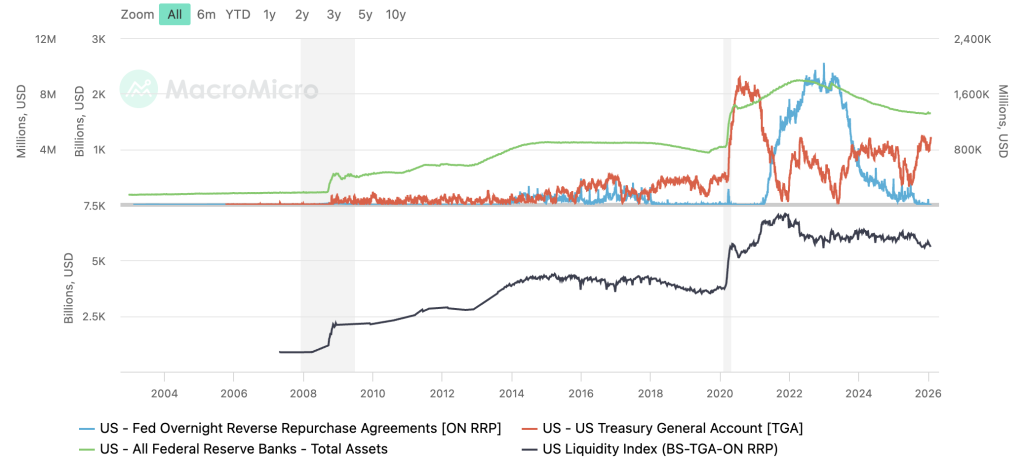
These are the finish of the Federal Reserve reverse repo facility drawdown in 2024, a reconstruction of the Treasury General Account in mid-year 2025, and the effects of the recent partial U.S. government shutdown.
 U.S. President Donald TRUMP signed a bill on Wednesday that formally ended the country's longest government shutdown.#DonaldTrump #GovernmentShutdownhttps://t.co/pTDbHsvj8O
He also included that a robust rise in gold also averted marginal liquidity that could have otherwise been pumped into less risky assets like crypto and high-growth equities.
Market data is also indicative of the magnitude of the damage, as Bitcoin plunged over 10% from a weekend high NEAR $84,000 to lows of approximately $76,000 to establish one of the biggest CME futures gaps in history.
Bitcoin and Ethereum Sink as Derivatives Interest Hits 9-Month Low
At the time of writing, Bitcoin was trading at $76,839, which is a 12.6% decline during the last week and 39% below its all-time value. ethereum was subject to even greater losses, falling by almost 7% in 24 hours to about 2243 and still more than 54% below its high.

The crypto market in general has been experiencing the same trend, with a total market capitalization going down to approximately $2.66 trillion, which was previously around $3 trillion just a week earlier.
Liquidations were fast, and over $2.5 billion was wiped out in a single day, with over $5.4 billion liquidated since Thursday, according to CoinGlass data.
The overall interest in all derivatives markets has dropped to about $24.2 billion, its lowest point in nine months, with Leveraged positions flushed out.
The selloff was coupled with dystrophic liquidity on weekends and a succession of macro news, such as trade tensions, increasing yields in long-dated Japanese government bonds, and increasing geopolitical risks in the Middle East and Asia.
On-chain indicators suggest confidence remains fragile. Exchange outflows dropped sharply after the sell-off, showing limited dip buying, while large Bitcoin holders reduced exposure by an estimated 10,000 BTC since early February.
Short-term holders are deep in unrealized losses, with NUPL metrics sitting in capitulation territory, though not yet at levels historically associated with final market bottoms.
Analysts note that without stronger accumulation from long-term investors, such rallies tend to fade.
