Ripple Co-Founder Launches $40M Counter-Attack Against California’s Wealth Tax Grab

Silicon Valley's crypto elite aren't just talking about tax flight—they're funding the fight.
The $40 Million War Chest
A coalition led by a Ripple founder just dropped a forty-million-dollar challenge to Sacramento's proposed wealth levy. This isn't lobbying; it's a direct financial counter-punch aimed at the ballot box. The move signals a new phase in the high-stakes battle between mobile capital and state revenue collectors—where legal briefs and campaign ads become the weapons of choice.
Digital Assets on Defense
The initiative exposes the raw nerve of taxing unrealized gains, a nightmare for volatile crypto portfolios. Proponents argue it protects innovation and founder equity from being liquidated by the state. Critics see it as a blatant carve-out for the tech-rich—because nothing says 'fair share' like writing a check to avoid writing a bigger check to the taxman.
The California Exodus Accelerator
This isn't just policy—it's a market signal. When founders commit eight figures to fight a tax, they're also pricing the cost of staying. The campaign fuels the narrative of a business exodus, turning a fiscal debate into a real-time test of California's hold on the wealth it helped create. Watch where the money moves next.
The ultimate irony? Using concentrated wealth to lobby against redistributing it—a perfectly cynical hedge in the portfolio of modern finance.
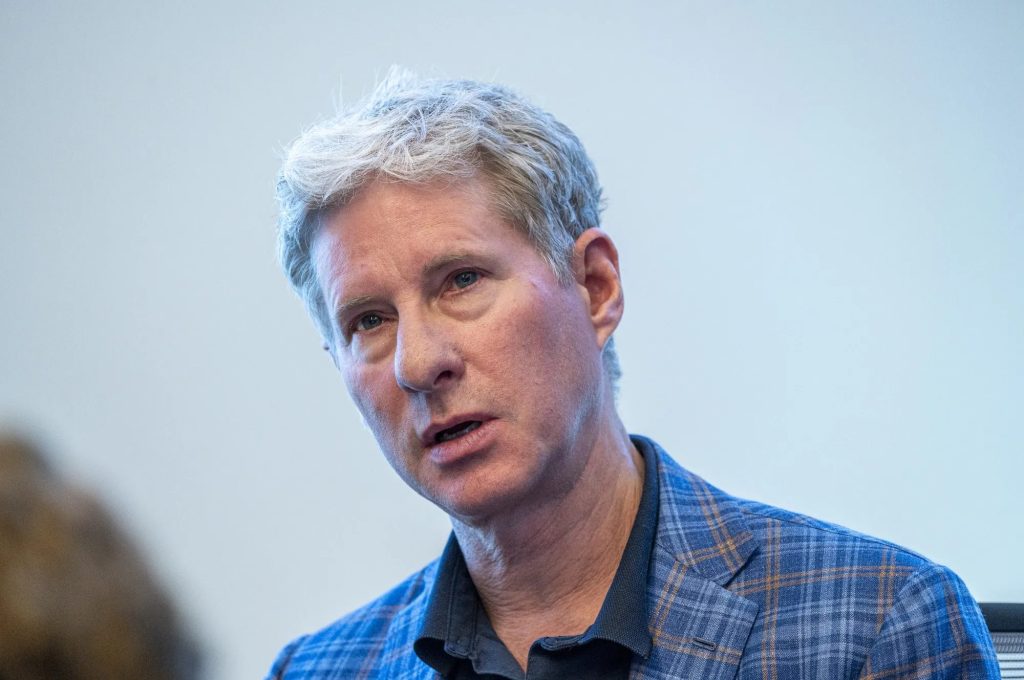 Ripple co-founder Chris Larsen. | Source: Bloomberg
Tech Billionaires Challenge Union Influence With Business-Friendly Candidates
Larsen, whose net worth is nearly $15 billion from Ripple holdings and crypto assets, said he expects to personally commit $30 million to the organization.
“If it takes a couple of cycles, fine — that’s what we’re here for,” he told The New York Times when asked about potential November losses.
The group plans to target about a dozen state legislative seats this year, focusing on public safety, homelessness, and budget discipline, according to Shaudi Fulp, the former Sacramento lobbyist leading daily operations.
While Democrats control more than two-thirds of seats in both legislative chambers, Grow California will not engage in the 2026 gubernatorial race or expensive ballot proposition campaigns.
Both founders come from the crypto industry, though they stress that the initiative does not represent the interests of the crypto sector specifically.
Larsen acknowledged learning lessons from Fairshake, the crypto super PAC backed by Ripple that spent over $100 million shaping the current Congress.
Draper, known for Bitcoin-themed accessories and his persistent campaign to split California into multiple states, did not respond to requests for comment.
“The government unions do a great job,” Larsen said, adding with a laugh, “I have respect for the job that they’ve done. They show up, and they’re there consistently. But that’s going to clash with a lot of the things that are going to make California successful if there’s no counterforce.“
 Crypto and tech leaders warn California’s proposed 5% billionaire tax on unrealized gains could trigger capital flight and an exodus of high-net-worth residents ahead of the 2026 ballot vote.#CaliforniaTax #CryptoBillionaires https://t.co/Sl1SR9z6Gw
California Crypto Politics Intensifies Amid Governor Race And Regulatory Expansion
The wealth tax debate coincides with former Assembly member Ian Calderon’s entry into the 2026 gubernatorial race on a pro-Bitcoin platform.
Calderon, 39, who served as Assembly Majority Leader from 2016 to 2020, declared his vision for California to become “the undisputed leader on Bitcoin” in his campaign announcement video.
Meanwhile, Governor Gavin Newsom has intensified criticism of President Donald Trump’s crypto-related pardons, launching a state-backed website tracking what his office calls “criminal cronies.“
The site prominently features Binance founder Changpeng Zhao, who received a full pardon in October after serving four months for Bank Secrecy Act violations, and Ross Ulbricht, whose life sentence for Silk Road operations was commuted.
 California Governor Newsom slams Trump’s crypto pardons, calling @binance's CZ and Silk Road’s Ross Ulbricht “criminal cronies” in a new state tracker highlighting controversial pardons.#GavinNewsom #TrumpPardons https://t.co/j9Sac1g4Th
Beyond political battles, California continues advancing digital asset infrastructure through the Digital Financial Assets Law, which takes effect in July 2025 and requires all crypto service providers to obtain state licenses.
The Assembly also unanimously passed AB 1180 in June, creating a pilot program for state fee payments using digital assets that runs through 2031.
Global Tax Frameworks Contrast California’s Uncertain Trajectory
While California debates wealth taxation, other jurisdictions are implementing clearer crypto tax structures.
Japan’s 2026 tax reform blueprint reduces crypto taxation from up to 55% to a flat 20% for specified digital assets handled by registered businesses, though the exact qualifying criteria remain undefined.
Similarly, the European Union’s DAC8 tax transparency law took effect on January 1, requiring crypto exchanges and service providers to collect and report user information to national tax authorities, with data sharing between EU countries beginning July 1.
“Tax authorities now have an automated dashboard tracking your digital assets,” wrote bitcoin educator Heidi Chakos.
 DAC8 took effect on Jan. 1, giving the EU power to seize crypto linked to unpaid taxes, while negating privacy for individual holders.#Crypto #Tax #DAC8 #EUhttps://t.co/JWKHNvbA3C
However, just like California, South Korea faces mounting uncertainty over its repeatedly delayed crypto tax regime, now scheduled for January 2027 despite lacking essential infrastructure.
Switzerland also postponed the automatic exchange of crypto account information with foreign tax authorities until at least 2027, though legal frameworks take effect in January 2026.
