Silver’s Shortage Narrative vs. Bitcoin’s Macro Beta Play: The 2026 Divergence

Forget gold. The real story in alternative assets is the widening chasm between two seemingly unrelated plays: industrial metal and digital gold.
Silver: The Physical Squeeze
Warehouse inventories are thinning. Industrial demand from solar panels to electronics isn't slowing. The silver market moves on whispers of a tangible shortfall—a classic commodity crunch where the price hinges on whether the next delivery truck arrives on time. It's a story of forklifts and supply chains, not interest rates.
Bitcoin: The Digital Pulse Check
Meanwhile, Bitcoin trades like a pure signal amplifier for global liquidity. A hawkish Fed whisper sends it tumbling; a dovish pivot rockets it north. It's become the high-beta proxy for macro sentiment, divorcing from any 'shortage' narrative—its code ensures predictable issuance, scarcity is programmed, not discovered. It doesn't wait on mining shipments; it reacts to central bank PDFs.
One asset is priced on whether we can dig enough up. The other on whether investors believe the system is making things up. In 2026, that's the trade—and the gap is only getting wider. After all, in traditional finance, a 'strategic asset' is often just a position you haven't been forced to explain yet.
Silver Price Surge as it Breaks Higher on Industrial Demand
The divergence has become more pronounced over the past several months. In 2025, silver finished the year up more than 140%, while Bitcoin ended slightly lower.
During parts of late 2025, silver gained close to 190% relative to Bitcoin over a four-month window, showing how differently the two assets responded to tightening financial conditions.
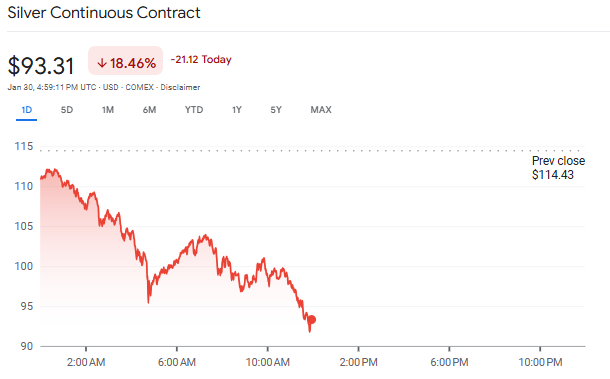
Data shows that in January alone, silver surged about 39% before suffering a sharp correction. Even with the pullback, the MOVE has been historic: silver climbed roughly 158% from an October 28 low near $45.51 to a late-January peak above $117, driven in part by concerns around China’s export licensing and global supply constraints.
Additionally, COMEX silver inventories falling from about 532 million ounces in early October to roughly 418 million ounces, a drawdown of 114 million ounces, evidenced the narrative that the rally has been supported by real supply dynamics rather than purely speculative flows.

Volatility patterns also flipped, as in December, silver’s realized volatility ROSE into the mid-50% range, exceeding bitcoin’s, which compressed into the mid-40s as crypto markets entered a post-leverage unwind phase.
Market participants point to fundamentally different drivers with silver’s rally, which has been anchored in physical supply tightness and industrial demand.
The metal has been operating at a structural supply deficit over the past few years, with the output of the mining sector failing to match the consumption.
Approximately half of the demand for silver is in industrial applications, such as solar panels, electric vehicles, and data centers, which keep growing at a very rapid pace.
That backdrop has turned silver into what traders increasingly describe as a shortage story.
Even this week’s sharp correction followed a parabolic advance, with profit-taking and higher margin requirements triggering abrupt sell-offs rather than a shift in longer-term demand trends.
Bitcoin Slips as Macro Fears and Tight Liquidity Hit Risk Appetite
Bitcoin’s decline, meanwhile, has been closely tied to macro and liquidity conditions.
Analysts have linked the latest leg lower to fears of a tighter U.S. policy environment, including speculation that a more hawkish Federal Reserve leadership could keep interest rates higher for longer and maintain balance sheet restraint.
Those concerns have weighed on risk assets broadly, from equities to crypto, reducing appetite for Leveraged exposure.
 Bitcoin has slipped below $89,000 as a hawkish-leaning Federal Reserve and Middle East tensions sap risk appetite.#Bitcoin #Cryptohttps://t.co/4mmQhy93nE
Analysts have pointed to a tech-led selloff on Thursday, and also global markets weakened after Microsoft shares fell sharply following announcements related to artificial intelligence investment, leading to a drop in Bitcoin’s price.
Crypto markets dropped alongside equities, with total market capitalization falling by roughly $200 billion in a single session.
Liquidations exceeded $1 billion over 24 hours, with bitcoin longs accounting for a major share.
CryptoQuant analysts noted that even a relatively modest pullback in Bitcoin compared with metals was enough to trigger nearly $300 million in long liquidations within hours.
The contrast has reframed how investors are viewing the two assets, with analysts noting silver is behaving like a commodity under physical stress, amplified by speculative momentum.
Bitcoin, despite its “digital gold” narrative, is trading more like a macro beta asset, rising and falling with liquidity expectations, ETF flows, and policy signs.
