UK Crypto Ownership Explodes: New Report Reveals Shocking Trends for 2026

Forget the quiet accumulation—Britain's digital asset landscape just detonated.
The Mainstream Stampede
New data cuts through the noise, revealing a seismic shift in who's holding crypto across the UK. It's no longer just the tech-savvy early adopters; a fresh wave of participants is bypassing traditional gatekeepers entirely. The profile of the average investor is morphing before our eyes.
Portfolios Get a 2026 Makeover
Asset allocation trends are flipping the script. While Bitcoin remains the cornerstone, diversification strategies are becoming more sophisticated—and more aggressive. The hunt for yield and utility is pushing portfolios into uncharted territory, leaving old-school 60/40 stock-bond splits looking as relevant as a fax machine.
Regulation: The New Catalyst
Clearer rules from the FSA aren't stifling growth; they're fueling it. The regulatory fog is lifting, giving both institutions and everyday Brits the confidence to dive in. It turns out people like knowing their assets won't vanish into a digital black hole—who knew?
The Bottom Line
This isn't a niche trend anymore. It's a fundamental rewiring of personal finance. The UK is building a parallel, decentralized financial system right under the noses of high-street banks, whose biggest innovation this decade was a slightly better mobile app. The genie isn't just out of the bottle—it's shorting the bottle's stock.
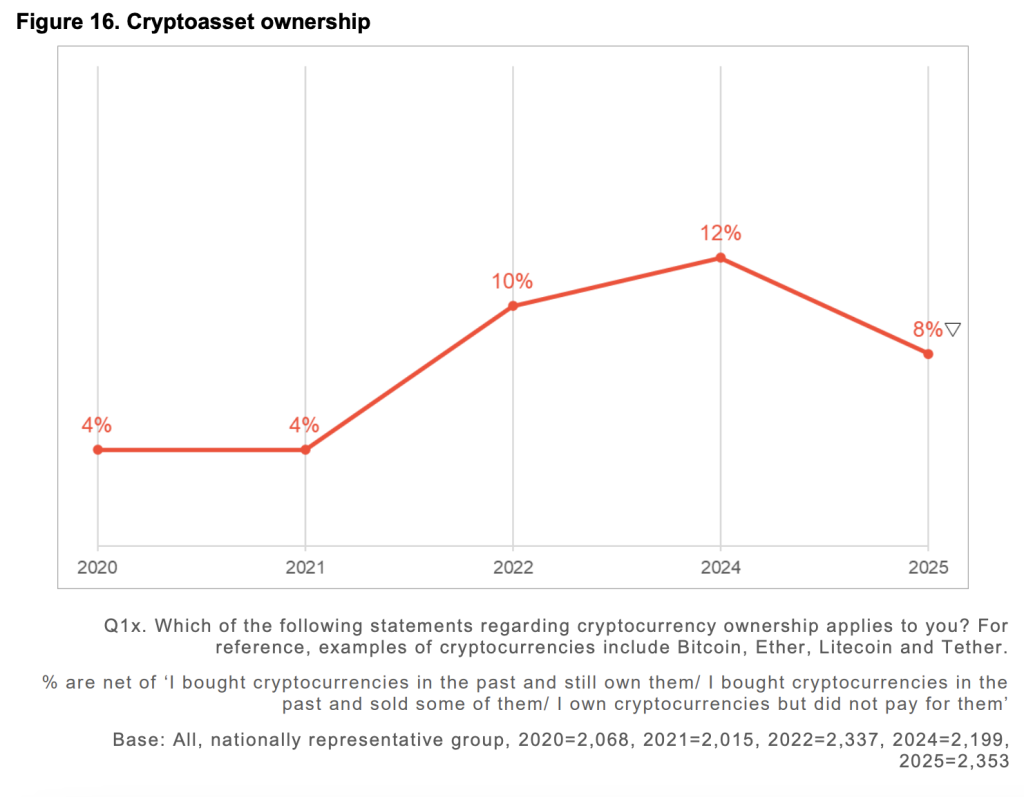
Although this might seem like a death knell for crypto on the face of it, there’s a lot of nuance when you delve into the numbers. For one, the FCA notes that ownership has still doubled since 2021.
And here’s another factoid: among the investors who have kept on HODLing, many are now adding to their positions. The number of Britons with £1,001 to £5,000 in their wallet has jumped from 17% to 21%, while those with balances between £5,001 and £10,000 are up three percentage points to 11%.
A slowdown in adoption reflects one of the dominant themes of the current cycle: an absence of retail involvement. Recent price rises have been spurred on by institutional interest and purchases of Bitcoin ETFs, rather than everyday consumers opening accounts on exchanges.
However, the FCA believes Britons who are dabbling in digital assets are far more savvy and informed about the potential dangers.
“Those participating in these activities tend to be more knowledgeable, more comfortable with risk, and more aware of our warnings than the average crypto user.”
Typically, investors are more likely to be men, between the ages of 18 and 34, from an ethnic minority background and belong to the ABC1 demographic — which usually denotes those with higher levels of disposable income.

Bitcoin’s Dominance Grows
Unsurprisingly given it’s the world’s biggest cryptocurrency, Bitcoin has the most brand recognition among Britons who took part in the Financial Conduct Authority’s survey at 79%.
However, just 57% of current investors actually own BTC as of 2025. This figure has been growing gradually over recent years — up five percentage points compared with 2024, but far below the 64% seen back in 2021. We’ve also seen Bitcoin’s dominance, relating to its overall share of the crypto market, creep up over this four-year period.
Ownership of Ether has remained pretty constant at 43%, a figure no doubt boosted by this digital asset’s outperformance in the run-up to when this survey was taken. And despite the fact that it’s currently languishing behind in 9th place in CoinMarketCap’s rankings, Dogecoin appears in 20% of British crypto investor portfolios.
Low levels of recognition of altcoins among the British public is particularly telling. Just 8% of those polled said they had heard of Solana and XRP, falling to 7% for chainlink and TRON, and 5% for the likes of BNB and Cardano. This powerfully illustrates how difficult it can be for newer digital assets to cut through the noise and gain meaningful market share.
Regulation, and crypto companies encouraging consumers to embrace digital assets pegged to fiat currencies as a payment method, helps explain why awareness surrounding stablecoins continues to rise — hitting 53%.
Why Are People Buying Crypto?
It’s also interesting to look at the motivations of those dabbling in digital assets — with those who have a household income of £50,000 or more saying their main ambition is to diversify their portfolio. Fascinatingly, those who have the highest annual earnings (that’s above £100,000) say they are buying cryptocurrencies in order to save for their retirement. This is despite regulatory warnings about their volatility.
So… what about those who are still sitting on the fence? The vast majority of those who aren’t planning to buy cryptocurrencies say it’s because they don’t know enough about how they work. Meanwhile, 17% believe they’re too risky because of price volatility — and 12% have correctly identified that there are few protections if something goes wrong. A further 11% argue the amount of money they have to spend isn’t enough to make the investment worthwhile.
The Financial Conduct Authority may have a cool attitude towards digital assets, but research like this offers a compelling insight into the health of the crypto sector.
