SEC & CFTC Chairs Break Silence: “Sensible Crypto Rules” Coming – Here’s What Changes

Regulatory ice thaws as top U.S. watchdogs signal a pivot—finally.
The long-awaited détente between crypto innovators and Washington's gatekeepers just got real. SEC Chair Gary Gensler and CFTC Chair Rostin Behnam, often at odds, now project rare alignment. Their message? A framework acknowledging digital assets as more than just speculative toys is imminent.
What's Actually Shifting
Forget the old binary—security or commodity? The new playbook introduces nuance. Expect clearer on-ramps for token offerings, redefined custody requirements that don't strangle innovation, and perhaps most critically, a taxonomy that distinguishes between a decentralized protocol and a centralized exchange wearing a DeFi mask.
Market Structure Gets a Rewrite
The changes target the plumbing. Trading venues face new transparency mandates, while stablecoin issuers brace for reserve audits that would make a traditional banker blush. The goal: protect consumers without suffocating the tech—a balance that's eluded regulators for a decade.
The Fine Print & The Fight Ahead
Don't expect a free pass. The "sensible" rules will still demand compliance, just of a kind that doesn't require a team of 100 lawyers to interpret. Jurisdictional turf wars between the SEC and CFTC aren't vanishing overnight, but the path for compliant growth is being paved. Of course, Wall Street veterans will watch, muttering about how it took a trillion-dollar asset class to get regulators to move faster than a dial-up connection.
This isn't a surrender; it's an evolution. The agencies are adapting, pressured by global competition and undeniable market maturity. The era of "come in and register" as the only option is closing. A new one, built on defined rules rather than enforcement threats, is beginning. The market's response will be the ultimate test—will clarity unleash the next wave of institutional capital, or will the rules simply create new, more sophisticated loopholes? Place your bets.
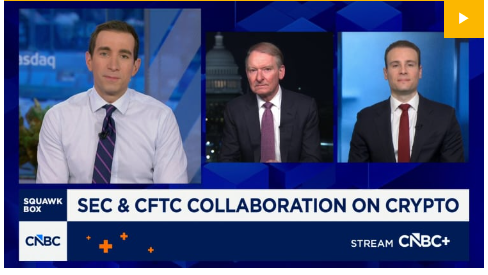 Source: CNBC
Their remarks coincide with Congress getting closer to enacting legislation that will help clarify whether a specific agency regulates various aspects of the digital asset market.
Atkins Emphasizes Narrow SEC Focus as Senate Hashes Out Crypto Rules
Atkins had admitted that the bill is at a sensitive stage. Following the approval of the House, the Senate is now debating it in both the Agriculture Committee and the Senate Banking Committee as lawmakers are trying to solve conflicting priorities in the policy.
 This week’s regulatory developments highlight a familiar reality in Washington: everyone agrees crypto needs rules — but there’s still no consensus.#Crypto #Regulations https://t.co/ug31wuHAPc
He explained that the regulators no longer head the debate but rather assist legislators in a technical manner. Although the disagreements continue, the SEC has been collaborating with the two committees to help lawmakers develop a workable policy.
One of the areas of conflict is the intersection of crypto activity and traditional banking, specifically in the context of stablecoins, deposits, and yield-generating products.
Such a discussion has only stepped up over the past few months when Coinbase has made a more aggressive MOVE into payments and financial services, attracting opposition from banks and even certain policymakers.
 Coinbase CEO @brian_armstrong said the exchange cannot support the Senate’s crypto bill as written, warning it WOULD hurt tokenized equities, DeFi and privacy while weakening the CFTC.#Coinbase #CryptoPolicy https://t.co/kMbxepaWYk
Atkins noted that stablecoins, in themselves, are not of much immediate concern to the SEC, since they had already been directly addressed in congressional action.
He emphasized that the SEC’s primary concern remains securities-related activity, including tokenized securities, and said the agency is prepared to operate within whatever boundaries Congress ultimately sets.
Selig Frames Crypto Legislation as a Reset for CFTC Authority
Selig echoed that position, noting that stablecoins and yield products do not fall squarely within the CFTC’s remit either.
He said the proposed legislation is more important for what it would do elsewhere, particularly by expanding the CFTC’s authority over crypto spot markets.
Senate introduces new crypto market Structure Bill draft to expand @CFTC authority over digital commodities like $BTC and $ETH.
#ClarityAct #CFTChttps://t.co/qKO9rR7aYs
While the agency already has broad powers to pursue fraud and market manipulation involving commodities, Selig said the bill would allow the CFTC to move beyond enforcement and establish a formal regulatory framework for spot trading in digital assets.
The remarks reflected a major shift in tone between the two agencies, which have spent years in jurisdictional disputes over crypto oversight.
Atkins dismissed speculation about a potential merger, describing the SEC and CFTC as historically separate institutions.
He said the real problem has been the undefined space between them, where uncertainty over authority has stalled product development and driven companies offshore.
U.S. Crypto Regulators Hint at Reset After Years of Turf Wars
Atkins also addressed concerns raised by Senator Elizabeth Warren and other critics about crypto exposure in retirement accounts.
He said many Americans already have indirect exposure through professionally managed pension funds and that discussions around expanding access to crypto in retirement plans are focused on proceeding carefully, with protections in place for retirees.
To end the interview, Selig described the broader effort as an opportunity to reverse a decade-long trend that pushed crypto innovation offshore.
The comments come as lawmakers begin a key markup session on Thursday morning on the Senate Agriculture Committee’s portion of the crypto market structure bill.
The outcome of the markup is expected to offer an early indication of how much bipartisan support the legislation retains as it advances.
Later today, Atkins and Selig are scheduled to appear together at CFTC headquarters for a public event on regulatory harmonization, rescheduled from earlier this week.
