Massive US Storm Forces Bitcoin Miners Offline – What Does That Mean for Bitcoin Holders?

Extreme weather knocks out mining hubs—hash rate plunges as rigs go dark.
The Halving Pressure Cooker
Miners face a brutal squeeze. Power grids buckle under winter storms, forcing operations offline just as the next Bitcoin halving looms. Reward cuts hit profitability—surviving miners need higher prices or they'll bleed out. It's a classic crypto stress test: centralized infrastructure meets decentralized protocol.
Supply Shock Brewing
Fewer coins minted daily means less sell pressure from miners covering operational costs. Historically, hash rate drops precede supply crunches—then price rallies follow. This isn't magic; it's basic economics. Reduced new supply against steady or growing demand creates upward pressure. Traders watch the miner outflow metric like hawks.
Network Security in the Balance
Temporary hash rate drops don't break Bitcoin—difficulty adjusts automatically. But prolonged outages could slow transaction confirmations. The network self-heals, though. Miners will fire back up when power returns, chasing those now-more-valuable blocks. Decentralization proves its worth again: no single storm can kill the chain.
Holder Windfall or False Dawn?
Short-term, reduced selling from miners could lift prices. Long-term, the halving's structural scarcity dominates. Storms pass; Bitcoin's code doesn't. This is just another volatility blip in the march toward digital gold—unless you're the miner who didn't hedge his energy contracts. Always hedge, folks. Wall Street would've charged a fortune for that lesson.
 https://t.co/e51LyWoxjs pic.twitter.com/uIrCD5JudD
— TheMinerMag (@TheMinerMag_) January 25, 2026
https://t.co/e51LyWoxjs pic.twitter.com/uIrCD5JudD
— TheMinerMag (@TheMinerMag_) January 25, 2026
Grid Operators Report Stability Despite Extreme Cold
The hashrate pullback coincided with a severe Arctic air mass pushing subfreezing temperatures, snow, and ice deep into the central and eastern United States.
Grid operators across multiple states issued conservation alerts as heating demand surged, yet Texas’s grid operator ERCOT reported on Friday that conditions remained stable despite the cold weather.
The stability contrasts sharply with February 2021, when Winter Storm Uri triggered widespread outages and prolonged blackouts across the state.
Since that crisis, Texas has added substantial large-load capacity, much of it tied to bitcoin mining and data center operations.
Unlike traditional industrial loads, many Bitcoin miners participate in demand response programs, allowing them to rapidly curtail consumption during periods of grid stress.
As noted by The Miner Mag, this flexible-load model represents a dynamic shift from the 2021 scenario, when such infrastructure did not exist to support grid balancing during extreme weather events.
 The U.S. #AI compute boom is running into a familiar problem.
Local communities aren’t buying it.
If this sounds familiar to #bitcoin miners, that’s because it is.
Singapore-based miner Bitdeer, which operates over 293,000 rigs globally, including facilities in Texas, said in a statement that it does not anticipate major disruptions from the storm.
A company spokesperson explained that the Electric Reliability Council of Texas considers Bitcoin miners “,” meaning they can curtail electricity usage on request, unlike other industrial users with firm electrical demands.
“Bitdeer stands ready to fully support the grid should supply constraints occur,” the spokesperson added.
The curtailments come as Bitcoin’s seven-day average network hashrate had already declined to about 992 EH/s, down roughly 13.7% from the all-time high of above 1.15 ZH/s reached in October, according to data reported by The Miner Mag last week.
The moderation follows Bitcoin’s market price falling nearly 30% from its October peak, prolonging pressure on mining economics by keeping competition for block rewards elevated even as revenues per unit of computing power fell.
Storm Threatens 60 Million People Across 1,800 Miles
The massive winter storm extends for 1,800 miles from far west Texas to the mid-Atlantic coast, threatening to affect upwards of 60 million people across more than a dozen states, according to AccuWeather.
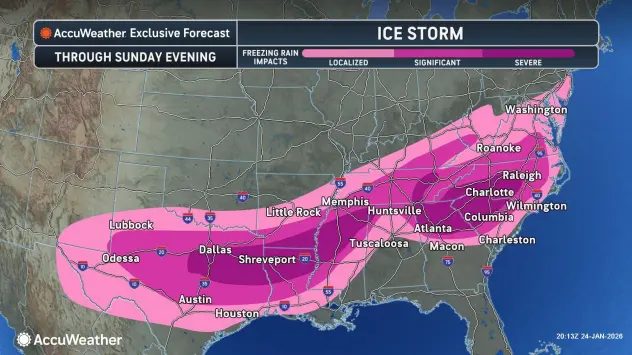
AccuWeather Senior Vice President Evan Myers warned that the combination of snow, ice, and bitter cold across such a large area WOULD “stall daily life for days,” with some power outages lasting through extended periods as Arctic air charges in behind the storm.
About 60 million people will experience icing conditions, with potentially 1 million people without power for an extended period, AccuWeather estimated.
AccuWeather Chief Meteorologist Jon Porter noted that many areas hit hard by Hurricane Helene in September 2024 still have temporary power lines that “may come down more easily than permanent lines,” potentially stretching recovery resources and personnel to the limit across North Carolina and other affected states.
The storm’s intensity has already prompted thousands of flight cancellations across the region as airlines deal with displaced aircraft and crews.

AccuWeather Storm Warning Meteorologist William Clark cautioned that “entire supply chains may break down from prolonged days of extensive interstate closures,” warning that critical supplies, including pharmaceuticals and basic necessities, may become scarce in the hardest-hit areas.
The United States controls nearly 38% of the global Bitcoin hashrate according to estimates from Hashrate Index, making American mining operations critical to network security.
