Binance’s Bold Comeback: Stock Trading Returns After 4-Year Hiatus

Binance is flipping the script—again. The crypto behemoth is dusting off its stock trading desk, a feature it shelved four years ago. This isn't just a re-release; it's a strategic power move into traditional finance's backyard.
The Full-Circle Play
Remember when crypto and stocks lived on different planets? Binance is bulldozing that wall. By bringing fractional shares of giants like Tesla and Apple onto its platform, it's betting that its 150 million-plus users want one-stop financial shopping. Why hop between apps when you can trade crypto, meme stocks, and blue-chips in the same window?
Why Now? The Regulatory Chessboard
Timing is everything. After navigating a global regulatory gauntlet—settling with watchdogs and tightening compliance—Binance has cleared enough runway. Reintroducing stocks now signals stability and ambition. It’s a message to users and regulators alike: We're not just a crypto exchange anymore; we're a financial hub.
The User Experience Edge
Forget clunky legacy interfaces. Binance will likely bake stock trading into its slick, mobile-first platform. Expect real-time charts, instant settlements (powered by crypto rails), and maybe even loyalty perks for BNB holders. The goal? Make buying a slice of Amazon as easy as swapping Solana.
A Cynical Nod to Tradition
Let's be real—the old-guard brokerages still charge fees for the 'privilege' of slow trades and 1998-era UI. Binance's move pressures that model. It's a jab at finance's sacred cows, wrapped in a user-friendly package. Because nothing says disruption like letting someone YOLO their Bitcoin profits into Nasdaq futures before their coffee gets cold.
The Bottom Line
This isn't a side project. It's a direct assault on the silos separating asset classes. If Binance pulls it off, the line between 'crypto exchange' and 'global marketplace' vanishes. Four years ago, they stepped back. Today, they're leaping forward—and daring everyone else to keep up.
Exchanges Race to Build Unified Platforms
Binance’s potential return to stock trading comes as multiple crypto platforms accelerate efforts to merge digital assets with conventional financial products.
Coinbase CEO Brian Armstrong defended his company’s push into equities in a recent Fortune interview, arguing the exchange is positioned to lead as financial assets migrate to blockchain infrastructure.
“We have deep crypto expertise. We have the most trusted brand in crypto,” Armstrong said, adding that Coinbase aims to bridge traditional finance and crypto while advancing tokenized equities.
The exchange currently offers stocks through Apex Fintech Solutions with plans to expand access to all customers in the coming weeks, though fully tokenized equities remain years away pending SEC coordination.
Austria’s Bitpanda also announced Wednesday it will launch a unified investing platform on January 29, bringing stocks, ETFs, crypto, and precious metals together under one app.
The expanded platform will offer more than 10,000 stocks and ETFs at a flat €1 trading fee with zero custody fees and no payment for order flow.
Infrastructure Moves Toward On-Chain Markets
Traditional market operators are also simultaneously advancing blockchain-based trading systems.
Earlier this week, the New York Stock Exchange unveiled plans to develop a platform for 24/7 trading and on-chain settlement of tokenized securities, combining its Pillar matching engine with blockchain-based post-trade systems across multiple blockchains.
“For more than two centuries, the NYSE has transformed the way markets operate,” said Lynn Martin, President of NYSE Group.
She said the exchange is now leading the industry toward fully on-chain solutions that combine trust, regulatory rigor, and modern technology.
Yesterday, January 22, Binance founder Changpeng “” Zhao also told a World Economic Forum panel in Davos that he is negotiating with over a dozen governments to tokenize state-owned assets as the next major step in crypto adoption.
 Binance’s @cz_binance confirms talks with governments to tokenize national assets on-chain, calling it the next phase after exchanges and stablecoins. #Crypto #Tokenizationhttps://t.co/1mv1mt5WwR
Zhao positioned tokenization as the third stage following exchanges and stablecoins, explaining that governments want to directly capture financial upside from their own assets rather than outsourcing value creation to private intermediaries.
Regulatory Clarity Fuels Institutional Momentum
Last month, the Securities and Exchange Commission (SEC) issued a rare no-action letter to the Depository Trust and Clearing Corporation, allowing it to proceed with a controlled tokenization program covering U.S. Treasuries, ETFs, and Russell 1000 equities.
The service is scheduled to launch in late 2026 and will operate on approved blockchains with tokenized assets carrying the same legal rights as traditional securities.
Market data and institutional research suggest this regulatory momentum is already translating into measurable growth.
Earlier this month, venture capital firm Andreessen Horowitz identified stablecoins,, and privacy infrastructure as key forces shaping crypto in 2026.
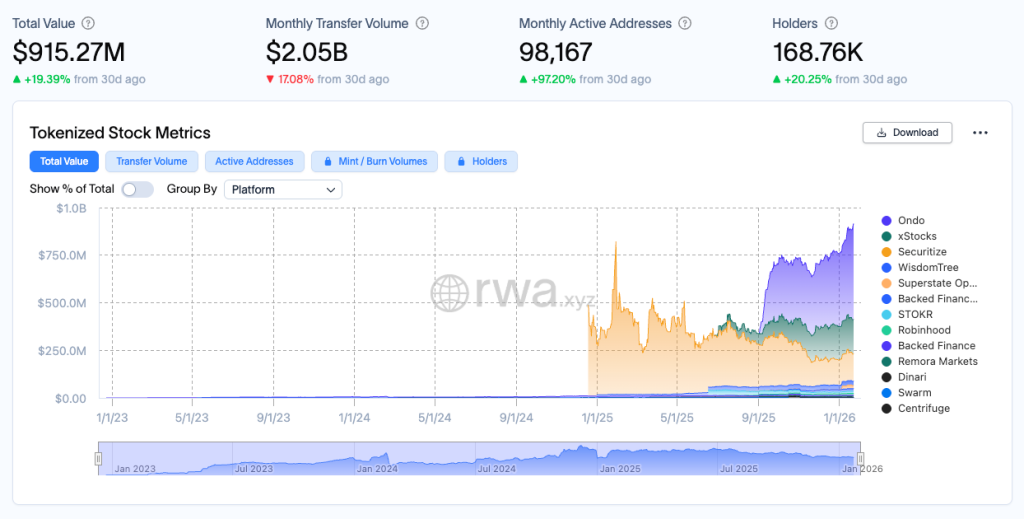
These assertions come as monthly transfer volumes for tokenized equities are down roughly 17% over 30 days to about $2.05 billion, according to rwa.xyz.
However, the number of Monthly Active Addresses is up nearly 98%, with over 98,167 addresses active in the past month alone.
David Duong, Coinbase’s head of investment research, also recently said regulatory clarity improvements and deepening institutional participation are creating favorable conditions ahead.
“We expect these forces to compound in 2026 as ETF approval timelines compress, stablecoins take a larger role in delivery-vs-payment structures, andcollateral is recognized more broadly,” Duong wrote in a year-end outlook.
Meanwhile, Binance confirmed today that it submitted a Markets in Crypto-Assets license application in Greece as crypto firms across Europe rush to secure regulatory approval before June 2026 transitional deadlines expire.
