Crypto Fundamentals Shattered Records in Q4 2025 While Prices Stubbornly Lagged Behind

Crypto's underlying engine roared in late 2025, but the dashboard needle barely flickered.
The Great Divergence
Network activity, developer commits, and total value locked hit all-time highs. The metrics that true believers watch—the ones that scream 'adoption'—went parabolic. Yet, the price charts told a different, frustratingly flat story. It was a quarter where the fundamentals screamed bull market, but the market itself just shrugged.
Building in the Quiet
While traders checked prices and sighed, builders kept their heads down. Layer-2 scaling solutions processed transactions at a blistering pace. Decentralized finance protocols saw user growth that would make a traditional bank CEO blush—if they understood it. The infrastructure for the next cycle wasn't just being planned; it was being deployed at record speed, funded by the very capital that seemed bored with the current show.
The Price Puzzle
So why the disconnect? Some point to macro headwinds—the old-world finance ghosts of inflation and rate hikes that still spook the digital alley. Others see it as a classic accumulation phase, where smart money loads up before the herd arrives, a necessary pause that separates a sustainable rally from a fleeting pump. It's the market's way of separating the patient builders from the impatient speculators, a process as old as finance itself—though now with more memes.
The takeaway? The foundations have never been stronger, even if the facade looks unchanged. When the lagging indicator of price finally catches up to the reality on-chain, the move could be violent. Until then, it's a masterclass in why 'number go up' is a terrible investment thesis, but watching the number not go up while everything else does might just be the most bullish signal of all.
Stablecoin Flows Tell a Different Story
The stablecoin market crossed $300 billion in October 2025. Daily average transaction volume reached $3.1 trillion, according to an October 2025 Arkham Research report.
TRON exemplifies the usage-price disconnect. The network ended 2025 with over $81 billion in stablecoin supply, with USDT accounting for 99% of that figure. Messari data show average daily USDT transfer volume hit $23.8 billion by Q4. TRON processed approximately $6-7 trillion in stablecoin transactions annually, commanding 65% of global retail USDT transfers under $1,000.
Network revenue tells the same story. tron achieved $1.2 billion in Q3 2025 revenue, an all-time high. Yet TRX spent much of 2025 consolidating around $0.28.
DeFi Outpacing Centralized Venues
Decentralized exchange volume has structurally outpaced centralized competitors. CoinDesk data from August 2025 showed daily DEX volume at $12.8 billion versus Coinbase’s $3.5 billion. Uniswap alone processes between $1-2 billion daily across supported chains, commanding a 55% DEX market share.
Uniswap v4 achieved $1 billion TVL within 177 days of launch. The protocol generated over $985 million in fees year-to-date through October 2025. Coinbase responded by integrating DEX trading directly into its app, routing orders through aggregators like 0x and 1INCH to access Uniswap liquidity.
The Q1 2023 Parallel
Bitwise’s analysis draws a direct comparison to Q1 2023, when similar conditions preceded a two-year bull run. That quarter saw blockchain revenues climb 139% quarter-over-quarter while Ethereum transactions hit all-time highs.
The current setup mirrors that period: falling prices, improving fundamentals, and capital quietly accumulating through stablecoin rails.
Current Market Snapshot
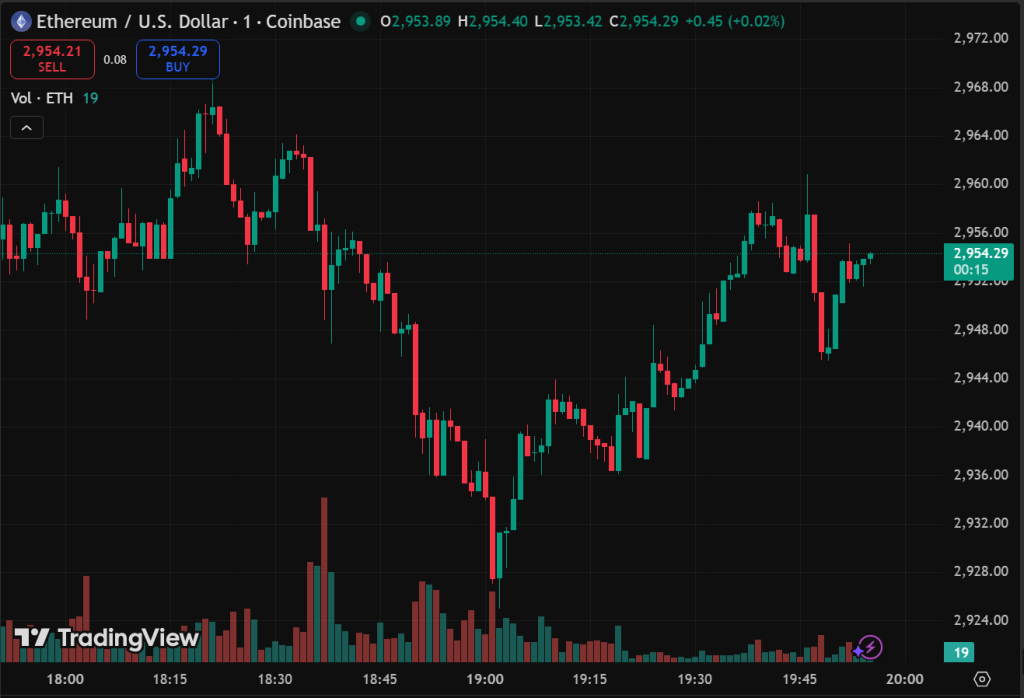
ETH is currently trading at $2,954.29, consolidating NEAR its 200-day EMA around $3,200-$3,300. The asset sits 39% below its all-time high of $4,946.
Hougan’s thesis hinges on three checkpoints for a rally in 2026, with one already achieved. The structural case rests on staking locking roughly 30% of the ETH supply, fee burns reducing issuance, and LAYER 2 expansion sustaining network activity.
For traders weighing the data against the price action, the question is timing. Fundamental strength without price follow-through can persist for quarters. But when adoption curves accelerate while valuations compress, the gap eventually closes. The direction of that convergence is what 2026 will determine.
