Ethereum vs Bitcoin 2026: Can ETH Finally Flip BTC? Experts Bet on Upside

Forget the flippening chatter of years past—2026 is shaping up as Ethereum's make-or-break moment against Bitcoin's throne.
The Layer-1 Heavyweight Bout
Ethereum's roadmap isn't just about upgrades; it's a full-scale assault on scalability. Each protocol enhancement cuts transaction costs and bypasses legacy bottlenecks, directly challenging Bitcoin's store-of-value narrative with a utility-first play.
Institutional Winds Shifting
Smart contracts aren't a niche feature anymore—they're the backbone of decentralized finance. That real-world utility creates a gravitational pull for capital that pure digital gold can't match, no matter how shiny.
The Valuation Game
Experts point to Ethereum's active developer ecosystem and burning tokenomics as latent rockets. The network's ability to generate its own economic activity—rather than just sitting in a vault—gives it a growth multiplier that traditional finance models still struggle to price. (Wall Street's still trying to value a network that pays its users, bless them.)
The Verdict
Beating Bitcoin isn't just about price parity; it's about proving a blockchain can be both a settlement layer and a global computer. Ethereum's 2026 campaign rests on executing that vision while Bitcoin guards its kingdom. One thing's certain: the crypto landscape won't be the same by 2027.
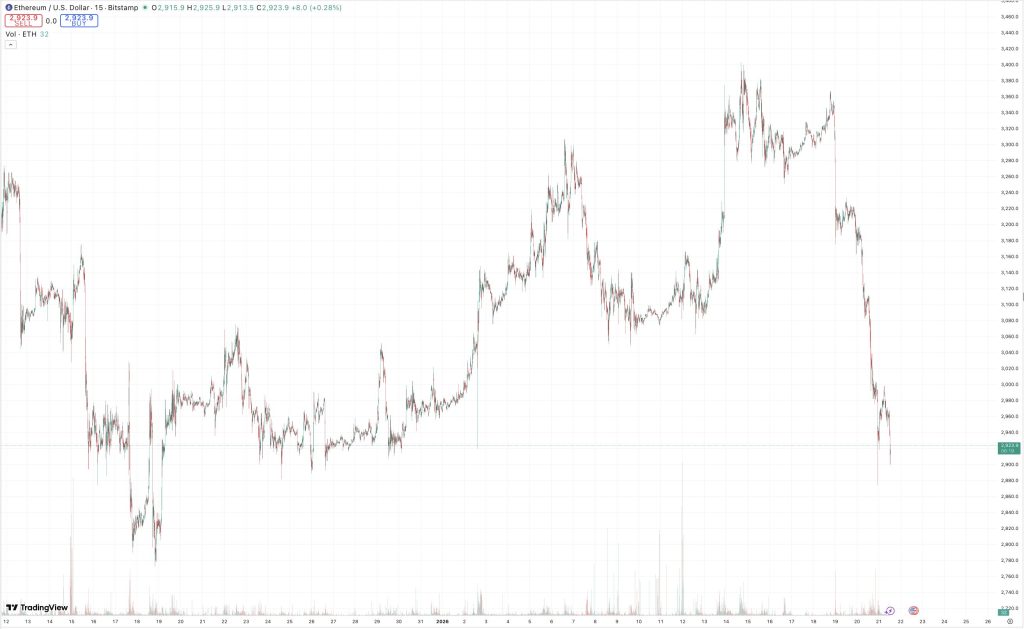 Source: TradingView
Still, discussions have not gone away. Some market participants continue to argue that Ethereum could outperform bitcoin in 2026. To understand why, Cryptonews spoke with industry experts.
What Would It Take for Ethereum Price to Reach $5,000?
Ethereum’s recent price action has reopened a familiar debate: is the market still willing to price in long-term narratives? Short-term momentum has clearly faded. Yet some institutional investors believe the gap between Ethereum’s price and its role in the ecosystem remains unresolved.
,, told Cryptonews that current market conditions may be masking how Ethereum could be positioned over a longer horizon, especially as institutional participation continues to evolve:
By 2026, Ethereum is also likely to consolidate its role as the default institutional settlement layer, maintaining leadership in Total Value Locked and reinforcing its position as the Core infrastructure of decentralized finance.
At the same time, Perez cautions that ethereum price struggles are not driven by sentiment alone. In his view, the network is facing internal trade-offs that have become harder to ignore as it matures, particularly around how value is captured at the protocol level:
A key challenge remains ensuring that ETH sustains dual demand: both as a monetary asset and as a productive financial asset used extensively within DeFi protocols.
Recent protocol changes have also complicated Ethereum price dynamics. Lower fees improved usability, but they also changed how investors assess Ethereum’s economic model:
Much of the recent downward pressure on ETH can be traced back to the Dencun upgrade, which dramatically reduced transaction costs and, as a result, temporarily weakened Ethereum’s revenue dynamics and perceived demand for blockspace.
Looking beyond short-term adjustments, Perez argues that Ethereum still lacks a clearly articulated framework for long-term economic resilience. This uncertainty continues to weigh on investor confidence during volatile periods:
More structurally, Ethereum currently lacks a clearly defined objective around financial sustainability at the protocol level.
For Ethereum to recover meaningfully, Perez says, the focus must go beyond individual upgrades. What matters more is whether the network can resolve these deeper tensions.
“If Ethereum succeeds in aligning scalability, economic sustainability, and asset-level demand, the case for prices above $5,000 in 2026 becomes compelling,” Perez said. “Failure to do so WOULD leave the asset exposed to continued volatility and underperformance relative to its strategic relevance.”
Why Ethereum Still Appeals to Institutions
One of Ethereum’s strongest advantages remains its reputation. Over the years, the protocol has established itself as stable and secure. That track record has turned it into the backbone of much of the crypto industry.
As stablecoins and real-world asset (RWA) projects continue to grow, Ethereum’s position is likely to strengthen further.
,, explained to Cryptonews why this matters to institutional players:
Despite that profitability crunch, the big players (BlackRock, stablecoin issuers) aren’t looking for the ‘shiny new thing.’ They want an institutional bedrock. They need battle-hardened finality, not just speed. To a bank, a chain that is faster but risks downtime is a non-starter.
According to Knorr, this is why RWAs and stablecoins continue to rely on Ethereum:
That’s why real-world assets and stablecoins are staying put on Ethereum. They are paying for security, not throughput.
The problem, however, is familiar. Ethereum price has failed to reflect the strength of its ecosystem for years.
If Bitcoin continues to weaken, investors may start rotating into other assets. Ethereum could benefit from that shift. This is not guaranteed, though. A sharp Bitcoin decline would likely drag ETH lower as well.
The pattern has already played out this month. When Bitcoin recovered slowly in early January, Ethereum showed relative strength. As soon as BTC moved back into a correction, ETH fell harder.
For now, Ethereum remains caught between long-term institutional appeal and short-term market pressure. Whether it can break out of that tension will likely decide if $5,000 is realistic in 2026.
Disclaimer: Crypto is a high-risk asset class. This article is provided for informational purposes and does not constitute investment advice.
