$875 Million Evaporates as Trump’s Europe Tariffs Spark Crypto Market Meltdown

Crypto markets just got a brutal reminder that traditional politics still holds the leash.
The Tariff Trigger
A fresh wave of proposed tariffs from the former president on European goods didn't just rattle stock futures—it sent a shockwave straight through digital asset portfolios. The announcement acted like a sell signal, triggering a cascade of liquidations.
The Liquidation Domino Effect
Leveraged positions crumbled first. As prices dipped, margin calls fired off, forcing automated sells that pushed prices down further. It's the same old story: high leverage meets high volatility, and the market cleans house. Over $875 million in long and short positions got wiped off the board in a matter of hours.
Decoupling Narrative? Not Today.
So much for crypto being a hedge against geopolitical risk. When big, traditional macro moves happen, the correlation between crypto and risk assets often snaps right back into place. It turns out, fear is still a universal currency—traders flee to perceived safety, whether it's the dollar, bonds, or under a mattress.
The Silver Lining Playbook
For the bulls, this is a volatility fire sale. Major corrections have historically been buying opportunities before the next leg up. The underlying tech—decentralized ledgers, smart contracts—hasn't changed. The panic is purely sentiment-driven. Savvy accumulators are watching for the dust to settle and the fear to peak.
The lesson? Crypto's grown up, but it hasn't moved out. It still lives in the global financial house, and when the old man—macro policy—yells, everyone jumps. Just another day where digital gold gets treated like digital brass, proving once again that in finance, the only true 'store of value' is the narrative of the moment.
Derivative Markets Absorb Brunt of Tariff Fallout
Leveraged crypto positions unwound rapidly as the announcement hit markets during US holiday closures, amplifying volatility through thinned liquidity.
CoinGlass data showed that $788 million of the total liquidations came from long positions, while shorts accounted for just $83 million. This heavy but moderate liquidation shows that traders were caught betting on the upside when geopolitical risk materialized.
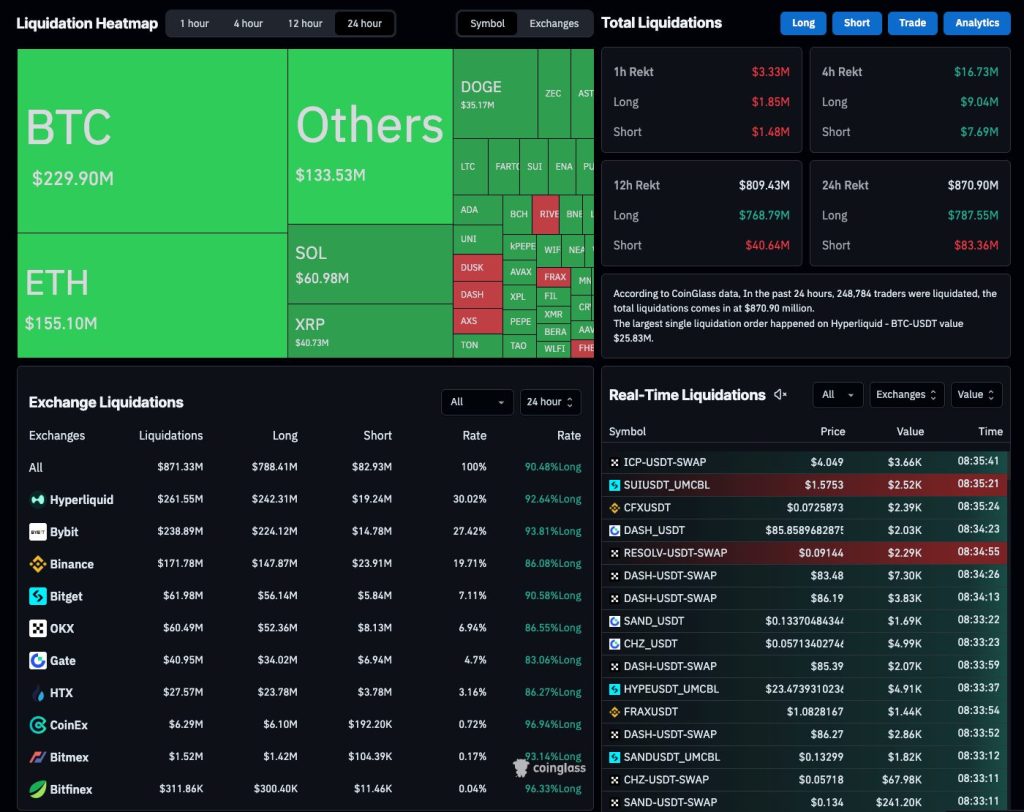
Hyperliquid led exchange liquidations totaled $262 million, followed by Bybit at $239 million and Binance at $172 million, with long positions accounting for over 90% of forced closures across all platforms.
Bitcoin futures open interest, which had recovered 13% from early January lows, is now facing renewed pressure, despite analysts noting that deleveraging could create stronger support for future rallies.
“At present, open interest is showing signs of a gradual recovery, suggesting a slow return of risk appetite,” CryptoQuant analyst Darkfost stated today, though the tariff shock threatens to reverse that momentum.

Beyond crypto, US stock futures fell 0.7% for the S&P 500 and 1% for the Nasdaq, while European equity futures dropped 1.1% amid a risk-off mood spreading across asset classes.
However, Gold surged 1.5% to record highs in the flight to safety, while the dollar weakened 0.3% against the yen.
“The fact that this threat was on social media instead of distilled into an executive order and it has a delayed implementation means a lot of investors might just decide to wait things out before overreacting,” said Brian Jacobsen, chief economic strategist at Annex Wealth Management, suggesting volatility may ease once markets digest the announcement.
Retaliatory Measures Threaten Transatlantic Economic Rupture
European leaders unified in condemnation despite political divisions, with UK Prime Minister Keir Starmer calling tariffs on allies “” while Sweden’s Prime Minister Ulf Kristersson stated bluntly, “We will not let ourselves be blackmailed.”
Spain’s Prime Minister Pedro Sanchez also warned that a US invasion of Greenland “would make Putin the happiest man on earth” by legitimizing Russia’s Ukraine invasion and spelling “the death knell for Nato.”
EU foreign policy chief Kaja Kallas echoed this, noting “China and Russia must be having a field day” as they “benefit from divisions among Allies.“
The European Parliament moved swiftly to halt ratification of the EU-US trade deal negotiated last July, with German MEP Manfred Weber declaring, “The 0% tariffs on US products must be put on hold.“
The EPP is in favour of the EU–U.S. trade deal, but given Donald Trump’s threats regarding Greenland, approval is not possible at this stage. The 0% tariffs on U.S. products must be put on hold. #EuropeanUnity
— Manfred Weber (@ManfredWeber) January 17, 2026That agreement, which eliminated tariffs on many US goods while accepting 15% duties on EU products and 50% on steel, had been criticized as skewed in America’s favor but was defended as providing stability.
Meanwhile, the EU is prepared to reactivate €93 billion in retaliatory tariffs previously delayed under last summer’s trade truce, while France pushed to trigger the anti-coercion instrument that could suspend US investment protections and restrict service trade access.
Deutsche Bank warned that the deeper market risk lies beyond tariffs themselves.
“It is a weaponization of capital rather than trade flows that WOULD by far be the most disruptive to markets,” wrote George Saravelos, the bank’s global head of FX research, noting European investors hold roughly $8 trillion in US bonds and equities that could shift if tensions escalate.
Goldman Sachs estimated that the 10% tariff would drag European earnings-per-share growth by 2 to 3 percentage points, while ING’s Carsten Brzeski projected the levies would shave a quarter of a percentage point off European GDP this year.
