Canaan’s 180-Day Nasdaq Countdown: Can the Bitcoin Miner Dodge Delisting?

Nasdaq just handed Canaan a six-month ultimatum.
The clock is ticking for one of Bitcoin's original hardware giants. Failure to get its share price back above the $1 minimum listing requirement means getting booted from the prestigious exchange—a move that would crater liquidity and investor confidence.
The Survival Equation
It's a brutal math problem. Canaan's fate now hinges on a volatile Bitcoin price, relentless mining competition, and its own operational efficiency. The company must engineer a turnaround while the market watches every hourly hash rate.
The Broader Signal
Canaan's struggle isn't happening in a vacuum. It's a stress test for public crypto miners everywhere, proving that a stock ticker doesn't magically insulate you from crypto's raw fundamentals. Sometimes, the public markets are just a more expensive venue to fail.
The next 180 days will reveal if this industry pioneer can mine its way out of a regulatory pit—or if it becomes a cautionary tale for the next batch of crypto companies dreaming of a Nasdaq plaque. After all, on Wall Street, they stop trading your stock long before they stop writing the analyst reports.
 Source: Canaan
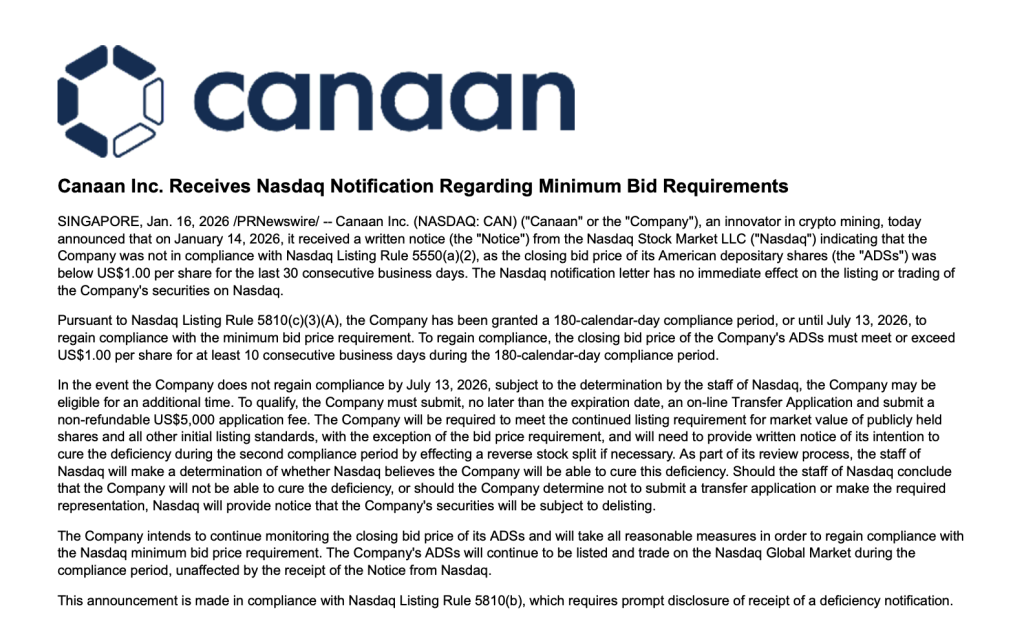
As Canaan stated, the notice has no immediate effect on the listing or trading of its American depositary shares that will remain listed and traded on the Nasdaq Global Market throughout the compliance period.
Canaan Shares Hover at $0.79 as Delisting Risk Grows
In order to regain compliance, the stock has to close at least 10 consecutive business days at or above $1. Unless that occurs before the end of July, the company can be subject to another grace period, assuming that it satisfies other listing criteria and files a plan, which might include a reverse stock split.
At the time of writing, Canaan shares were changing hands around $0.79, firmly in penny stock territory. The stock has not traded above $5 since 2022 and last closed above $2 in October, according to market data.

While short-term movements have shown occasional rebounds, the broader trend has remained sharply negative, with the stock losing more than half its value over the past year.
This delisting alert follows indications of operational improvement in 2025, with Canaan reporting in October its biggest hardware buy in three years, a contract to purchase 50,000 Avalon A15 Pro mining rigs.
That rally, however, faded quickly, reflecting a pattern investors have seen repeatedly as positive operational news fails to translate into sustained equity strength.
Investor confidence took another hit in December when Streeterville Capital, previously Canaan’s largest institutional holder, exited its entire position.
The sale removed a significant source of support for the stock and reinforced concerns around liquidity, dilution risk, and long-term profitability.
Canaan Grows Fast, but Profitability Remains Elusive
Financially, Canaan still wears its financial burden despite the fact that the revenue skyrocketed in 2025 as a result of not only hardware sales but also self-mining activities; losses still dominated the bottom line.
Revenue increased more than 2.5 times compared to the prior year during the third quarter of 2025 to reach $150.5 million, but the company continued to post a net loss of $27.7 million.
 @CanaanInc revenue has surged 104% to $150.5M in Q3 2025, with stock jumping 16% despite $BTC dropping below $90K.
#Bitcoin #CryptoMining https://t.co/FFF6ACNWOc
Operating and net margins remained deeply negative, and analysts do not expect consistent profitability before 2027.
Although Canaan posted record adjusted EBITDA in mid-2025 and strengthened its cash position to $119 million by the end of Q3, data also points to high cash burn and elevated financial risk.
Operationally, the company expanded aggressively as its deployed hashrate climbed to nearly 10 exahash per second by the end of 2025, and its crypto treasury grew to a record 1,750 BTC alongside significant ETH holdings.
At the same time, rising electricity costs, post-halving reward compression, and intense competition among hardware manufacturers have squeezed margins.
Canaan’s renewed $30 million share buyback program, announced in December, shows management’s view that the stock is undervalued.
However, buybacks alone have so far failed to lift the share price above Nasdaq’s threshold, as it lacks sustained profitability and stable investor demand.
Canaan is not the only one facing the situation, as other crypto-adjacent companies have recently faced similar Nasdaq warnings.
In December, healthcare and Bitcoin treasury firm KindlyMD disclosed that it, too, had fallen out of compliance and was given until June 2026 to recover.
