Coinbase Expands: Stock Trading Now Live for Select Users in Major ’All-in-One’ Platform Push

Coinbase just blurred another line. The crypto giant is now letting a slice of its user base trade stocks—right alongside their Bitcoin and Ethereum. This isn't just a new tab; it's a direct shot across the bow of traditional brokerages.
The 'All-in-One' Gambit
Forget switching apps. The move stitches traditional equities directly into the crypto-native interface. Users get one portfolio, one cash balance. It’s a seamless bridge between asset classes that legacy finance has struggled—or refused—to build.
Why This Stings for Wall Street
Traditional brokers spent decades building moats with fees and complexity. Coinbase is pitching a drawbridge: a unified, mobile-first experience for a generation that doesn't see a difference between trading Tesla stock and SOL. One less reason to ever open that old brokerage account.
The Cynical Take
Let's be real—this also conveniently diversifies Coinbase's revenue away from crypto's notorious boom-bust cycles. When Bitcoin catches a cold, stock trading commissions might just buy the tissues. A brilliant hedge disguised as customer convenience.
The final play is clear: become the default financial operating system. Not just for crypto degens, but for everyone. If it works, the very definition of a 'crypto exchange' might just become obsolete.
Stock Offering Launches Through Traditional Rails
The exchange currently offers stocks through conventional methods using Apex Fintech Solutions for backend operations, with plans to expand access to all customers in the coming weeks.
Armstrong acknowledged that fully tokenized equities (where shares are issued directly on blockchain with rights like dividends and voting) remain years away and require extensive coordination with the SEC.
“I think the most interesting [offering] is a tokenized asset, where it’s truly one-to-one represented underneath,” Armstrong said.
He predicted the transition WOULD begin within two years, likely starting with newer companies before established firms adopt blockchain for share management.
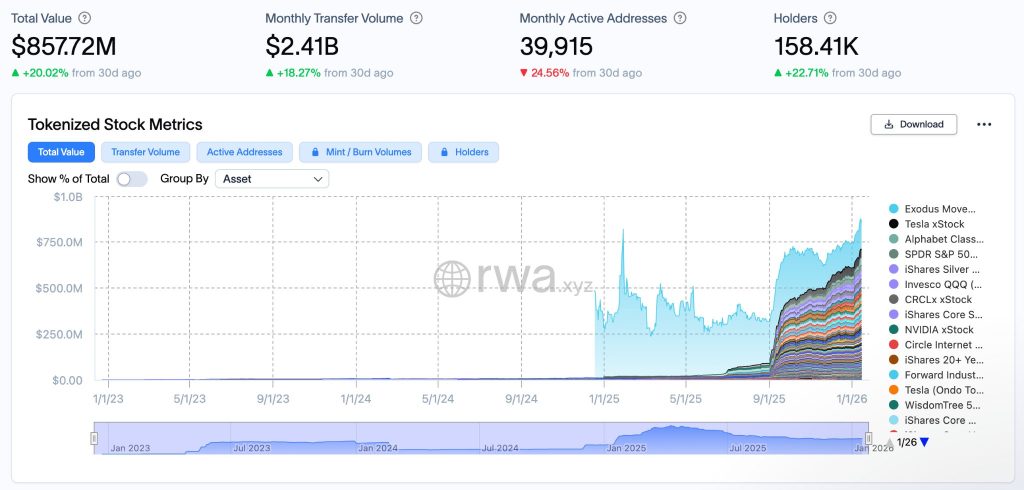
The push comes as monthly transfer volumes for tokenized equities climbed roughly 19% over 30 days to about $2.41 billion, according to rwa.xyz.
While Robinhood and Kraken already list tokenized US stocks in select jurisdictions, Coinbase plans to issue these products in-house rather than through external partners.
Earlier this month, Armstrong outlined three priorities for 2026 in an X post, which involved building the everything exchange globally, scaling stablecoins and payments, and bringing users onchain through developer tools, the Base blockchain, and consumer apps.
“Goal is to make Coinbase the #1 financial app in the world,” he wrote, noting major investments in product quality and automation.
The expansion extends beyond equities into prediction markets, where Coinbase partnered with the federally regulated platform Kalshi to offer event contracts across economics, politics, sports, and technology.
Leaked screenshots in November revealed a Coinbase-branded prediction interface supporting USDC or USD trading through Coinbase Financial Markets, the exchange’s derivatives arm.
Regulatory Friction Clouds Expansion
Armstrong’s broader legislative agenda hit turbulence after he withdrew Coinbase’s support for the Senate Banking Committee’s draft crypto market structure bill, warning that it would impose a “” on tokenized equities, restrict stablecoin rewards, and weaken CFTC authority.
“We’d rather have no bill than a bad bill,” Armstrong posted on X, triggering a markup postponement as negotiations continue.
The dispute centers partly on provisions limiting stablecoin yield, which banks argue could blur lines with deposit products.
Armstrong accused banking interests of influencing restrictions that would cut into Coinbase’s revenue streams tied to stablecoin rewards.
 Coinbase CEO @brian_armstrong said the exchange cannot support the Senate’s crypto bill as written, warning it would hurt tokenized equities, DeFi and privacy while weakening the CFTC.#Coinbase #CryptoPolicy https://t.co/kMbxepaWYk
Chairman Tim Scott signaled that talks would continue despite the setback.
“This bill reflects months of serious bipartisan negotiations and real input from innovators, investors and law enforcement,” Scott said, emphasizing the goal of delivering clear rules that protect consumers while ensuring the future of finance is built in the United States.
Citron Research escalated the clash by backing tokenization rival Securitize while accusing Coinbase of opposing clearer tokenization rules to protect its market position.
“He is fighting to protect its stablecoin yield revenue while complaining about tokenized equity restrictions,” Citron wrote, arguing that a permissive framework would benefit firms like Securitize, which operates with broker-dealer licenses and has issued over $4 billion in tokenized assets for partners including BlackRock and Apollo.
Coinbase stock fell nearly 4% following the criticism.

Armstrong has since struck a more conciliatory tone but maintains that the draft requires significant changes before winning industry backing.
Despite all these, Coinbase is still optimistic. David Duong, Coinbase’s head of investment research, said regulatory clarity improvements and deepening institutional participation are creating favorable conditions ahead.
“We expect these forces to compound in 2026 as ETF approval timelines compress, stablecoins take a larger role in delivery-vs-payment structures, and tokenized collateral is recognized more broadly,” Duong wrote in a year-end outlook.
