Belgium’s KBC Bank Shatters Tradition With First-Ever Bitcoin and Ether Trading Under MiCA Framework

Belgium just rewrote the crypto rulebook—and a traditional bank is holding the pen.
The MiCA Era Lands With a Banker's Stamp
Forget shadowy exchanges and offshore wallets. The first regulated Bitcoin and Ether trades under Europe's landmark Markets in Crypto-Assets (MiCA) framework didn't come from a crypto-native firm. They came from KBC Bank, a pillar of Belgium's centuries-old financial establishment. This isn't a fintech side project; it's core banking business, now with a crypto ticker.
Why Your Bank Suddenly Cares About Your Bitcoin
MiCA didn't just create rules—it built a highway for institutional capital. By providing regulatory clarity, it turns speculative crypto assets into compliant financial instruments. For banks like KBC, that means a new, lucrative product line with a built-in client base. It's the ultimate regulatory arbitrage: repackaging digital rebellion as a prudent portfolio addition. The suits have finally figured out how to tax the revolution.
The Domino Effect Starts in Brussels
KBC's move isn't an isolated experiment. It's a starting pistol. Watch as other EU banks, previously paralyzed by compliance fears, now race to launch their own MiCA-compliant crypto services. The infrastructure is approved, the precedent is set, and the client demand is simmering. The floodgates for mainstream, bank-facilitated crypto investment are officially cracking open.
So, the next time your banker drones on about bond yields, ask about their ETH staking rate. The old world of finance just co-opted the new one—with regulators holding the door open. A cynical take? They're not embracing innovation; they're monetizing your FOMO and calling it compliance.
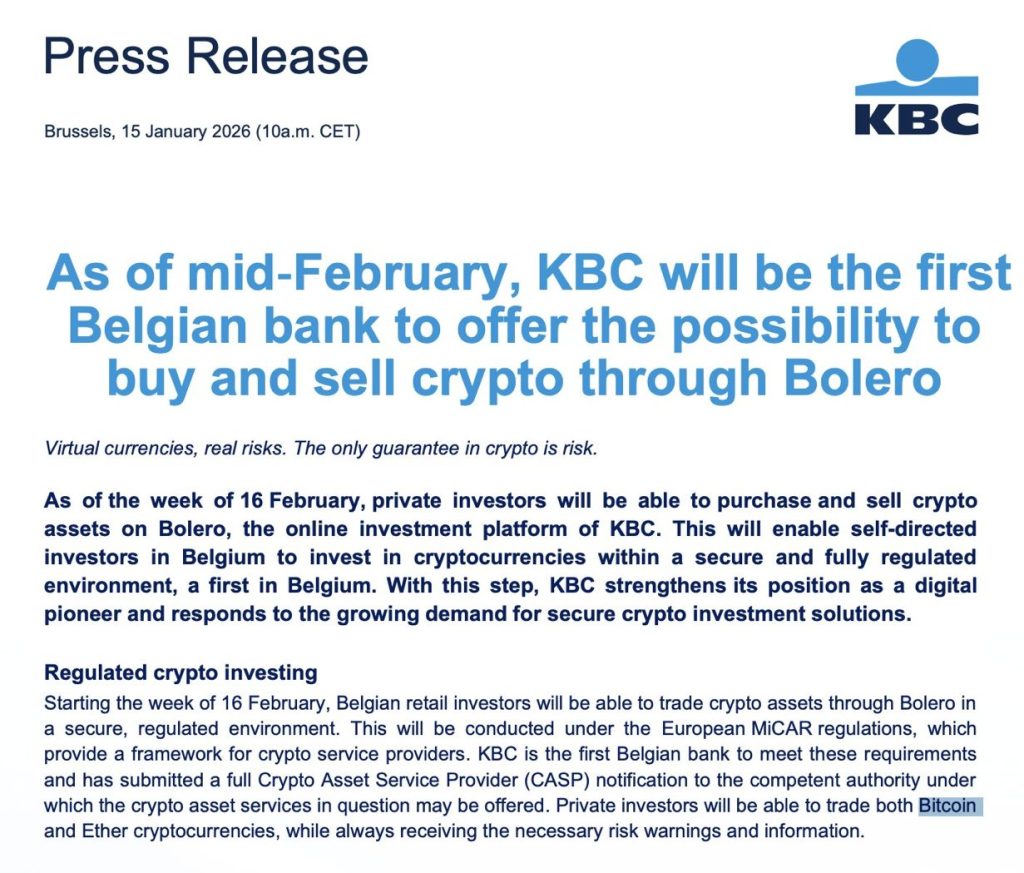 Source: KBC
Until now, no major Belgian bank had integrated crypto trading directly into its Core investment platforms.
The bank announced on Thursday that, starting the week of 16 February, Belgian private investors will be able to buy and sell the two largest cryptocurrencies through Bolero, KBC’s online investment platform.
KBC Responds to Crypto Demand While Ring-Fencing Risk
KBC’s decision shows growing pressure on traditional financial institutions to respond to sustained retail demand, even as regulators across Europe tighten oversight of digital assets.
The launch follows KBC’s submission of a full Crypto-Asset Service Provider, or CASP, notification to the relevant authority under MiCA.
While the bank did not specify which regulator it coordinated with, Belgium only recently completed its national implementation of MiCA.
The country published its implementing law in December 2025, with the framework becoming legally effective on Jan. 3, 2026.
Oversight of crypto markets in Belgium now falls jointly to the Financial Services and Markets Authority and the National Bank of Belgium.
Under MiCA, Bitcoin and Ether are not treated as stablecoins or asset-referenced tokens because they have no central issuer or pegged value. Instead, they fall under a broad category of “other crypto-assets.”
Even so, the regulation places extensive obligations on service providers like KBC and Bolero, including strict consumer protection rules, segregation of client assets, capital requirements, cybersecurity standards, and controls to prevent market abuse.
Any CASP authorized in one EU member state can, in principle, offer services across the bloc through passporting, a feature that has sparked debate among regulators.
KBC said crypto trading on Bolero will take place within a closed loop, meaning customers can only buy and sell crypto within the platform, with no external transfers permitted.
The bank said this structure is designed to reduce risks related to fraud, money laundering, and unauthorized transactions.
The bank will provide custody through its infrastructure, removing the need for customers to manage private keys or interact with third-party exchanges.
All transactions will be subject to strict know-your-customer and transaction monitoring procedures, with funds used for trading fully verified.
Why Is KBC Warning So Loudly Before Letting Customers Trade Crypto?
KBC repeatedly emphasized risk disclosures in its announcement, warning customers that crypto prices can fluctuate sharply, that total loss is possible, and that crypto assets are not covered by deposit guarantee schemes.
Bolero will operate on an execution-only basis, meaning customers will not receive investment advice and must make their own decisions.
Before trading crypto, users will be required to complete a knowledge and experience test to demonstrate awareness of the risks.
Céline Pfister, CEO of Bolero, said educational materials will be provided through the Bolero Academy at launch to help investors understand the new asset class.
KBC’s decision follows its initial announcement in July 2025 that it planned to offer Bitcoin and Ether trading pending regulatory approval.
 KBC Bank moves to offer Bitcoin and Ether trading for retail customers via Bolero.#CryptoBanking #Belgiumhttps://t.co/9V64D4Zx6j
The rollout now places the bank ahead of its domestic competitors and aligns it with a broader European trend.
More than 60 banks across Europe already offer some FORM of crypto-related service, a recent industry report shows.
Its move comes as other institutions across Europe cautiously expand into digital assets, even as some regulators push for tighter, centralized oversight at the EU level.
