Coinbase CEO Sounds Alarm on US Crypto Legislation - Warns of Innovation Exodus

Coinbase's chief executive just dropped a bombshell on Capitol Hill—and the entire crypto industry is listening.
The Regulatory Red Flag
Brian Armstrong isn't mincing words. In a sharp critique of proposed US crypto legislation, he's warning that current drafts could strangle innovation and push the next wave of financial technology overseas. The message is clear: get this wrong, and America loses.
Why This Bill Misses the Mark
The legislation, according to insiders familiar with Armstrong's position, creates more hurdles than highways. It layers complexity where clarity is needed—a classic Washington move that protects incumbents while startups suffocate. Think of it as building a moat around traditional finance just as the drawbridge was finally lowering.
The Stakes for Everyday Investors
This isn't just industry chatter. Overly restrictive rules could limit access to emerging assets, keep promising projects in regulatory limbo, and ultimately leave US investors watching from the sidelines as global markets evolve. The digital economy won't wait for committee approvals.
The Innovation Exodus Threat
Armstrong's core warning hits hardest: talent and capital follow opportunity. If the US builds walls, builders will simply set up shop elsewhere—Dubai, Singapore, Zurich. We've seen this movie before with tech regulation, and the ending usually involves American companies incorporating offshore.
The Path Forward
There's still time to course-correct. The bill needs sharper definitions, clearer jurisdiction lines, and actual pathways to compliance that don't require a team of lawyers and a fortune in legal fees. Simplicity breeds innovation; complexity breeds loopholes and offshore subsidiaries.
One cynical take? Washington might finally understand crypto—just in time to regulate it into a form that benefits the usual Wall Street players while calling it 'protection.' The game isn't about banning innovation; it's about controlling who profits from it. And right now, the scoreboard doesn't look good for the home team.
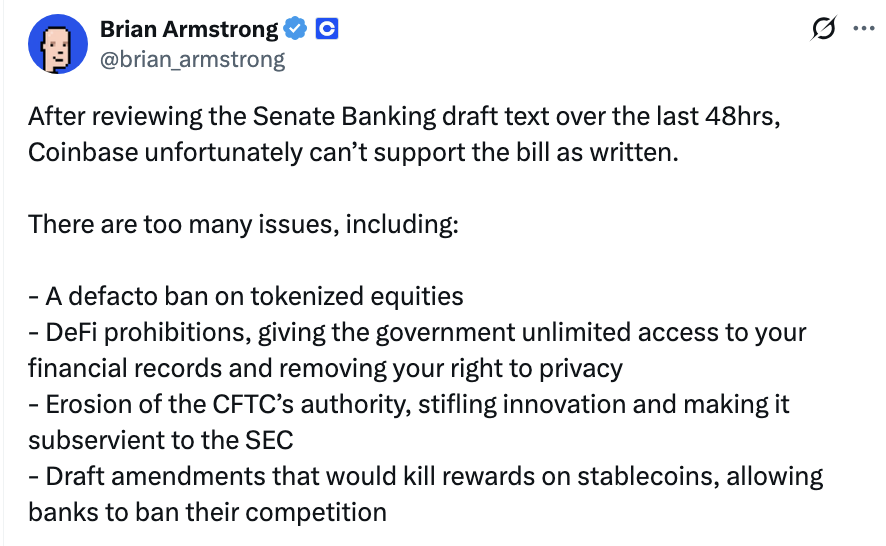
Image Source: X/@brian_armstrong
Armstrong Flags Risks To Tokenization, DeFi And Privacy
He said the draft carries too many problems, including what he described as a de facto ban on tokenized equities, restrictions affecting decentralized finance and privacy, and changes that WOULD weaken the CFTC in ways that could leave innovation at the mercy of the Securities and Exchange Commission.
Armstrong also took aim at provisions that would limit rewards tied to stablecoins, a flashpoint in a widening lobbying fight between banks and crypto firms over whether yield like payouts resemble deposit products.
“We appreciate all the hard work by members of the Senate to reach a bi-partisan outcome, but this version would be materially worse than the current status quo. We’d rather have no bill than a bad bill. Hopefully we can all get to a better draft.”
The bill does not allow crypto companies to pay interest to consumers solely for holding a stablecoin, although it still permits rewards for certain activities such as making payments or joining loyalty programs, with disclosure rules to be set by the SEC and CFTC.
Crypto Industry Watches Closely As Bill Enters Critical Phase
Coinbase’s stance matters because the company has been a central voice in market structure negotiations and a major spender in pro-crypto political campaigns, and lawmakers now head into a Senate Banking Committee markup scheduled for 10 am ET Thursday without a key industry backer.
Separately, Galaxy said the Senate Banking draft goes further than the House passed Digital Asset Market Clarity Act on illicit finance, and warned it could expand the Treasury Department’s reach into crypto transfers through a new special measures authority.
Galaxy compared that power to tools created after the September 11 attacks under the Patriot Act, arguing Treasury could apply the authority broadly across offshore venues and transaction rails if it labels certain jurisdictions, institutions, or transaction categories as primary money laundering concerns.
The push for a Senate framework lands as the TRUMP administration signals a more supportive tone toward parts of the industry, and as lawmakers try to replace enforcement led uncertainty with clearer lines on oversight, disclosures, and market conduct.
For crypto markets, the next few days will set the temperature, either lawmakers soften the draft to keep major platforms onside, or the bill slows again, leaving the industry to navigate the same patchwork of agency guidance and courtroom fights it has lived with for years.
