Maxine Waters Demands SEC Hearing Over Dropped Crypto Cases - Regulatory Showdown Looms

Congressional pressure mounts as Representative Maxine Waters calls for immediate SEC hearings on abandoned cryptocurrency enforcement actions. The move signals escalating tensions between lawmakers and financial regulators over digital asset oversight.
The Regulatory Vacuum
Waters' demand exposes growing frustration with what critics call selective enforcement—dropping cases while maintaining aggressive rhetoric. Industry insiders whisper about political calculations overshadowing consistent policy. One compliance officer quipped, "The SEC's enforcement strategy changes faster than a meme coin's valuation."
Broader Implications
This confrontation could reshape how regulators approach emerging technologies. Waters' intervention suggests Congress may force clearer guidelines, potentially accelerating institutional adoption by reducing regulatory uncertainty. Market observers note similar patterns in traditional finance—where enforcement ebbs and flows with political cycles.
The hearing demand arrives during peak crypto market activity, creating perfect conditions for political theater. Waters' committee could compel SEC officials to explain why certain cases vanish while others proceed aggressively. The outcome might reveal whether regulators truly understand this asset class or just enjoy the power to disrupt it.
Ultimately, this showdown highlights crypto's awkward adolescence—old enough to threaten traditional finance, yet young enough for politicians to score points debating its supervision. The real question isn't about dropped cases, but whether any regulator can keep pace with technology that reinvents money faster than bureaucrats can schedule meetings.
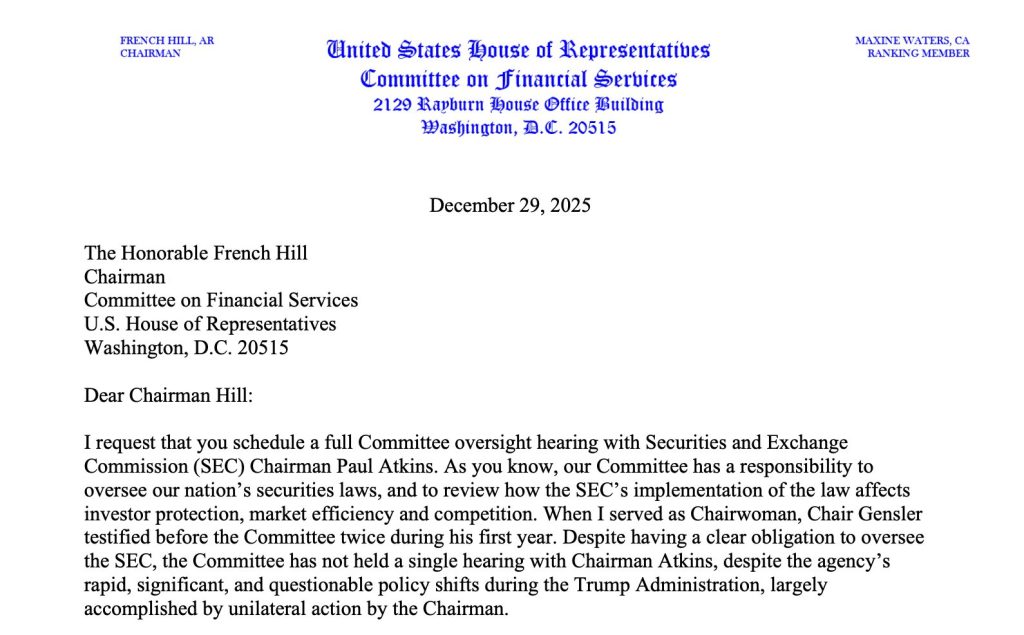 Source: Waters Letter
Crypto Enforcement Retreat Draws Fire
The lawmaker’s central concern is the SEC’s termination of enforcement actions against Coinbase, Binance, and Justin Sun, among others, who were previously accused of securities violations.
“The SEC has terminated or stayed major enforcement actions against multiple crypto companies and individuals that had been credibly accused of major violations of our securities laws,” Waters wrote, adding that defendants sometimes announced case dismissals before the Commission voted.
Waters questioned whether Chairman Atkins’ office took “an unusually active role in negotiating an end to these cases,” demanding the Committee examine the SEC’s rationale for abandoning matters affecting millions of retail investors.
The agency has dropped or paused nearly sixty percent of crypto cases since Trump’s January inauguration, according to recent reports, while no new crypto enforcement actions have been filed in 2025.
 The @SECGov has sharply scaled back its enforcement actions against the cryptocurrency industry since @realDonaldTrump returned to office.#SEC #Trumphttps://t.co/NCTPm62pCR
The SEC dismissed cases against Coinbase in February 2025 and against Kraken in March, both resolved without fines or admissions of wrongdoing.
Binance’s case ended in May following a February pause request, while the Ripple lawsuit concluded in August with a reduced $125 million penalty, but appeals were withdrawn.
Waters has consistently opposed Trump’s crypto connections, previously slamming his October pardon of Binance founder Changpeng Zhao as legitimizing “” and enabling operations “with virtually no guardrails.“
Independence and Transparency Concerns Mount
Beyond crypto enforcement, Waters outlined ten areas requiring immediate oversight, starting with SEC independence.
“Congress designed the SEC to be independent of the WHITE House. Yet, Chairman Atkins repeatedly frames the agency’s agenda as an instrument of the Administration,” she stated, warning that this “politicization threatens market integrity” amid suspicious trading patterns around tariff announcements.
The ranking member criticized the SEC’s approach to policymaking, which “eschews notice-and-comment rulemaking in favor of staff statements,” calling it a violation of the Administrative Procedure Act.
Waters highlighted withdrawn investor-protection rules covering artificial intelligence, cybersecurity, and market structure reforms, stemming from GameStop-era concerns, and questioned what “empirical analysis the SEC relied upon in reversing course.“
Meanwhile, the SEC has delayed hedge fund transparency requirements and extended securities-lending reporting deadlines into 2028, moves Waters says effectively kill manipulation-detection reforms.
The agency also announced it will largely cease issuing no-action responses for shareholder proposal exclusions following Atkins’ instructions, potentially emboldening executives to ignore investor concerns.
Deregulation Agenda Under Scrutiny
Waters compared Atkins’ regulatory rollbacks to conditions preceding the 1929 stock market crash, echoing concerns raised by SEC Commissioner Caroline Crenshaw.
The agency’s Spring 2025 agenda outlines potential reductions in registration requirements and disclosure obligations, as well as expanded access to private assets for retirement accounts.
“We have not had the opportunity to examine Chairman Atkins’s deregulatory agenda,” Waters noted.
The letter also addressed the SEC’s decision to abandon climate-risk disclosure rules despite investor demand for standardized information, as well as concerns about weakening market surveillance under a “notice-first enforcement approach.”
Waters questioned restructuring plans for the Consolidated Audit Trail, essential for detecting insider trading.
Staffing emerged as another flashpoint, with Reuters data showing the SEC lost fifteen to nineteen percent of full-time staff in Enforcement, Trading and Markets, and Corporation Finance divisions over several weeks in May.
 The SEC is offering $50,000 for current employees to leave the regulating agency as federal workforce cuts continue.#SEC #DOGEhttps://t.co/QTyA7jHKht
“We must assess the operational impact of the recent mass exodus of senior career staff,” Waters wrote, questioning whether the agency maintains “human capital necessary to accomplish its mission.“
Waters concluded by urging Hill to convene the hearing “as soon as practicable when Congress returns,” asserting that “investors, retirees, and working families deserve transparency and accountability” from the nation’s primary securities regulator.
