ECB Confirms DLT Transactions Launching in 2026 as Digital Euro Privacy Debate Heats Up

The European Central Bank just put a date on the future—and it's written in blockchain.
The Infrastructure Countdown Begins
Forget theoretical pilots. The ECB confirmed its wholesale settlement system for digital assets will go live on distributed ledger technology in 2026. This isn't a sandbox experiment; it's the foundation for a new financial architecture. The move positions the Eurozone to directly settle tokenized bonds, equities, and potentially a digital euro, bypassing legacy intermediaries.
Privacy: The Political Battlefield
Meanwhile, the design of a retail digital euro is sparking a firestorm. Lawmakers and privacy advocates are clashing over transaction visibility. Should the ECB see every coffee purchase? Can it track cross-border payments? The debate cuts to the core of financial sovereignty in a digital age, pitting state control against individual anonymity.
The Institutional On-Ramp
The 2026 timeline sends a clear signal to traditional finance: adapt or get left behind. Major banks and asset managers now have a concrete deadline to build DLT interoperability. It validates the entire sector, proving that blockchain's killer app might just be propping up the old guard—with a cynical twist for an industry that once fought it.
The race is on. Europe is building the rails, but who controls the passengers' data will determine if this train runs on trust—or surveillance.
ECB Readies Digital Euro System, Puts Decision in Lawmakers’ Hands
Under the plan, transactions executed on DLT platforms would be able to settle directly in central bank money rather than relying on private intermediaries.
The ECB has argued that this is necessary to prevent fragmentation in tokenized markets and to ensure that new digital asset ecosystems continue to rely on a risk-free public settlement asset.
Cipollone said the digital euro infrastructure would also be designed to interact with other central bank digital currencies, allowing institutions to use it for cross-border payments.
He added that safeguards such as holding limits and the absence of interest payments would be built in to prevent large-scale shifts of deposits away from commercial banks, preserving their role in credit creation and monetary transmission.
The ECB’s technical preparations are largely complete, following a two-year preparation phase that ended in October 2025.
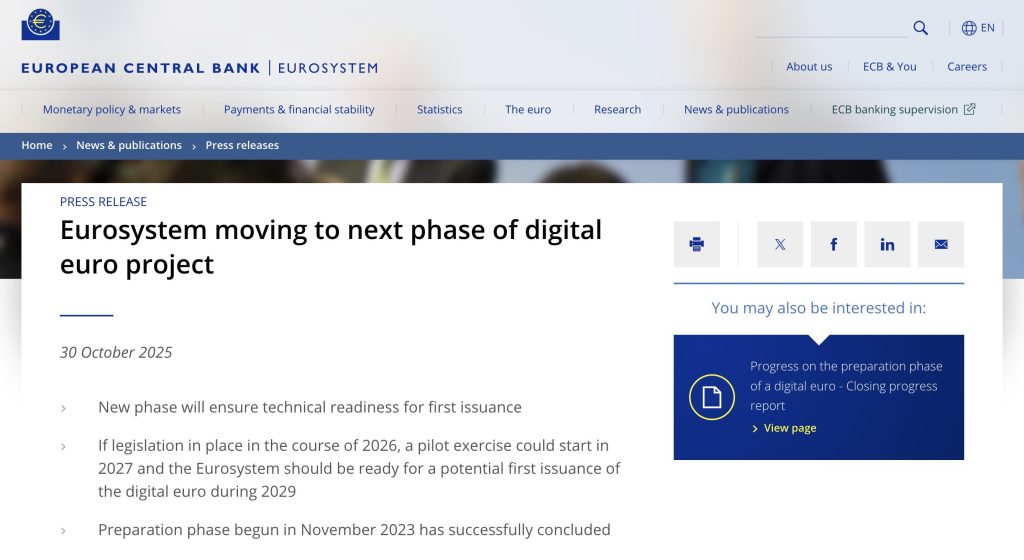
The project has now moved into a readiness phase, with the central bank selecting potential system providers and testing settlement mechanisms.
However, officials have stressed that the ECB cannot proceed without a legal framework approved by EU lawmakers.
ECB President Christine Lagarde stated this week that the central bank’s design work is finished and that responsibility now lies with political institutions.
 ECB President Christine Lagarde said that the digital euro is technically ready and is now awaiting legislative approval.#ECB #DigitalEuro #EUStablecoinhttps://t.co/4cdYV6UdSJ
If the legislation is adopted in 2026, pilot transactions using the digital euro could begin in mid-2027, with the ECB aiming to be ready for a first issuance in 2029.
ECB Promises Privacy, but EU Rules Complicate the Digital Euro Vision
As the timeline becomes clearer, the debate over privacy has intensified.
The ECB has consistently said it does not support a programmable digital euro that would restrict how users can spend their money.
It has also proposed an offline payment option that would allow low-value transactions to take place without being recorded on a central ledger, offering privacy protections comparable to cash.

Offline balances would be stored locally on devices or smart cards, enabling device-to-device payments without third-party validation.
These assurances contrast with broader regulatory trends in the European Union.
Recent EU proposals on data retention and anti-money laundering have raised concerns among privacy advocates, particularly as new AML rules are set to ban crypto accounts that allow transaction anonymization from 2027.
 July 2027 triggers a compliance countdown for blockchain companies in the EU who must shut down anonymous crypto accounts or risk expulsion.#EU #CryptoAccountshttps://t.co/Oa89JRaSmg
Critics argue that these policies risk undermining the privacy guarantees promised for a digital euro, even if the ECB itself does not seek access to user data.
Political negotiations are now underway as the Council of the EU agreed on December 19 on its negotiating position for the digital euro’s legal framework, clearing the way for talks with the European Parliament, which is expected to finalize its stance by May 2026.
ECB officials have described discussions among member states as constructive but have acknowledged that privacy, data access, and democratic oversight remain contentious issues.
Public interest also remains uncertain. An ECB consumer survey published in March found that many Europeans see little need for a digital euro and prefer existing payment methods, including cash and bank accounts.
 A new European Central Bank (ECB) report highlights Europeans' reluctance to adopt the digital euro, posing challenges for its planned rollout.#ECB #DigitalEuro https://t.co/3IIUvpseRd
While the ECB has said adoption levels would not threaten financial stability, it has acknowledged that public trust and education will be critical.
