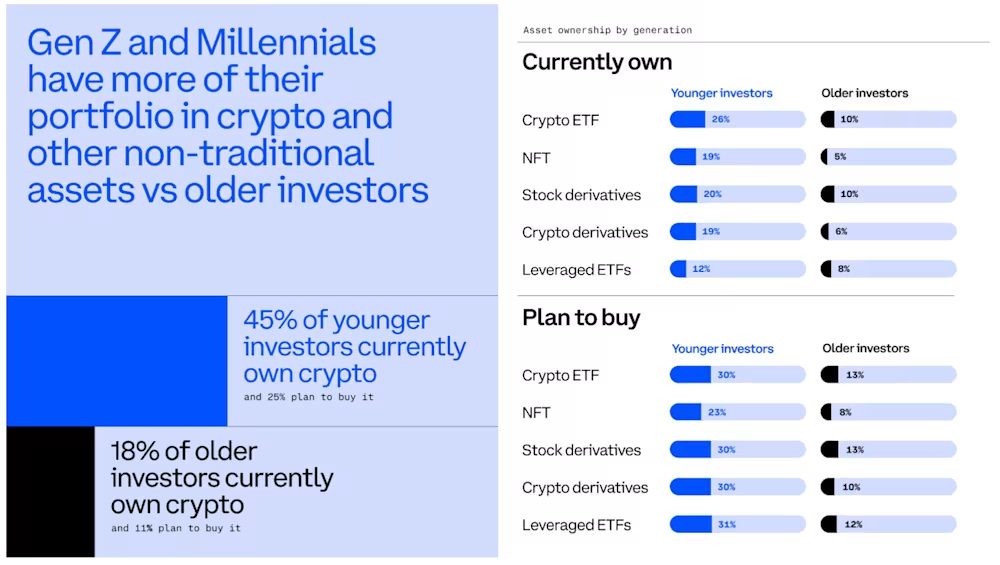
45% of Young Investors Now Hold Crypto as Housing Dreams Dim: Survey Reveals Generational Shift

Forget the white picket fence—Gen Z and Millennials are betting on blockchain instead. A new survey shows nearly half of young investors now hold cryptocurrency, a stark pivot from traditional wealth-building paths.
The Unattainable Down Payment
Faced with soaring real estate prices and stagnant wages, the classic starter home feels more like a fantasy. Young adults aren't just priced out—they're opting out, redirecting capital toward assets they can actually afford to buy fractions of. It's portfolio construction by necessity.
Digital Assets, Tangible Hopes
This isn't mere speculation; it's a calculated alternative. Crypto offers liquidity, accessibility, and a narrative of disruption that resonates with a generation skeptical of legacy financial systems. Why save for a 20% down payment in a broken market when you can deploy capital in a 24/7 global one?
The New Wealth Playbook
The move signals a deeper disillusionment. Trust in traditional wealth gatekeepers—banks, mortgage lenders, the Federal Reserve—is eroding. Young investors are building their own ladders, bypassing the old rules entirely. It's a quiet rebellion with a very public ledger.
One cynical take? Wall Street spent decades convincing everyone a house was the best investment you'd ever make. Now, a generation is calling that bluff—and putting their money where the old guard's mouth isn't. The future of finance isn't being built in a boardroom; it's being coded, traded, and held in digital wallets by those who gave up waiting for an invitation.
 Source: Coinbase
A Generation Betting Against the Old Playbook
Despite reporting greater Optimism about broader economic conditions, younger investors don’t believe traditional wealth-building mechanisms work in their favor.
The cohort has watched housing affordability deteriorate while student debt mounted and wage growth lagged, driving 73% to conclude that their generation faces steeper wealth-building challenges than 57% of older adults.
This perception translates directly into portfolio decisions. While stock ownership rates remain similar across age groups, younger investors add substantially more alternative exposure, actively seeking reward mechanisms beyond conventional stock dividends.
The strategy reflects deliberate pursuit of tools and markets that might help close generational wealth gaps rather than passive investment approaches.
The crypto allocation isn’t treated as speculative positioning but as a central strategy. Nearly half of younger investors (47%) want access to new crypto assets before general market availability, compared with just 16% of older investors.
Four in five younger adults believe cryptocurrency will play a significantly larger role in future financial systems, dropping to three in five among older investors.
Risk Appetite Extends Beyond Bitcoin and Ethereum
The willingness to embrace emerging opportunities doesn’t stop at spot crypto holdings.
Four in five younger investors say they’re willing to try new investment opportunities before others, compared with under half of older adults.
Interest spans crypto derivatives, prediction markets, round-the-clock stock trading, early-stage token sales, altcoins, and decentralized finance lending products.
This pattern marks a clear departure from recent data showing cooling crypto enthusiasm across broader investor populations.
A December FINRA Foundation study found crypto consideration among US investors dropped from 33% to 26% between 2021 and 2024, while those viewing digital assets as extremely or very risky ROSE from 58% to 66%.

Yet that pullback appears concentrated among older demographics rather than the younger cohort driving current adoption.
The generational divide extends to trading behavior and information sourcing.
Younger investors trade more frequently, take more calculated risks to chase higher returns, and push platforms toward always-on operations that support a wider asset range.
US crypto purchase interest falls to 26% from 33% in 2021 as investor risk appetite declines sharply, FINRA study shows.#US #Cryptohttps://t.co/4mTMJ49hLC
— Cryptonews.com (@cryptonews) December 5, 2025Notably, social media “” now guide investment decisions for 61% of investors under 35, with YouTube serving as the dominant platform, and word-of-mouth from friends and family surpassing financial professional recommendations.
The Infrastructure for a New Investment Generation
The shift toward non-traditional assets among younger investors aligns with separate findings showing institutional adoption bolstering confidence.
A November Zerohash survey found that 35% of wealthy young Americans had already moved money away from advisers who did not offer crypto exposure, with more than four-fifths reporting increased confidence as major institutions like BlackRock, Fidelity, and Morgan Stanley embraced digital assets.
Portfolio concentration in volatile assets raises legitimate concerns about long-term financial stability.
However, the trend appears durable rather than speculative, with median allocations to non-traditional assets reaching meaningful levels, and younger investors consistently describing crypto as essential to wealth-building strategy rather than an opportunistic position.
 US crypto exchange Coinbase is letting users to trade stocks on its platform and place bets on a wide range of events through a partnership with Kalshi.#Coinbase #CoinbaseKalshi #PredictionMarkethttps://t.co/7X7UId3tKZ
Coinbase is responding by building what it calls the Everything Exchange, designed to support trading across asset types at any time while maintaining security, compliance, and responsible innovation standards.
The approach recognizes that younger investors expect platforms native to an internet-first generation rather than traditional market structures built around limited trading hours and narrow asset selection.
