SEC’s Crypto Crackdown: Broker-Dealers Must Control Private Keys or Face the Music

The SEC just dropped a hammer on Wall Street's crypto custody game. No more passing the buck—broker-dealers now have to hold the keys themselves.
The New Custody Rule: Your Keys, Your Problem
Forget about third-party storage loopholes. The updated mandate forces firms to maintain exclusive control over client crypto assets. That means direct possession of private keys, period. It's a move that slams the door on the 'not our vault, not our problem' defense that's been floating around trading desks for years.
Why This Changes Everything
This isn't a gentle nudge—it's a structural overhaul. Compliance teams are scrambling. The rule effectively merges the traditional fiduciary duty of safeguarding securities with the unforgiving technical reality of blockchain. Lose a key? That's not an IT hiccup anymore; it's a regulatory breach with teeth. Auditors will now need to verify cryptographic proof of control, not just check a box on a custody agreement from some offshore entity.
The Industry's Billion-Dollar Headache
Implementation won't be cheap. Firms are staring down massive capital expenditures for qualified custody tech and insurance that meets the SEC's bar. Some smaller players might find the math doesn't work, potentially consolidating power with the giants who can afford the fortress-like infrastructure. It's the kind of rule that makes hedge fund managers miss the simple days of hiding fees in complex financial structures—at least those were hard for clients to trace.
A New Era of Accountability or a Innovation Stifler?
The SEC is drawing a line in the digital sand: operate in the regulated financial system, play by its asset-protection rules. Proponents hail it as the final piece needed for true institutional adoption. Critics see it as a classic regulator's move—applying 20th-century safekeeping concepts to 21st-century tech, potentially freezing out newer, more efficient custody models before they can even be tested. One cynical take? It's a brilliant play—forcing the industry to spend billions building compliance moats, all while the regulators get to say they 'protected the investor' from the very innovation they're now mandating.
The message is clear. In the eyes of the SEC, crypto assets on your platform are your direct responsibility. Control the keys, or prepare for the consequences.
Holding Crypto Isn’t Enough—SEC Says Control Is What Counts
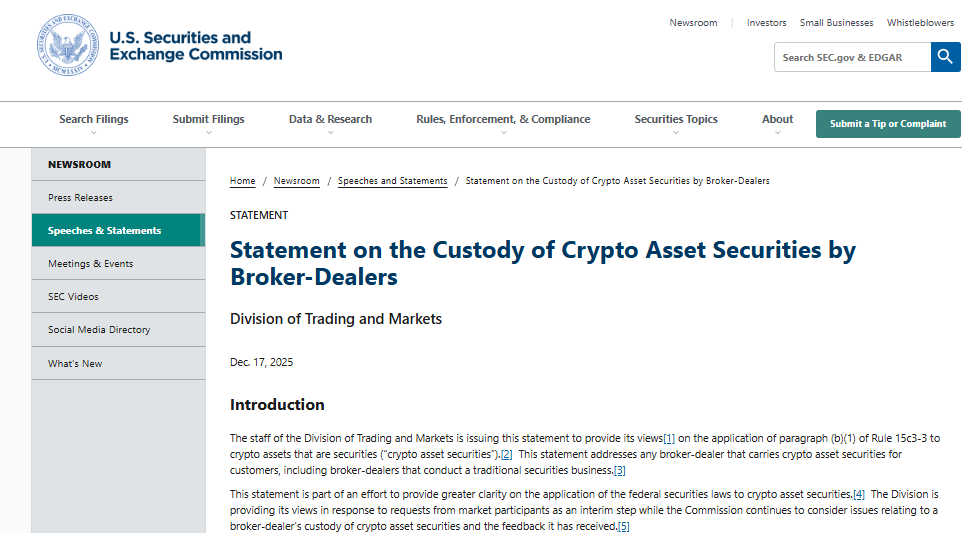
The statement focuses on paragraph (b)(1) of Rule 15c3-3, the long-standing customer protection rule that requires broker-dealers to maintain physical possession or control of fully paid and excess margin securities.
While the guidance does not introduce a new rule, it explains how the staff believes that requirement can be met when securities exist on a blockchain rather than in traditional form.
Under the SEC’s view, a broker-dealer can deem itself to have possession of a crypto asset security only if it has direct access to the asset on the relevant distributed ledger and the technical ability to transfer it.
That access must not be shared, as the staff emphasized that neither customers nor third parties, including affiliates, can hold private keys or otherwise MOVE the asset without the broker-dealer’s authorization.
The guidance also requires broker-dealers to formally assess the blockchains and networks on which crypto asset securities operate before taking custody and to repeat those assessments at regular intervals.
Also, firms are expected to evaluate performance, security, governance, upgrade processes, and risks such as hard forks, 51% attacks, or protocol changes that could affect ownership records.
If a broker-dealer becomes aware of material security or operational weaknesses in a blockchain network, the staff said the firm should not treat itself as having possession of the asset.
The focus, according to the statement, is on risks tied directly to custody and transfer, rather than market or reputational concerns.
Crypto Custody Was Once Off-Limits; The SEC Now Says Otherwise
The statement arrives after several years in which broker-dealers argued that crypto custody was effectively impossible under SEC interpretations.
Between 2022 and 2024, the agency’s approach relied heavily on accounting and structural constraints that discouraged traditional firms from entering the space.
 Firms under the SEC's jurisdiction will receive a notice first ahead of being hit with an enforcement action, Chair Paul Atkins says. #PaulAtkins #SECChairhttps://t.co/aWBXuDc2pW
Staff Accounting Bulletin 121 required public companies holding customer crypto to record those assets as balance-sheet liabilities, making custody capital-intensive and, for many banks, commercially impractical.
At the same time, the SEC limited crypto custody largely to special-purpose broker-dealers that were barred from operating traditional securities businesses.
Large firms declined to pursue that model, citing operational complexity and regulatory uncertainty.
Industry lawyers often described the period as a regulatory dead zone in which compliance was required but rarely achievable.
The new statement attempts to resolve that standoff by tying compliance to concrete operational controls rather than abstract concerns about blockchain design.
The custody clarification follows another notable development at the SEC. On Dec. 13, the agency published a crypto wallet and custody investor bulletin outlining risks and best practices for self-custody and third-party custody.
The guide discussed rehypothecation, commingling of assets, and the trade-offs between hot and cold wallets, indicating a more educational posture toward crypto investors.
Together, the custody statement and investor guidance suggest a recalibration in how the SEC approaches crypto market infrastructure, with clearer expectations for firms and more explicit protections for customers.
