India’s Tokenization Bill Could Unlock Billion-Dollar Real Estate for the Middle Class — Will It Pass?

India's parliament is weighing a move that could reshape the country's wealth landscape — and put crypto at the center of it.
Tokenization: The Real Estate Game-Changer
Forget buying a whole apartment. The proposed bill would let you own a fraction of one. By converting physical property into digital tokens on a blockchain, the legislation aims to slice India's massive real estate market into affordable, tradeable pieces. It's a direct play to let the middle class tap into an asset class that's been locked behind seven-figure price tags.
The bill promises to cut out layers of brokers, bypass notoriously slow paperwork, and bring transparency to a market riddled with opacity. Proponents argue it's not just about access; it's about liquidity. Stuck with an illiquid asset? Sell your tokens in minutes, not months.
The Regulatory Hurdle
Passage is far from guaranteed. The bill must navigate a maze of existing property laws, state-level regulations, and concerns from traditional banks. Skeptics question custody, valuation, and the risk of creating a speculative frenzy around basic housing. One finance veteran quipped it could turn 'location, location, location' into 'volatility, volatility, volatility.'
If it clears parliament, India won't just be opening real estate — it'll be building a multi-billion-dollar on-ramp for digital asset adoption. The question isn't just if the middle class gets a seat at the table, but whether the table itself gets tokenized.
Can Tokenization Unlock Wealth for India’s Middle Class, or Is Regulation Holding It Back?
Chadha told lawmakers that India’s middle class remains largely limited to savings accounts, fixed deposits, and mutual funds, with little exposure to assets that typically generate higher long-term returns.
He argued that tokenization could allow ordinary investors to buy small stakes in office buildings, highways, and other capital-intensive projects, while also providing faster liquidity without relying on brokers or complex paperwork.
He called for bespoke legislation and a regulatory sandbox that would allow new models to be tested under supervision, rather than being forced into existing and often ill-fitting rules.
With a population estimated at about 1.46 billion people and a median age under 30, the country has seen sharp reductions in extreme poverty, which is now estimated at around 1% using the $2.15-per-day benchmark.
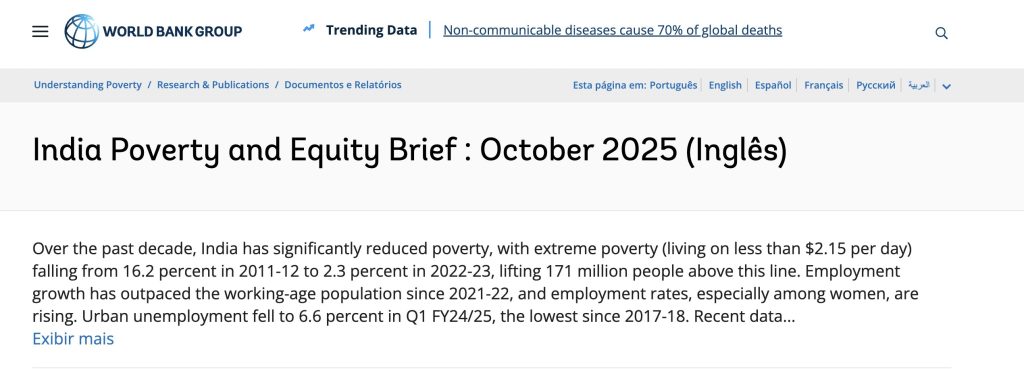
Broader poverty measures still show large gaps, however, with more than a quarter of the population falling under the lower-middle-income poverty line.
Only a smaller portion of household wealth is actively deployed in financial markets, leaving limited room for diversification into assets such as carbon credits, infrastructure, or commercial property.
Early Tokenization Efforts Emerge as Regulators Urge Caution
Supporters of tokenization say fractional ownership could lower minimum investment thresholds and draw parts of this idle capital into more productive use.
Critics note that the pool of people able to participate meaningfully remains constrained by income levels and uneven financial literacy.
India already has early experiments in this space. In GIFT City, platforms such as Tokeny and Terazo have worked on regulated tokenized real estate structures, typically using special purpose vehicles and public blockchains like Polygon.
These efforts operate under existing securities and VIRTUAL digital asset rules, rather than a unified tokenization law.
The Reserve Bank of India and the Securities and Exchange Board of India have both allowed limited pilots but have stressed caution, especially around investor protection and settlement risk.
State-Level Momentum Grows, Yet India Falls Behind on Asset Tokenization
Momentum has also come from state governments. In November, Maharashtra Chief Minister Devendra Fadnavis said the state was working toward a framework that could unlock an estimated ₹50 trillion in idle capital by digitizing asset transfers, particularly in Mumbai’s real estate market.
The announcement followed RBI disclosures that its wholesale central bank digital currency pilots for financial instruments had improved settlement efficiency, reinforcing interest in blockchain-based infrastructure.
Despite this activity, India still trails countries that have moved faster on asset tokenization.
Jurisdictions such as the UAE, Singapore, Germany, Hong Kong, and the United States have adopted clearer legal standards allowing regulated platforms to offer fractional ownership to retail investors.
 The SEC has given a key green light to the Depository Trust and Clearing Corporation’s (DTCC) push into blockchain-based markets. #SEC #Cryptohttps://t.co/LOvN1BzjZ1
In Dubai, for example, property tokenization pilots have reduced entry points from millions of dirhams to a few thousand, while Singapore’s Project Guardian has focused on institutional-grade frameworks that can later scale to the public.
 Dubai’s real estate market is witnessing a surge in new investors thanks to its new tokenization initiative.#Dubai #Tokenizationhttps://t.co/HwG1ztgavq
Indian policymakers have been wary of moving too quickly, citing complex land titles, fragmented state laws, and data privacy concerns.
The result is that tokenization remains narrow in scope, even as crypto adoption at the grassroots level is high.
