Zcash’s Privacy Shield Cracks – 50% of Transactions Now Traceable

Zcash, the cryptocurrency that promised financial invisibility, just got a lot more transparent. New analysis reveals a staggering shift: half of all ZEC transactions are now visible on the public ledger. The privacy coin's core promise is under siege.
The Anatomy of a Leak
Zcash's privacy relies on a sophisticated cryptographic tool called zk-SNARKs, which allows users to shield transaction details. But here's the catch: using this feature is optional. A growing number of users and services are opting for the transparent version of transactions, either for regulatory compliance, exchange listing requirements, or sheer convenience. This choice is creating a massive, unintended data trail.
Transparency by Default
The network doesn't nudge users toward privacy; it's a conscious switch they must flip. Wallets, exchanges, and payment processors often default to the transparent mode to simplify integration and avoid regulatory red tape. The result? A blockchain where privacy is the exception, not the rule. The very design that offered flexibility is now its biggest liability.
The Ripple Effect for 'Digital Cash'
This isn't just a Zcash problem. It strikes at the heart of the entire privacy coin narrative. If a significant portion of activity is traceable, it undermines the network effect of fungibility—the idea that every coin is equal and untraceable. Law enforcement and chain analysts can now map a substantial chunk of the ecosystem, potentially chilling legitimate use while giving regulators all the ammo they need for another round of skeptical scrutiny—because nothing says 'sound investment' like watching half your private ledger go public.
The privacy arms race in crypto just entered a new, messy chapter. Zcash's optional anonymity model is showing its seams, proving that in finance, if you offer a backdoor, someone will inevitably leave it wide open.
Tracking Claims Draws Sharp Industry Backlash
Blockchain developers quickly challenged Arkham’s announcement, pointing out fundamental limitations in tracking shielded Zcash transactions.
Multiple industry figures noted that Arkham can only trace transparent-to-transparent, shielded-to-transparent, and transparent-to-shielded movements.
At the same time, fully shielded transactions remain cryptographically protected through zero-knowledge proofs that make deanonymization technically impossible.
Mert from Helius Labs called the announcement a “,” arguing Arkham deliberately included references to shielded transactions “for a few clicks” despite being unable to track them.
He added that “for a data org, that’s as scammy as it gets” and suggested the MOVE prioritized “,” potentially damaging the firm’s credibility in blockchain analytics.
Saad El Kouari from AWB noted that the platform failed to identify major holders, including Grayscale, Electric Coin Company, and Shielded Labs, suggesting that its tracking capabilities remain limited to transparent wallet activity.
He emphasized that Arkham “” and “0 individuals, not even very clear targets” like Wilcox himself, demonstrating the significant gaps in the firm’s surveillance reach.
Dynamic Fee Proposal Addresses Network Congestion
Beyond the privacy debate, Zcash developers advanced a separate initiative to overhaul the network’s fee structure.
Shielded Labs released a detailed blueprint Monday proposing a shift from static fees, originally 10,000 zatoshi, later reduced to 1,000, to a dynamic model based on median transaction activity across 50-block periods.
The proposal addresses recurring “sandblasting” spam episodes that previously clogged wallets and congested the chain under fixed-fee structures.
An earlier ZIP-317 proposal introduced action-based accounting, treating every transaction component as a uniform “action,” fixing abuse vectors while maintaining predictable, low fees that don’t adjust to network usage.
https://t.co/x2nHCOXHHP
—
Developers emphasized that with ZEC’s recent price surge and increasing institutional interest, the current system has become unsustainable.
Some users have reported edge cases where shielding small transactions costs double-digit ZEC amounts.
The dynamic fee mechanism introduces a stateless design using “comparables” to establish standard fees while maintaining privacy protections.
Under network stress, a temporary priority lane at 10× the standard fee would allow users to compete for block space without requiring protocol redesign or risking the complexity of EIP-1559-style mechanisms that could compromise Zcash’s privacy constraints.
Institutional Adoption Drives Token Performance
ZEC surged nearly 5% today, trading above $400 and vastly outperforming the broader market.
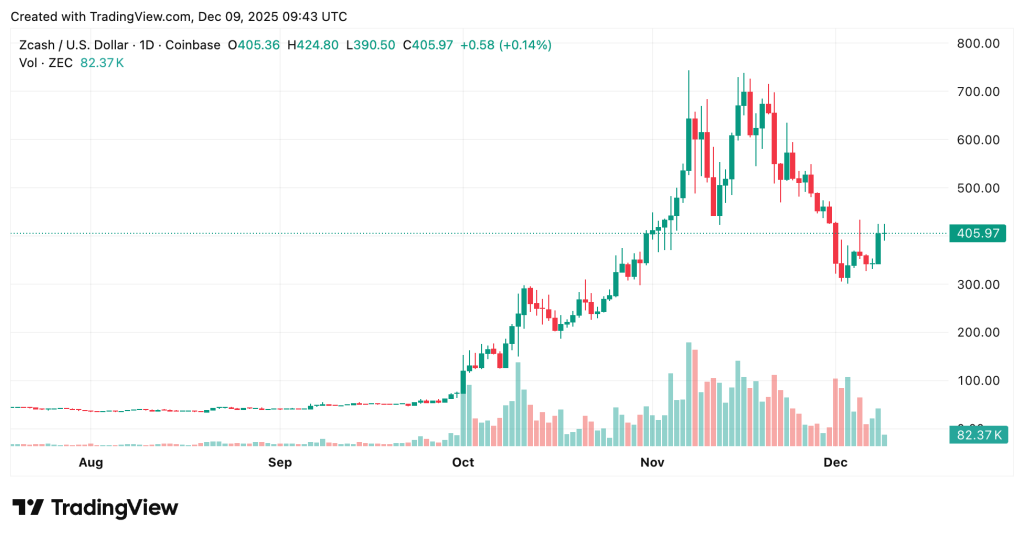
Last month, Zcash received significant institutional validation. The Winklevoss twins’ treasury vehicle has acquired 200,000 ZEC since November, worth over $80 million, targeting eventual ownership of roughly 5% of the circulating supply.
Similarly, Reliance Global recently liquidated all other digital asset positions to focus exclusively on Zcash.
Grayscale also filed with regulators to convert its existing Zcash Trust into a spot ETF tracking the CoinDesk Price Index, potentially opening new access channels for institutional investors.
So far, the token’s share of supply held in shielded addresses has climbed to approximately 30% from an average of 10% in 2024, according to Grayscale Research.
Looking forward, as Carter Feldman, Founder and CEO of Psy Protocol, told Cryptonews, we are seeing a surge in demand for onchain privacy, and “not just at the base layer, but also with the emergence of next-generation blockchains designed for privacy-preserving smart contracts, like Psy, Miden, and Aztec.”
