Phantom’s Bold Bet: Why Solana’s Top Wallet Is Skipping the Stock Market IPO Frenzy

While crypto rivals rush to Wall Street, Phantom's holding its ground on the blockchain frontier.
The Defiant Stand
Solana's dominant wallet isn't following the IPO parade—choosing decentralization over traditional finance's regulatory circus. No S-1 filings, no shareholder meetings, just pure crypto-native execution.
Building While Others Bank
While competitors chase stock market validation, Phantom's team keeps shipping features that actually matter to users. No time for roadshows when there's real innovation to deliver.
The Crypto Purist's Play
Some call it stubborn—we call it strategic. In a world where every fintech wants to be the next PayPal, Phantom remembers crypto was supposed to replace Wall Street, not join it.
Because nothing says 'revolutionary technology' like begging traditional finance for approval—said no true crypto believer ever.
Phantom: Private Capital vs. Public Scrutiny
Launched in 2021, Phantom is a Solana-based crypto wallet that began with a focus on the blockchain’s eponymous token SOL. It later expanded into Ethereum, Polygon and Sui, and now boasts over 7M monthly active users.
The company, one of the fastest-growing in crypto, counts heavyweights Paradigm, a16z, and Sequoia Capital among its investors, a line-up Millman said gives Phantom access to “as much private funding as we want.”
“Just because you can go public from a revenue perspective does not mean you need to or that you should,” Katherine Dowling, an adviser to Bitwise Asset Management, told Cryptonews in an interview.
“Many companies make the decision to stay private and are quite profitable with their own organic growth. They can fund their business needs without accessing the public markets.”
Dowling said Phantom likely weighed the cost of a public listing. It’s a list that includes regulatory filings, quarterly disclosures, board oversight, and compliance laws that crypto startups have tended to resist in the past.
Crypto firms could also be exposed to the same market pressures that plague traditional corporations, such as earnings anxiety, stock market volatility, and the whims of shareholder sentiment. Dowling notes:
“Given the caliber of their investors and success to date, Phantom has no doubt assessed the pros/cons of accessing the public markets, including the heavy costs and burdens being public places on a business.”
She added that some IPO-ready firms also attract interest from potential suitors, suggesting Phantom is keeping its options open. “There’s the real possibility Phantom is entertaining synergistic buyer interest,” she said.
The timing of Millman’s IPO rejection is noteworthy. Crypto markets have rallied in 2025, spurred by clearer U.S. regulations and a MOVE away from former SEC Chair Gensler’s infamous “regulation-by-enforcement” approach.
“When the IPO market is hot, it is a great time for companies that need additional funding to pursue their growth objectives to go public,” Dowling tells Cryptonews, adding:
“But if they are already comfortably in the green, they may not need to take on this cost and, going forward, burden.”
A Tighter Focus, Not A Token
In his interview on the Empire podcast, Millman dismissed the possibility that Phantom will issue a token, a route often used by crypto companies seeking to raise fresh capital or introduce user incentives.
He said once a token is launched, the company has “responsibility to the stakeholders and holders of the token that you can’t break.” Adding that to the demands of a public listing WOULD be “difficulty times two or three.”
The Phantom co-founder pointed to some of his early token experiments with 0x, where market swings unrelated to the crypto swapping project hurt sentiment and created what he called an “undying hater base.”
“You could launch a token, then the next day [a macro event hits] like TRUMP turning on some tariffs. You may have just accidentally killed your company in that moment. People hate you. Even if it’s not your fault, they don’t care.”
Millman said the dual-path model that integrates an IPO with a token, which is being pursued by the likes of Uniswap and Polymarket, may unlock new business structures, but so far remains untested.
“It’s completely uncharted territory,” he averred. “There’s a lot to lose if we did something like that incorrectly.”
Token sales are so back.
Launching tokens has always been a Core part of the crypto ecosystem. It’s been a source of incredible innovation and product development.
But it’s also caused serious problems – unfair access, max extraction, and misaligned incentives – all of which…
Phantom’s other strategy is just as contrarian. Asked if, like many of its peers, the company was planning to build a blockchain of its own, Millman replied, “No, I don’t think so.”
“Launching your own chain is antithetical to the open, permissionless nature of crypto,” he said. “We are always going to try to just reinvest into Solana and the other ecosystems that are already built.”
Millman said no other blockchain is close to overtaking Solana in its “fast and cheap” performance category. “Solana really captured the fast and cheap narrative. I think that’s over,” he opined.
He added that domain-specific chains such as derivatives DEX Hyperliquid or stablecoin payment networks like Tempo and Arc might gain traction, but not by competing with Solana “on the vectors of fast and cheap.”
Phantom Stays Chained to Solana
According to analysts, Phantom’s reliance on a single ecosystem could expose the firm to concentrated risk. Yaroslav Patsira, fractional director at CEX.io, said Phantom’s growth is closely tied to Solana’s performance.
For example, its revenue shows a 97% correlation with Solana’s total app revenue and 95% with app fees, Patsira told Cryptonews. Each month, he says, Phantom captures around 8-18% of app revenue and 3-9% of app fees.
“The wallet scales almost one-to-one with the broader solana economy,” he explained. “This tight link is both a strength and a risk.”
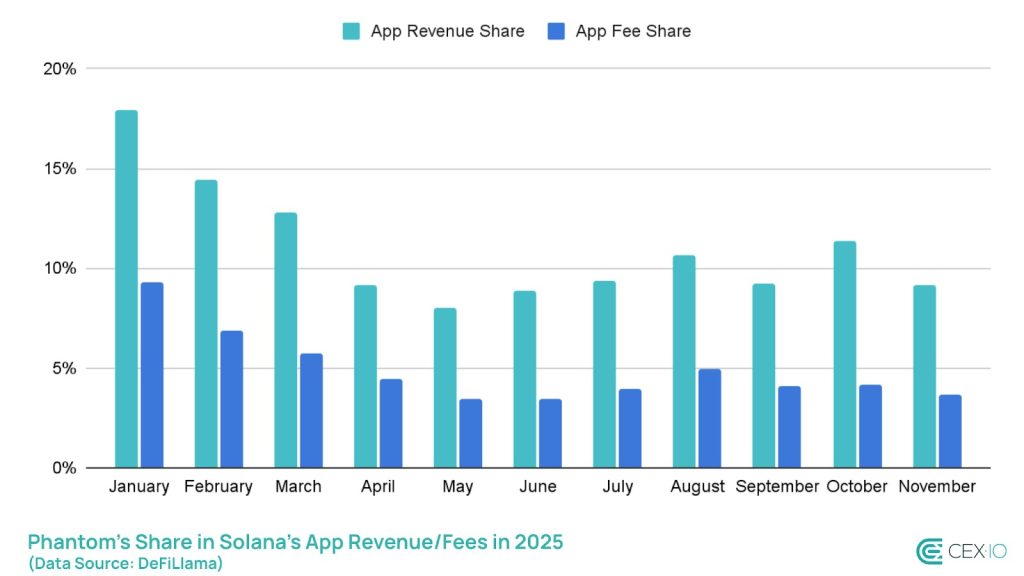
Phantom benefits instantly from spikes in Solana trading activity, whether through decentralized exchanges or meme-driven booms.
On Nov. 13, it briefly became Solana’s largest trading venue, accounting for over 33% of total volume. “This gives Phantom strong network effects and keeps it deeply embedded in the user flow,” Patsira said.

But if activity slows or users migrate elsewhere, the impact is immediate. “In the second half of 2025, a notable portion of memecoin activity moves from Solana to BNB,” he said. “That hit both the network and Phantom’s revenue.”
As companies dump the growth-at-all-costs playbook from the previous bull cycle, experts say Phantom’s decision against a public listing reflects a change in priorities among crypto startups dealing in consumer apps.
Maja Vujinovic is the CEO and co-founder of Digital Assets at Nasdaq-listed FG Nexus, a company that’s focused on accumulating Ethereum. Speaking to Cryptonews, Vujinovic said staying private allows Phantom to “focus on product, not quarterly earnings or market volatility.”
“Private capital is still abundant, and a wallet business benefits from staying nimble rather than getting pulled into the distraction and scrutiny of an IPO. It’s the right move, I would say.”
Path to IPO Readiness Without the IPO
Vujinovic said public markets today reward predictable cash flows, not high-growth volatility. Regulatory uncertainty, particularly around issues to do with wallets, custody, and staking, adds to the risk, she observed.
“With U.S. rules … still unsettled, going public too early can actually box them [Phantom] into rigid compliance frameworks and slow innovation,” Vujinovic said in response to questions from Cryptonews.
She added that Phantom’s choice is an important signal. “It shows consumer crypto companies are finally prioritizing real revenue and sustainability over HYPE cycles,” Vujinovic detailed.
“The hype and fluffy announcements need to go away. If this trend continues, Web3 matures into an industry built on durable economics, not just token sentiment or IPO momentum.”
Dowling, the Bitwise Asset Management adviser, likened the move to the dot-com era.
“Just as we saw the birth and growth of many [internet] companies, we will continue to see crypto companies find the product or market fit and profitability,” she said.
Phantom may be reluctant to go public, but the company is preparing for the discipline required of a publicly traded entity, Millman said.
“One thing that we think about internally, whether or not we IPO, is getting a path to IPO readiness just so we have that sort of hygiene in our company,” said the Phantom CEO.
“That’s a pretty tall order. Thinking about having an IPO and token readiness at the same time sounds difficult.”
