Bitcoin vs Gold: Why Pros Are Dumping Gold for BTC While Boomers Cling to Relics

Wall Street's smart money is making the switch—and leaving gold in the digital dust.
The Great Wealth Transfer
Younger investors see gold as their grandparents' safe haven—heavy, physical, and gathering dust in vaults. Bitcoin? Pure digital velocity. It cuts through traditional finance like a hot knife through butter.The Liquidity Divide
Try selling your gold bars at 3 AM on a Sunday. Bitcoin never sleeps, settling transactions in minutes while gold shipments take weeks. The old guard complains about volatility—meanwhile their 'stable' gold has been outperformed by BTC for seven consecutive years.Institutional Adoption Accelerates
Major funds are allocating 5-10% to digital assets while reducing gold exposure. The writing's on the blockchain: digital scarcity beats physical weight in the modern portfolio. Gold bugs keep waiting for inflation to save them—Bitcoin creates its own economic reality.Store of Value 2.0
Gold had its 3,000-year run. Bitcoin delivers the same scarcity narrative with programmable features gold can only dream of. The metal sits in vaults earning zero yield while Bitcoin becomes the backbone of decentralized finance.Funny how the 'barbarous relic' crowd never mentions their favorite metal's 30% price swings during crisis periods—but they'll scream about Bitcoin's volatility over their morning prune juice.
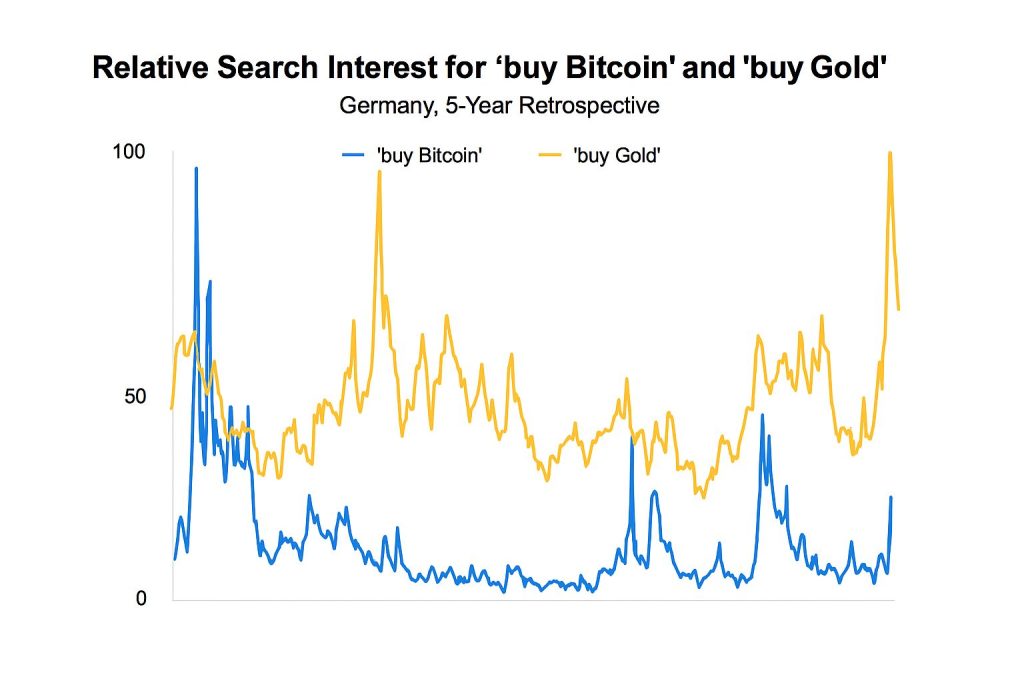 The graphic shows the relative search volume (Google Trend score) for “buy Bitcoin” and “buy gold.” Germany, five-year review, scores evaluated separately. Source: trends.google.de
The current high demand for gold is no coincidence. The precious metal has shown exceptionally strong performance over the past twelve months: Measured in US dollars, the price of gold rose by 43.3 percent – a remarkable figure for such a capital-denominated asset. bitcoin recorded a slightly higher gain of around 48 percent during the same period, but with significantly greater volatility and a much shorter history.

In the ranking of the largest investment assets by market capitalization, Gold clearly tops the list with about $27.6 trillion. Bitcoin, just behind silver, currently holds the eighth position.
The enormous size of the gold market could even prove to be a structural disadvantage in the long term. Moreover, and this may be even more decisive than the sheer market capitalization itself, is the ongoing new supply. While gold continues to expand annually through continuous mining, Bitcoin’s supply is strictly limited by its algorithm.
As the infographic shows, the value of newly mined gold in 2024 amounted to around $680 billion, a figure that requires consistently high demand to maintain stable prices. Bitcoin’s annual new issuance, by contrast, currently stands at about $24 billion.
This structural scarcity means that even relatively small capital inflows can trigger significant price movements. Bitwise CEO Hunter Horsley puts it succinctly: “Gold needs many new buyers to keep prices stable. I believe Bitcoin will be the better store of value.” An assessment that an increasing number of industry observers now share.
As the infographic shows, people aged 18 to 29 already invest more frequently in cryptocurrencies than in gold—a trend that continues in the 30–39 age group. Only from around age 50 does this ratio reverse: in the 50–59 age cohort, traditional precious metals like gold and silver once again dominate. This comes from a recent survey highlighting the differing investment preferences between generations.
As the infographic indicates, gold and Bitcoin have reacted very differently to geopolitical and economic key events in recent years. In the short term—meaning within the first ten days after an event—Bitcoin generally displayed greater volatility and significantly sharper movements up or down. While the precious metal often rose moderately during crises, the cryptocurrency sometimes saw double-digit gains in periods of heightened uncertainty, such as after the U.S.–Iran escalation in 2020 or during the regional banking crisis of 2023.
Over the longer term, viewed over 60 days, the picture becomes more nuanced. In several cases, Bitcoin showed much stronger increases than gold, such as after the 2020 U.S. election or more recently following U.S. tariff announcements in spring 2025.
This suggests that the cryptocurrency increasingly functions as a speculative but potentially higher-yield crisis indicator, while gold continues to play its role as a defensive anchor of stability. Not without reason, more and more experts share a long-term bullish outlook for Bitcoin.
