HTTP 402 Code Makes Crypto Comeback: x402 Token Explodes 2,000% in Wild Market Surge

An obscure HTTP status code just triggered one of crypto's most bizarre bull runs.
The 402 Payment Required protocol—dormant for decades—has roared back to life, fueling a token that's defying all market logic.
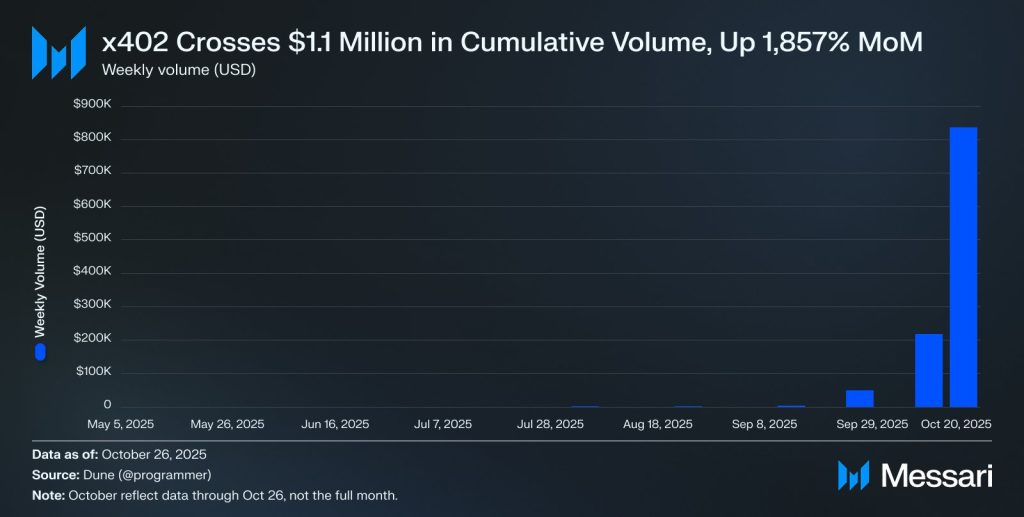
Volume Goes Vertical
Trading activity exploded by 2,000% as developers rediscovered the payment protocol's potential. The surge caught traditional finance completely off guard—proving once again that Wall Street still doesn't understand internet money.
While bankers debate interest rates, crypto builds the actual payment infrastructure of the future. The 402 code's revival shows that sometimes the best financial innovations come from resurrecting old internet ideas rather than creating new banking fees.
 (@CoinbaseDev) May 6, 2025
How x402 Works
After the announcement, there was little to no activity for months. The surge only came in late October. According to Messari, cumulative trading volume surpassed $1 million, marking a nearly 2,000% increase in just days.
To understand what x402 actually does, it helps to look at its name. The number “402” isn’t random; it refers to the HTTP status code 402: Payment Required. If “404 Not Found” sounds familiar, that’s because both come from the same system: the Hypertext Transfer Protocol (HTTP ), the backbone of the web since the 1990s. For decades, the 402 code was listed as “Reserved for future use.” Now, that “future” seems to have arrived.

The HTTP LAYER is exactly where x402 operates. Its core idea is to embed payment directly into the web request. Imagine opening a market analytics website where some data is paid. Instead of creating an account or adding a credit card, the server replies, “Payment Required.”
A browser or machine agent recognizes the instruction, sends the payment in USDC via a chain like Base, and retries the request. The server confirms the payment and unlocks the page. Transactions are made in stablecoins, since they are compatible with EVM networks through EIP-3009, which allows signature-based transfers without separate approvals.
The result is a model where machines or humans pay for web resources directly over HTTP, without traditional subscriptions or card payments.
Even Anatoly Yakovenko, co-founder of Solana, seems impressed.
x402 is awesome https://t.co/gkHPLAzwUG
— toly
Is It Actually Useful?
For crypto and beyond, x402 could mark a real step toward integrating digital assets into the web’s core infrastructure. It tackles real-time data payments and microtransactions, use cases that traditional payment rails have struggled to serve. It also shows how stablecoins can function as a settlement layer between autonomous agents and online services, with no intermediaries required.
According to the project’s website, x402 doesn’t require DEEP blockchain knowledge: “x402 allows any web developer to accept crypto payments without the complexity of having to interact with the blockchain.” Full documentation is available on Base’s GitHub, complete with SDKs and integration examples.
Developers are already experimenting, posting short demos and tutorials showing how x402 can be plugged into existing systems.
 Just hit a big milestone — I successfully made my first-ever localhost x402 request verification and got it returning to the client! This marks a huge leap forward in my x402 integration journey for Ace Data Cloud! So thrilled to see it! pic.twitter.com/9ICSGtXMw9
x402 doesn’t have its own token, and there hasn’t even been a hint of one. At the same time, an ecosystem has started to form, built around tokens linked to projects that integrate or support the protocol. The broader market may remain shaky, but these x402 ecosystem coins have shown impressive weekly gains. According to CoinGecko, many of them are up over 100%.
PAYAI surged over 500% (though it’s now correcting), Unibase (UB) climbed about 250%, and VPay (VPAY) jumped nearly 1,900%. Of course, this kind of growth is rarely sustainable. Some of these coins will likely fade. But the trend itself is telling: traders are clearly drawn to the narrative of instant, intermediary-free payments, especially when paired with AI agents. With Base and Cloudflare behind the concept, the x402 experiment might have technical credibility to match the hype.
The sudden rush of interest, however, is another reminder of how fast narratives MOVE in crypto and how important it is to stay curious without giving in to FOMO.
99% of x402 projects will fail. Here’s why (and how to survive the bubble):
Most “x402 agents” or infra projects won’t make it past this meta.
Because let’s be honest, most of them are:
• Just bots with AI buzzwords
• Memecoins pretending to be “AI agents”
• Copy-paste…

