Solana ETF Battle Intensifies as Grayscale Challenges Bitwise in Wall Street Showdown

Wall Street's crypto arms race escalates as another heavyweight enters the Solana ETF arena.
The Institutional Stampede Begins
Grayscale Investments just threw its hat into the Solana ETF ring, joining Bitwise in a high-stakes competition that's heating up faster than a GPU mining rig. Two major financial firms now vie for the first-mover advantage in what could become the next billion-dollar crypto ETF market.
Why Wall Street Suddenly Cares About Solana
The rush reflects growing institutional confidence in Solana's technology and market position. Speed, scalability, and that sweet transaction cost advantage over Ethereum make SOL increasingly attractive to traditional finance players—who apparently discovered that faster and cheaper might just be better than slow and expensive.
The Regulatory Hurdle Ahead
SEC approval remains the elephant in the room. Both firms must navigate the same regulatory maze that delayed Bitcoin ETFs for years. Because nothing says financial innovation like waiting for government permission to innovate.
Wall Street's latest crypto infatuation proves even traditional finance can't resist chasing the next shiny blockchain object—as long as there are fees to collect and assets to manage.
Grayscale Enters With Staking-Enabled Structure
GSOL carries a 0.35% expense ratio and holds 525,387 SOL tokens, with 74.89% currently staked to generate network rewards.
Grayscale intends to pass on 77% of all staking rewards to investors on a net basis, potentially adding 5-6% annual returns based on historical Solana staking yields of 6-8%.
Introducing Grayscale Solana Trust ETF (Ticker: $GSOL), offering investors exposure to @Solana $SOL, one of the fastest-growing digital assets. $GSOL features: Convenient Solana exposure paired with staking benefits.
 Exposure to a high-speed, low-cost blockchain.… pic.twitter.com/TgVNlhqBPO
The fund first launched as a private trust in 2021, was listed on OTCQX in 2023, and began staking in October 2025.
Inkoo Kang, Senior Vice President of ETFs at Grayscale, framed the launch as evidence that digital assets belong in “” alongside traditional equities and bonds.
Kristin Smith, President of Solana Policy Institute, also noted that staking ETPs allows investors “to help secure the network, accelerate innovation for developers, and earn rewards on one of the most dynamic assets in modern finance.”
The product is not registered under the Investment Company Act of 1940, meaning it lacks the regulatory protections of traditional ETFs and mutual funds.
Grayscale emphasized that GSOL represents indirect exposure to Solana and carries significant risks, including the potential loss of principal.
Bitwise Dominates Early Solana ETF Flows
Bitwise’s Solana ETF captured $69.5 million on its October 28 debut, nearly six times the $12 million raised by Rex-Osprey’s competing product.
BSOL stakes 100% of its held SOL tokens in-house to deliver Solana’s full network yield to investors, charging a 0.20% management fee that has been waived for the first three months.
Matt Hougan, Bitwise’s Chief Investment Officer, attributed institutional enthusiasm to Solana’s on-chain revenue leadership.
“Institutional investors love ETFs, and they love revenue,” he said.
Institutional investors love ETFs, and they love revenue. Solana has the most revenue of any blockchain. Therefore, institutional investors love Solana ETFs.
I have a feeling the Bitwise Solana Staking ETF, $BSOL, is gonna be huge.
This material must be accompanied by a…
Rex-Osprey’s SSK takes a different approach, holding 54% in direct Solana, 43.5% in a Swiss-listed CoinShares ETP, and the remainder in JITOSOL and cash, with monthly staking rewards classified as return of capital for tax purposes.
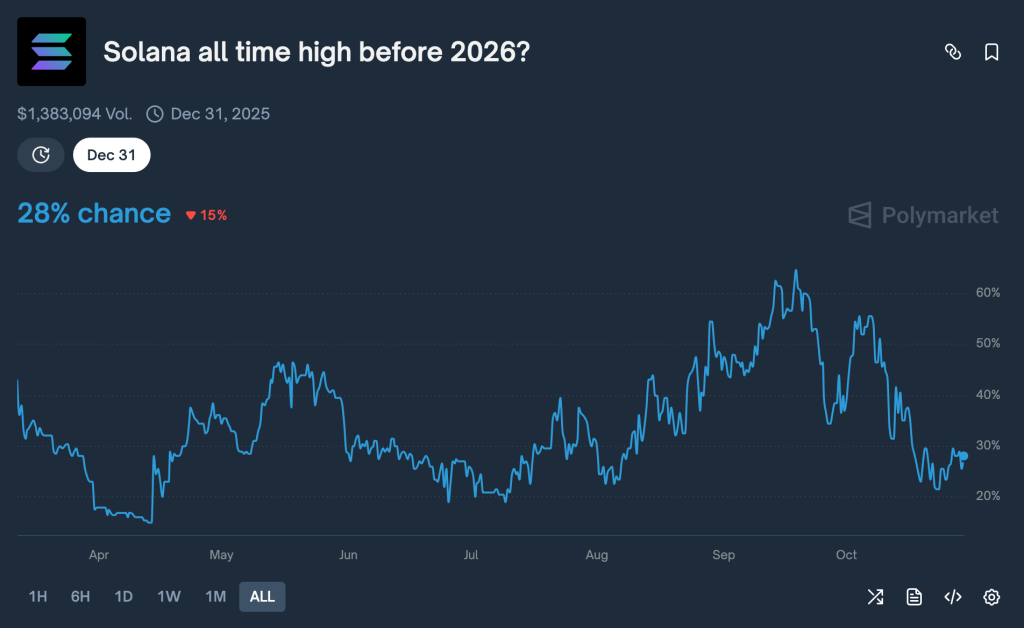
Despite positive sentiment around ETFs, the market remains cautious about near-term price action.
Traders on Polymarket give Solana just a 28% chance of reaching a new all-time high before 2026, with SOL trading at $200 today, up nearly 1% over 24 hours.
Solana Challenges Ethereum’s Institutional Dominance
Speaking with Cryptonews, Maria Carola, CEO of StealthEX, views the Solana ETF launch as a defining moment in the battle for LAYER 1 blockchain dominance.
“The launch of a spot ETF on Solana is a signal that has broken out in the protracted battle for dominance in the Layer 1 blockchain space,” she said.
“For the first time, institutional investors are being invited to consider Solana as a standalone macro asset.“
Carola notes that projections of $3 billion in ETF inflows over the next 12-18 months depend on Solana maintaining its 2024 momentum in DeFi expansion and network stability.
She acknowledges that while Solana offers technological advantages in speed and scalability, “it’s Ethereum’s fundamentals, such as stability, institutional reputation, and integration into the global financial system, that maintain its leadership.”
Ethereum currently holds over $60 billion locked in DeFi with a mature staking ecosystem that continues to set the standard for institutional investors seeking predictability and reliability.
However, Carola suggests a potential coexistence model where “Ethereum serves as the underlying trust and settlement layer in the on-chain economy, while Solana becomes its high-performance execution engine.”
She adds that if ETF inflow projections are met by the end of 2025, “Solana could become the first blockchain since ethereum to break the institutional glass ceiling.“
Regulatory Momentum Builds Across Multiple Blockchains
The Solana ETF wave follows Hong Kong’s October approval of China Asset Management’s SOL spot fund, which began trading on October 27 with a minimum investment of $100.
The product carries a 0.99% management fee and a 1.99% total expense ratio, making Solana the third cryptocurrency, after Bitcoin and Ethereum, to receive spot ETF clearance in the territory.
Multiple U.S. issuers, including VanEck, Canary Capital, Franklin Templeton, Fidelity, and CoinShares, have also received approval for Solana ETF proposals.
 SEC Poised to Approve HBAR ETF — Hedera’s Gregg Bell calls it a “new chapter” for regulated crypto access, marking the first time investors can gain ETF exposure to $HBAR#HBAR #ETFhttps://t.co/x1w10VfAvE
Recently, Bloomberg analyst Eric Balchunas also confirmed that the SEC is expected to approve the first Hedera and Litecoin ETFs, with listing notices for Canary’s HBAR and LTC products scheduled for October 28.
