Ethereum Co-Founder Vitalik Buterin Unveils Fusaka: The Most Ambitious Scaling Solution in Crypto History

Ethereum just dropped its nuclear option on scalability.
Vitalik Buterin's Fusaka protocol represents the most radical architectural overhaul since Ethereum's inception—promising to finally solve the blockchain trilemma that's plagued developers for years.
The Technical Breakthrough
Fusaka doesn't just iterate—it reinvents. Using recursive zero-knowledge proofs and novel data availability schemes, the protocol achieves what layer-2 solutions could only dream about. Transaction throughput jumps from dozens to thousands per second while maintaining decentralization.
Market Impact
This isn't another incremental upgrade. Fusaka positions Ethereum to absorb entire financial ecosystems that previously considered blockchain infrastructure 'not ready for primetime.' Traditional finance giants watching from the sidelines now face undeniable pressure to adopt—or get left behind.
The catch? Implementation requires coordinated ecosystem upgrades that make previous hard forks look like simple patch updates. Buterin's team anticipates full deployment within 18 months, assuming developer buy-in matches the technical ambition.
Meanwhile, Wall Street analysts continue valuing Ethereum using outdated metrics—completely missing that infrastructure breakthroughs, not quarterly earnings, drive real crypto valuation. Fusaka either makes Ethereum unstoppable or reveals the limits of decentralized coordination. Either way—the scaling war just entered its final chapter.
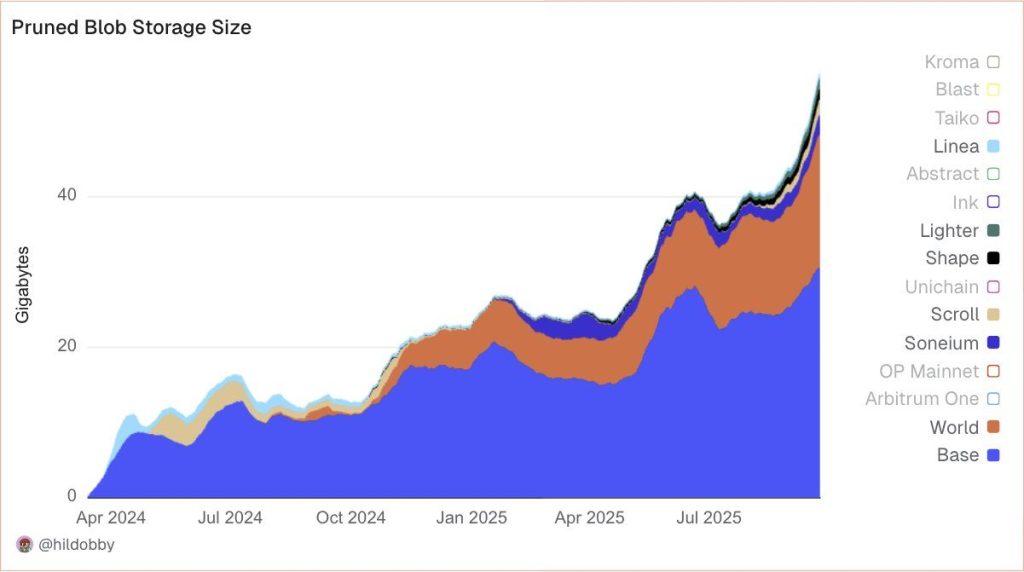 Source: X/@hildobby
Current network congestion forces over 2 million ETH into exit queues, facing 43-day delays, while entry processing completes in just 7 days.
Fusaka will more than double blob capacity within two weeks through automated parameter-only forks, expanding from the current limits of 6/9 blobs to 14/21.

The phased approach begins with conservative increases before becoming more aggressive as the technology proves stable.
The upgrade comes as Ethereum’s revenue fell 44% to $14.1 million in August despite ETH reaching new all-time highs above $4,950.
Layer 2 adoption has reduced base layer fee generation, creating sustainability concerns about the network’s economic model.
Revolutionary Data System Changes Everything
As reported earlier, the Fusaka Upgrade is scheduled to go live on December 3, and PeerDAS will fundamentally alter how the blockchain networks handle information by distributing data verification across thousands of computers, rather than requiring complete downloads.
Traditional systems force every participant to store entire blocks, creating bottlenecks as networks grow larger.
The new approach uses mathematical probability to ensure data availability. If more than 50% of data chunks remain accessible across the network, any computer can theoretically download those pieces and reconstruct missing information using erasure coding techniques.
Initially, complete data blocks must still exist in one location for broadcasting new information and emergency reconstruction when publishers provide incomplete data.
However, these roles remain untrusted, requiring only one honest participant among potentially hundreds of dishonest actors.
Future developments will eliminate even these centralized functions through cell-level messaging and distributed block building.
Different computers can handle these tasks for different blocks, which further decentralizes the entire process.
Fusaka will fix this.
But also, safety first is of the utmost importance for Fusaka. The Core feature, PeerDAS, is trying to do something pretty unprecedented: have a live blockchain that does not require any single node to download the full data.
The way PeerDAS works is that… https://t.co/go6QsqjaFC
Notably, Buterin emphasized the cautious testing approach CORE developers have adopted despite years of development work.
The conservative blob count initially increases and will become more aggressive as real-world performance validates the technology’s stability and security.
Ethereum Battles Revenue Crisis With Infrastructure Focus
The Fusaka upgrade addresses Ethereum’s growing economic challenges as Layer 2 networks reduce mainnet transaction demand.
August revenue of $14.1 million marked one of the weakest months since early 2021, which has raised concerns about sustainability.
Witnessing this, Buterin recently proposed low-risk DeFi protocols as Ethereum’s potential revenue anchor, comparing the model to Google Search funding broader company operations.
He suggested protocols offering 5% yields on blue-chip stablecoins could provide economic stability without compromising ethical foundations.
These protocols include mainstream lending platforms like Aave, where users can earn stable returns by supplying USDT and USDC to borrowers without speculative risks.
 Ethereum co-founder @VitalikButerin believes the network’s long-term sustainability may depend on an unlikely hero — low-risk DeFi protocols.#Ethereum #Buterinhttps://t.co/zte7GmHoaw
Fusaka’s infrastructure improvements will reduce transaction costs for such applications, making them accessible to everyday users who previously faced prohibitive gas fees when interacting with DeFi protocols.
The upgrade includes 11-12 ethereum Improvement Proposals targeting scalability and node efficiency improvements.
Blob parameter-only forks will activate automatically based on predetermined schedules rather than requiring separate network upgrades.
Additionally, recent controversies in the validator queue also add to the ongoing scalability pressures.
However, Buterin defended the current 43-day exit delays as essential security features, comparing validator commitments to military service, which requires “friction in quitting.”
The upgrade follows May’s successful Pectra implementation, which introduced account abstraction and increased validator staking limits from 32 ETH to 2,048 ETH.
That upgrade delivered infrastructure improvements for social recovery wallets and smart contract execution capabilities.
For Fusaka, the improvements in data availability will support the next growth phase of Ethereum, while maintaining the security guarantees that distinguish Ethereum from its competitors.
