The EU-US Customs Deal: How This Historic Pact Reshapes Global Trade in 2025

Trade wars? Tariffs? The EU and US just sidestepped decades of deadlock with a customs deal that rewrites the rules.
Why This Isn’t Just Another Bureaucratic Handshake
Forget minor tweaks—this agreement slashes red tape for 40% of transatlantic trade. Suddenly, everything from German autos to Kentucky bourbon flows faster.
The Crypto Angle Wall Street Missed
While traditional finance obsesses over tariffs, blockchain firms quietly cheer. Customs digitization means smart contracts could automate $2.8 trillion in annual trade—no middlemen taking their usual pound of flesh.
Bet You Didn’t See This Coming
Three years post-Brexit, the UK now faces an ironic dilemma: beg Brussels for similar terms or watch London’s financial hub status erode further. Poetic justice for the ‘sovereignty’ crowd.
Bottom Line: This deal proves globalism isn’t dead—it’s evolving. And for once, the bureaucrats actually delivered something useful. (Unless you’re a customs broker—RIP your commission fees.)
In Brief
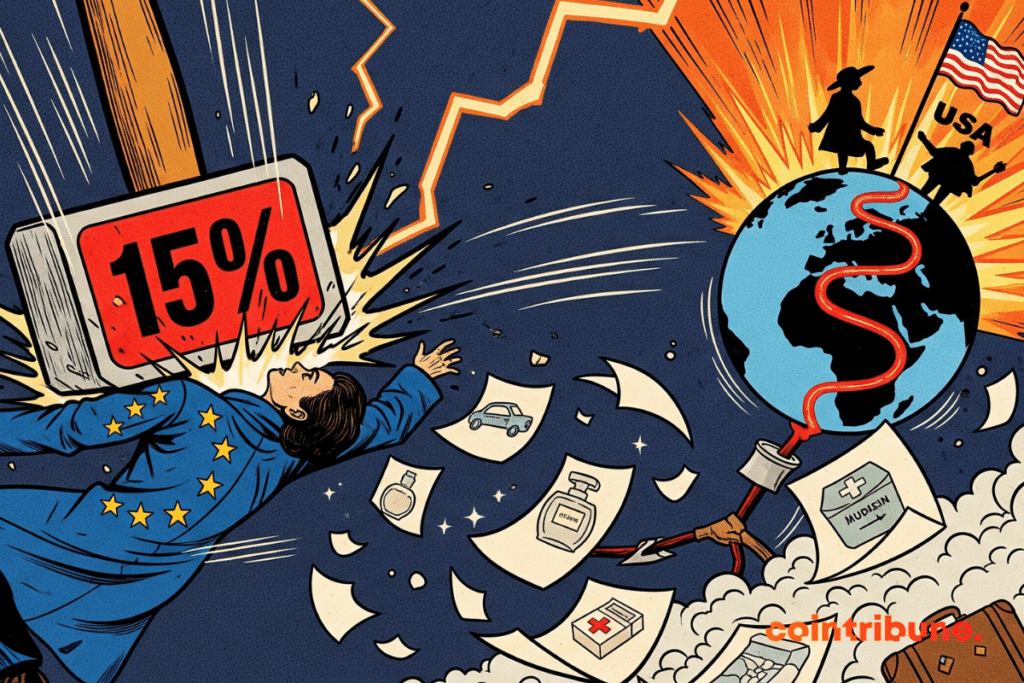
- Trump imposes a 15% tax on key sectors of the European economy.
- The EU commits to purchasing 750 billion dollars of American energy, weakening its economic sovereignty.
A European economy hit at the heart of its strategic sectors
Sunday, July 28,imposes a 15% tax on a wide range of European products exported to the United States. More explicitly, this protectionist turn directly affects strategic sectors such as:
- automotive,
- luxury,
- pharmaceuticals,
- cosmetics.
For example, German manufacturers will now face a 15% customs duty — a change from the 27.5% tariffs they’ve been subject to since April. In the luxury sector, LVMH and Kering are trying to offset the impact by relocating part of their production to the U.S. However, wine and spirits exports remain in a grey area, with no clear resolution in sight. These sectors account for €8 billion in annual exports.
An agreement with vague outlines but massive impact
The transatlantic economy is also shaken by the EU‘s commitment to, including American shale gas. These promises, which are difficult for the European Commission to implement, risk worsening the trade balance. But not only that! They could also contradict climate goals, as highlighted by the agreement concluded between Ursula von der Leyen and Donald Trump on tariffs.
Another sensitive point: the end of customs exemption for medicines, which alone represent 22.5% of European exports. For many observers, this is a ticking time bomb for European trade policy.
In total, between forced imports, sectoral taxation, and industrial reorientations, this agreement ushers the European economy into.
One thing remains certain: the agreement between Donald Trump and the European Union illustrates a profound reshaping of the global economy. It is clear that international trade is now played on unequal terms.
Maximize your Cointribune experience with our "Read to Earn" program! For every article you read, earn points and access exclusive rewards. Sign up now and start earning benefits.
