BRICS Set to Shake Global Finance with New Currency Launch by 2026!

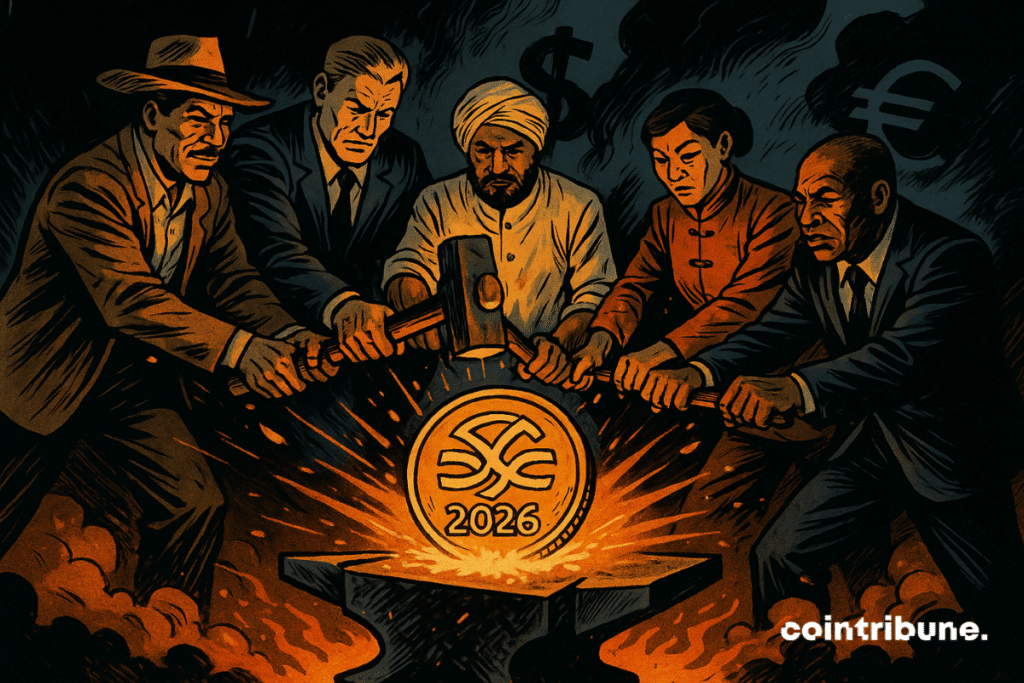
The BRICS alliance is gearing up to drop a financial bombshell—a unified currency that could redraw the global economic map by 2026. Here's why Wall Street should be sweating.
The Dollar's New Rival?
Five nations controlling 40% of the world's population are about to play monetary hardball. This isn't just another altcoin—it's a geopolitical power move wrapped in economic pragmatism.
Timing Is Everything
With 2026 circled in red on the economic calendar, the countdown begins. The move comes as developing nations increasingly bypass SWIFT and dodge dollar dominance through bilateral trade deals.
Bankers Hate This One Trick
While JP Morgan analysts call it 'unworkable,' the same was said about Bitcoin in 2010. The BRICS playbook? Cut out the middleman, save on forex fees, and maybe—just maybe—make the IMF irrelevant.
One thing's certain: the financial old guard won't go down without writing some angry op-eds first.
In Brief
- The BRICS strengthen their monetary cooperation with a clear goal: to launch a common currency as early as 2026.
- At the last summit, leaders endorsed concrete advances, notably through the expansion of settlements in local currencies.
- The project relies on BRICS Pay, a digital infrastructure under development to facilitate cross-border payments.
- Pilot tests are planned before 2026 to assess system compatibility and the viability of a common currency.
The political and monetary axis is strengthening
During the 17th BRICS summit, held in early July 2025 in Brazil, leaders took a new step in their drive for monetary emancipation from the dollar. Thus, the bloc members reaffirmed their commitments to monetary cooperation and endorsed substantial advances in the expansion of trade in local currencies as well as in the development of BRICS Pay.
Although no official launch date has been set, analysts estimate that the project follows a structured multi-phase approach and that 2026-2027 is now the realistic horizon for operational implementation.
The dynamics underway within the bloc show concrete empowerment, supported by several strategic levers:
- Intensification of settlements in local currencies: Russia and China favor the ruble and yuan in their bilateral trade, while India is expanding the use of the rupee with Global South countries;
- Strengthening of the BRICS Pay project: a common payment system at the heart of the bloc’s financial sovereignty strategy;
- The declared objective of dedollarization: an active reduction of dollar use in exchanges, especially for raw materials;
- The enlargement of the bloc: this new perimeter represents 46% of the world population and 37% of global GDP, which increases the legitimacy of a monetary alternative.
These elements are no longer just diplomatic rhetoric. They reflect real coordination, reinforced by tangible economic and diplomatic facts. The bloc now expresses a clear ambition: to build an independent monetary infrastructure, on a precise timetable, and with interoperable tools already in development.
The digital infrastructure, pillar of the monetary project
Beyond the political and commercial dimensions, the BRICS currency project rests on an ambitious technological foundation. Indeed, member states “are actively building sophisticated payment systems” capable of supporting the future common digital currency.
These infrastructures notably rely on blockchain to facilitate cross-border payments and bypass traditional systems such as SWIFT. The development of BRICS Pay is at the Core of this technical strategy, aiming to interconnect central banks and end users through a unified, interoperable, and resilient interface.
Research work on central bank digital currencies (CBDCs) is also being integrated into the project architecture. Thus, member countries “are making productive progress in research on integrating CBDCs”, with pilot programs planned to test key stages of the timetable by 2026.
These experiments should allow calibrating the compatibility between existing national digital currencies and a supranational monetary unit still in development. The stakes are twofold: ensure smooth multilateral settlements while guaranteeing the monetary sovereignty of each member state.
The implications of such a shift are major. A functional BRICS currency, particularly the great shift towards local currencies, could redefine global monetary correlations, influence pricing of raw materials (especially energy), and offer Global South countries a credible alternative to the dollar. However, the success of the project will depend on fine coordination between economies with divergent profiles, political stability among members, and the ability to establish trust in a monetary unit still theoretical.
Maximize your Cointribune experience with our "Read to Earn" program! For every article you read, earn points and access exclusive rewards. Sign up now and start earning benefits.
