Fed Cuts Rates Again Amid Growing Internal Division - What It Means for Your Crypto Portfolio

The Federal Reserve just dropped rates again—but this time, the cracks are showing. Internal dissent is boiling over, and the traditional playbook is looking frayed at the edges.
The Split at the Heart of the System
Forget unanimous decisions. The latest cut comes with a side of very public disagreement among policymakers. Some see it as a necessary shield against economic headwinds; others view it as a dangerous gamble that could overheat everything. This isn't just bureaucratic squabbling—it's a signal that the old consensus is breaking down.
Digital Assets Don't Wait for Consensus
While central bankers debate, crypto markets operate on a different clock. Rate cuts traditionally weaken the dollar, and a softer dollar has historically been rocket fuel for hard assets like Bitcoin. This institutional indecision creates the perfect volatility cocktail for traders who thrive on uncertainty.
The real story isn't the rate cut itself—it's the loss of confidence it reveals. When the masters of the traditional financial universe can't agree on the path forward, it makes their whole model look a bit less like science and a lot more like guesswork. And nothing fuels the argument for decentralized alternatives quite like watching the centralized planners fight amongst themselves. After all, in finance, the only thing more predictable than a rate cut is the herd of Wall Street analysts who will claim they saw it coming all along.
 Read us on Google News
In brief
- The U.S. Federal Reserve lowered its key interest rates by 25 basis points, placing them between 3.50 % and 3.75 %.
- This is the third consecutive cut since September, amid an economic context marked by uncertainty.
- Two Fed members voted against this decision, while another advocated for a stronger 50-point cut.
- The lack of recent economic data, due to the shutdown, made decision-making particularly delicate.
An expected but controversial cut within the Fed
The U.S. Federal Reserve announced, on Wednesday, December 10, a new 25 basis point cut to its key interest rates as markets had anticipated, bringing the Fed Funds Rate range to 3.50 % – 3.75 %.
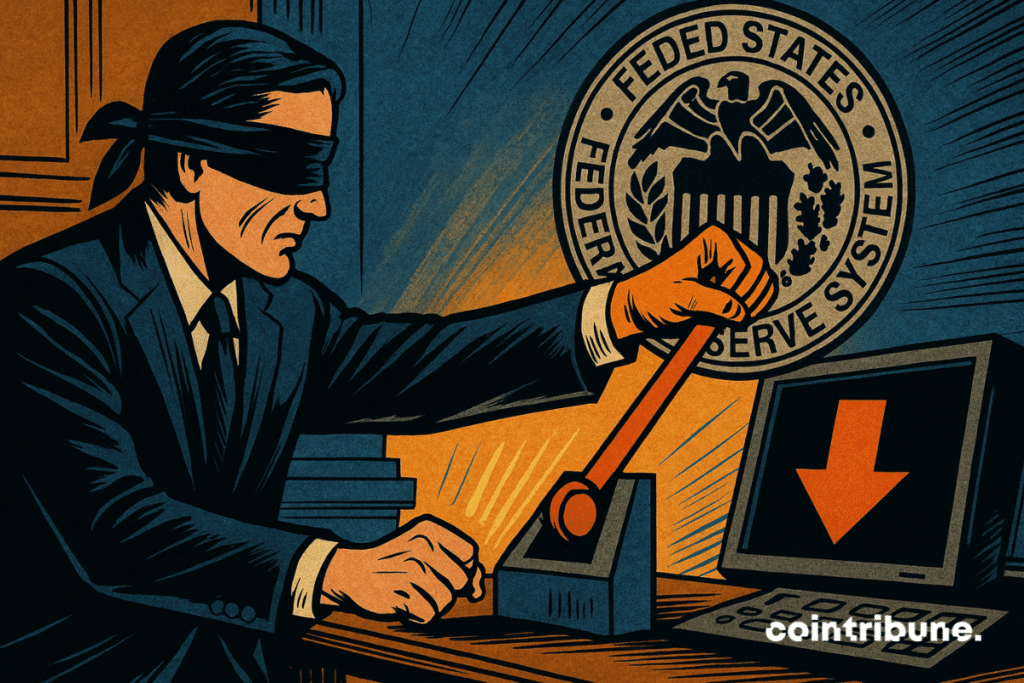
This marks the third consecutive cut since September. This decision, although expected by markets, was not unanimous within the monetary policy committee. According to the official statement, “uncertainty regarding economic prospects remains high”, and the committee “judges that downside risks to employment have increased in recent months”.
The internal dissensions, rarely so marked, were made public :
- Two members voted against the rate cut : Jeffrey Schmid (Kansas City) and Austan Goolsbee (Chicago), both supporters of the status quo ;
- One member, Stephen Miran, recently appointed by Donald Trump, distinguished himself by voting for a more aggressive 50 basis point reduction ;
- This division reflects a deep disagreement on the strategy to adopt in an still unclear economic context.
This tension is also explained by the lack of updated on-chain economic data, a direct consequence of the extended U.S. government shutdown. The latest available unemployment rate, from September, is 4.4 %, while inflation then reached 2.8 %, above the 2 % target.
Several key indicators, such as job creation and consumption data, have not been published for several weeks, leaving the Fed in a delicate position. Due to lack of visibility, some members preferred to wait, while others judged it necessary to act now to support the labor market.
A Fed under political pressure at the dawn of 2026
Beyond internal tensions, this monetary decision comes in a particularly sensitive political context.
President Donald TRUMP has intensified his criticism of Jerome Powell, whom he blames for monetary policy still too restrictive. Powell’s term expires in spring 2026, and the White House has already launched consultations to replace him with a more accommodative profile.
According to several sources, Kevin Hassett, former economic advisor to Trump, is among the favorites. Trump makes no secret that he expects the future Fed chair to lead a more accommodative policy. This growing politicization of the central bank fuels concerns about the institution’s future independence.
In parallel, the composition of the FOMC will evolve in 2026: four new voting members from regional banks will join the committee, according to the usual rotation system. This renewal could change the internal balance of debates, especially if profiles more favorable to low rates are appointed or promoted by the executive.
In the economic projections published this Wednesday, the Fed anticipates only one rate cut for 2026, while markets expect two. This divergence between the institution’s discourse and market expectations increases uncertainty, notably for investors seeking visibility.
The Fed resists Trump and maintains its stance despite political pressures. By opting for a measured cut, it asserts its independence while accommodating the markets. The question remains whether this stance will hold against the economic tensions of 2026 and investors’ growing expectations.
Maximize your Cointribune experience with our "Read to Earn" program! For every article you read, earn points and access exclusive rewards. Sign up now and start earning benefits.
