Ethereum Burns $18B in Tokens, Yet Its Supply Defies Logic and Keeps Growing

Ethereum just torched another $18 billion worth of its own currency. The burn mechanism, designed to create digital scarcity, is working overtime. So why is the total supply still climbing?
The Deflationary Promise vs. The Inflationary Reality
EIP-1559 was supposed to flip the script. Every transaction now incurs a base fee that gets permanently destroyed, theoretically making ETH a deflationary asset. The numbers don't lie—$18 billion has vanished into the cryptographic ether. Yet, the network's total token count tells a different, more stubborn story.
Staking Rewards: The Unstoppable Counter-Force
Here's the catch. While fees burn on one side, the proof-of-stake consensus mints new ETH on the other. Validators securing the network earn freshly created tokens as rewards. This continuous issuance acts as a powerful inflationary pressure, a relentless drip-feed of new supply that the burn rate struggles to outpace.
A Network at War with Itself
The result is a fascinating economic tug-of-war. Fee burn aggressively removes tokens from circulation, aiming to boost value for holders. Simultaneously, staking rewards inject new tokens to pay for security, potentially diluting that same value. It's a high-stakes balancing act where the market cap grows, but your individual slice of the pie might not—a classic finance tale of 'growth' that doesn't quite trickle down.
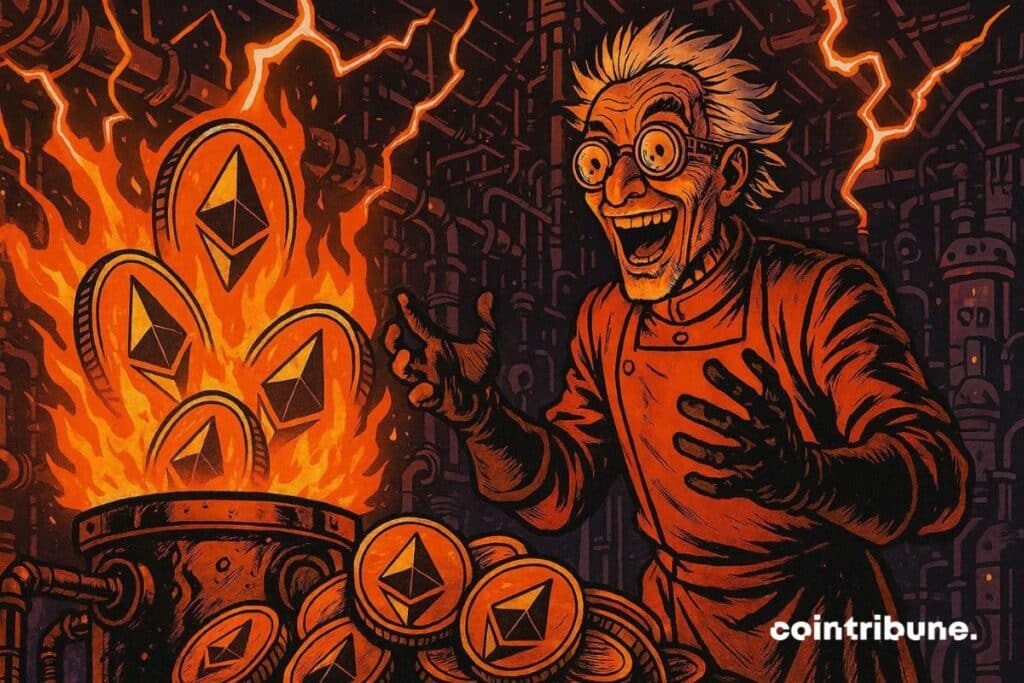
For now, the ledger shows growth. The burn furnace is hot, but the mint is still on. Until network activity reaches a fever pitch that permanently outpaces validator payouts, Ethereum's supply will keep inching upward, proving that in crypto, even a $18 billion fire can't always burn away the fundamentals.
 Read us on Google News
In brief
- Ethereum has burned 6.1 million ETH ($18 billion) via EIP-1559, but its total supply keeps growing.
- Despite the burn, issuance of new ETH often exceeds destroyed volumes, maintaining a net annual inflation of about 0.8%.
- The Fusaka update could reverse Ethereum’s trend, boosting crypto network activity.
Crypto: Ethereum burns $18 billion in value
The introduction of EIP-1559 in August 2021 marked a turning point for Ethereum. This mechanism, integrated through the London hard fork, allows burning a portion of crypto transaction fees, thus reducing the circulating supply. To date, more than 6.1 million ETH have been permanently removed, representing a value of 18 billion dollars at the current rate.
The most active protocols, like OpenSea and Uniswap, contribute massively to this phenomenon. For example, OpenSea, the leading NFT platform, alone has burned hundreds of thousands of ETH. Periods of high activity, such as transaction peaks in 2021 and 2022, accelerated this process, but since then, the pace has slowed down.
Data shows that the volume of ETH burned depends directly on network usage. In 2025, with decreased activity, the burning rate slowed, limiting the expected deflationary impact. Despite everything, this mechanism remains a key tool to regulate crypto supply in the long term.
Why Ethereum keeps expanding despite burning 6 million ETH
Even with 6 million ETH burned, Ethereum’s total supply keeps growing. The reason? The switch to Proof-of-Stake (PoS) in 2022. Unlike Proof-of-Work (PoW), PoS issues new ETH to reward validators who secure the crypto network. As a result, about 4 million ETH have been added to supply since the London hard fork.
The PoS mechanism, though less inflationary than PoW, maintains a net positive issuance. During periods of low activity, burned fees are insufficient to offset newly issued ETH. Thus, despite efforts to reduce supply, Ethereum remains inflationary, with an estimated annual rate of 0.8%. The consequences are twofold: on one side, a growing supply limits ETH’s scarcity; on the other, a rebound in activity could reverse the trend.
Crypto: Could Fusaka save Ethereum?
The recent Fusaka update, deployed on Ethereum, introduces major optimizations to reduce transaction costs and improve network efficiency. By facilitating the adoption of rollups and LAYER 2 solutions, Fusaka could revive blockchain activity, thereby increasing the volume of ETH burned through crypto transaction fees.
If this update manages to attract more users and projects, the burning rate could surpass net issuance, making Ethereum deflationary. However, effects will only be visible in the medium term. By the end of 2025, forecasts vary. Some crypto analysts predict stabilization around $3,000. Others, more pessimistic, mention a bearish scenario if Ethereum fails to differentiate itself from competitors like Solana.
Ethereum has burned $18 billion in ETH, but its supply keeps growing. This paradox is explained by the Proof-of-Stake mechanism, which still issues new tokens. The question remains open: will Ethereum become deflationary? The answer will depend on the evolution of its ecosystem and its ability to attract more crypto users.
Maximize your Cointribune experience with our "Read to Earn" program! For every article you read, earn points and access exclusive rewards. Sign up now and start earning benefits.
