Bitcoin Miners Pivot to AI - But Revenue Still Playing Catch-Up

Bitcoin's backbone is undergoing a seismic shift—miners are diving headfirst into artificial intelligence, yet their balance sheets aren't keeping pace with the hype.
The Great Compute Migration
Mining operations worldwide are repurposing their massive computing power toward AI model training and inference workloads. Those warehouses full of GPUs that once secured the Bitcoin network are now crunching neural networks instead of cryptographic puzzles.
Revenue Reality Check
Despite the strategic pivot, earnings reports tell a different story. AI contracts aren't delivering the same margins that Bitcoin mining once commanded during bull markets. The transition's proving more complex—and less profitable—than many anticipated.
Infrastructure Growing Pains
Retrofitting mining facilities for AI workloads comes with hidden costs: specialized cooling systems, different power requirements, and entirely new client acquisition strategies. It's not just about flipping a switch.
Wall Street's already placing bets on which miners will survive the transition—because nothing says innovation like betting on other people's infrastructure struggles.
 Read us on Google News
In Brief
- The global hashrate explodes, but miners’ revenues stagnate or even flirt with the critical threshold.
- Return on investment now exceeds three years for new bitcoin mining machines.
- Cipher, IREN, and CleanSpark turn to AI and cloud to diversify their revenues.
- Stock markets are booming, driven by announcements despite a sharp decline in real profitability.
Bitcoin in the red, but the hashrate breaks records
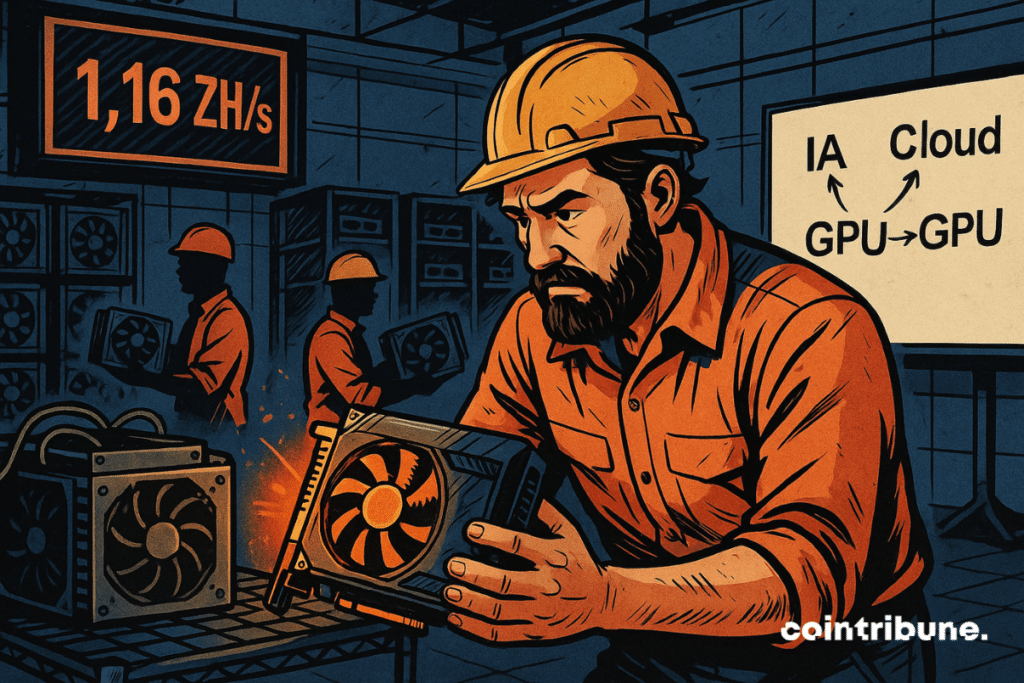
On one side, the global hashrate for bitcoin mining reaches a historic peak at 1.16 ZH/s. On the other, the hashprice falls to 35 $/PH/s, gnawing margins down to the bone. In short? More power, but for less revenue. The return on investment for machines now exceeds 1,200 days. At this pace, even the most efficient rigs become energy-consuming kettles.
The report from The Miner Mag accurately summarizes the situation, saying mining margins have weakened as hashprices have fallen and machine amortization periods have lengthened, even though publicly traded mining companies have bounced back thanks to analyst recommendation upgrades and new deals in high-performance computing (HPC).
In this climate, some miners give in to the temptation of over-indebtedness. Others just “bite the bullet,” hoping for kinder days in BTC prices. Meanwhile, the infrastructure keeps growing… mechanically.
Bitcoin in the cloud: miners bet on AI
Facing this downward spiral, industry giants adapt their strategy. CleanSpark, Cipher Mining, IREN: all redirect their computing power towards the cloud and HPC (High Performance Computing), hoping to find new cash cows.
And it’s starting to pay off… at least on the markets. J.P. Morgan recently boosted morale by raising its forecasts: Cipher could climb to $18, IREN to $39. And why this enthusiasm? Because Cipher has already secured 600 MW of capacity for AWS and Google via Fluidstack, while IREN signed a $9.7 billion contract with Microsoft to host Nvidia GB300 GPUs.
But beware of the magnifying effect. The report from The Miner Mag points out that the revenues from these services, although increasing, remain too low to truly compensate for the sharp drop in bitcoin mining gains.
In short, AI will not save everyone. And certainly not right away.
When the stock market booms while bitcoin wears out
Curiously, despite struggling fundamentals, mining stocks are soaring. Cipher Mining rises 4.59%, CleanSpark 4.42%, and even outsiders like RIOT or MARA regain color. The engine? Optimistic analyst ratings, juicy deals with tech giants, and a persistent faith in BTC’s long-term potential.
Yet, not everything is rosy. JP Morgan analysts have lowered their targets for MARA ($13) and RIOT ($17), pointing to their large BTC reserves and stock dilution. In short: these companies stockpile bitcoin like piling up buoys… but at what cost?
The entire mining ecosystem finds itself in a strange balance between innovation, speculation, and disillusionment.
Key figures to remember
- The global hashrate peaks at 1.16 ZH/s;
- The bitcoin price at the time of writing: $87,243;
- The hashprice has fallen to $35/PH/s, down from $55 just a quarter ago;
- AI/HPC contracts signed approach $10 billion, but the revenues remain minimal;
- Return on investment exceeds 1,200 days in an industry historically profitable within a few months.
While the United States funds abundantly and Europe seeks greener regulation, China moves covertly. Officially, it still bans bitcoin mining. Unofficially? It hosts up to 20% of the global hashrate. The low-cost electricity from Xinjiang and Sichuan powers ever more numerous “ghost” farms. A shadow strategy that says a lot about geopolitical ambiguities around BTC. For Beijing, it might be better to mine discreetly than depend on the dollar.
Maximize your Cointribune experience with our "Read to Earn" program! For every article you read, earn points and access exclusive rewards. Sign up now and start earning benefits.
