DeFi Governance Chaos: Why CRV Soars While AAVE Crashes in 2025’s Crypto Storm

DeFi's governance systems are cracking—and the market's reaction reveals everything about real power in decentralized finance.
Token holders just watched two major protocols take opposite trajectories during the same governance crisis. Curve's CRV token defied logic with a bullish surge while Aave's governance token plunged double-digits. The divergence exposes fundamental flaws in how DeFi projects handle decision-making when stakes are highest.
The Contagion Effect (Or Lack Thereof)
Traditional finance would expect correlated declines across similar assets during sector-wide stress. DeFi's governance tokens broke that pattern completely. CRV's resilience suggests either exceptional protocol fundamentals or sophisticated market manipulation—while AAVE's decline hints at deeper structural vulnerabilities the market priced in immediately.
Governance Isn't Just Voting Anymore
Passive token holders learned the hard way that governance rights come with real financial consequences. The crisis revealed how proposal mechanisms, veto powers, and emergency protocols actually function when billions are at risk. Several major proposals stalled entirely as factions within each DAO fought for control, creating decision paralysis exactly when decisive action was needed.
Whale Movements Tell the Real Story
On-chain data shows coordinated accumulation patterns around CRV during the turmoil, while AAVE experienced sustained institutional outflow. The divergence wasn't random—it reflected calculated positioning by entities with inside knowledge of each protocol's governance resilience. Sometimes decentralization looks suspiciously like old-fashioned insider trading with extra steps.
What This Means for Your Portfolio
Governance token volatility now reflects political risk alongside financial metrics. Investors must assess proposal success rates, voter participation trends, and contingency mechanisms before allocating capital. The days of treating governance tokens as simple yield vehicles are over—each now carries embedded political optionality that can swing valuations 30% in either direction overnight.
DeFi's governance experiment just entered its most dangerous phase. Protocols that survive will emerge with battle-tested systems; those that fail will become case studies in how decentralized decision-making collapses under pressure. Either way, traders are making fortunes betting on which governance models actually work when everything goes wrong—proving once again that in crypto, someone always profits from the chaos.

The DeFi space has entered a crucial phase wherein the two popular platforms are facing governance issues. Curve DAO and Aave, both protocols, have entered an active dispute over the revenue share. As a result, the Aave Price has come under selling pressure, while the CRV price has maintained a substantial ascending trend. In times when the traders are dealing with these tokens differently, the impact on the prices of the cryptos needs to be closely watched.
Governance stress exists in both, but it’s not the same kind
At first glance, Curve and AAVE appear to be facing a similar problem: disagreements between token holders and core contributors. Dig deeper, and the nature of that friction diverges sharply.
In the case of Curve DAO, recent governance debate has focused on developer funding, treasury transparency, and DAO oversight. These discussions are messy but familiar in mature DAOs. Importantly, they do not threaten Curve’s Core economic engine—stablecoin liquidity, trading volumes, and fee generation remain intact.
By contrast, Aave is dealing with a governance dispute that touches the most sensitive area possible: revenue ownership and control. Questions around where protocol-linked fees flow, who controls key assets, and how decisions are pushed through governance have raised concerns about alignment between the DAO and the core development entity.
Markets tend to tolerate procedural noise. They react far more aggressively when economic clarity is questioned.
Why Markets Are Treating CRV and AAVE Very Differently
Despite both protocols facing governance tension, traders are reacting to price behavior at key levels, not just headlines. AAVE is trading NEAR $151.44, down 4.79% in the last 24 hours, and price action remains heavy. Each intraday bounce has failed to hold, signaling that sellers are using rallies to exit rather than build positions. This keeps AAVE locked in a short-term distribution phase.
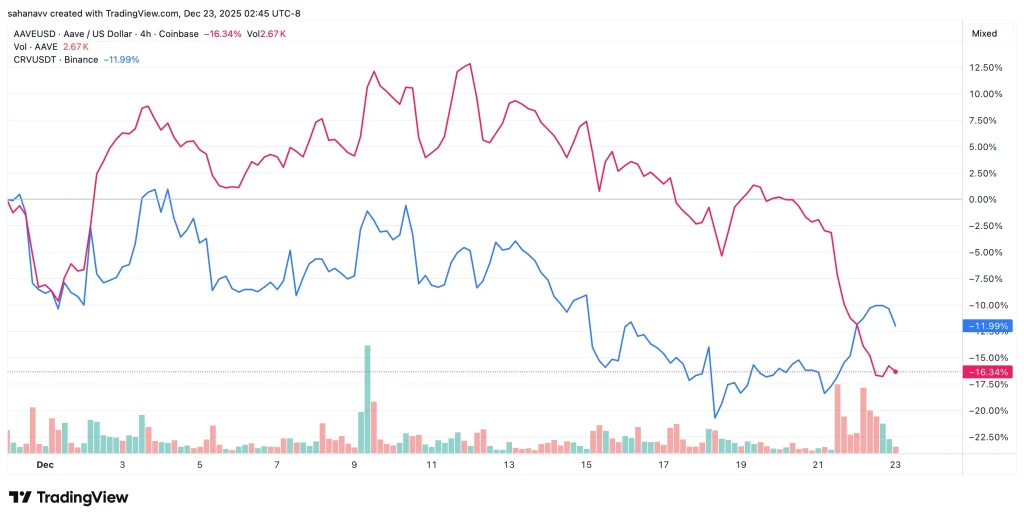
By contrast, CRV is holding around $0.3688, up a modest 0.9% on the day. While the MOVE is not explosive, the key difference is stability. CRV has avoided sharp sell-offs and is consolidating rather than breaking down, suggesting supply is being absorbed near current levels.
Both tokens are experiencing diverse price action, and hence, it WOULD be interesting to watch how the upcoming price action could unfold.
Bottom Line!
The divergence between AAVE and CRV makes one point clear: markets are no longer reacting to governance headlines alone but to the quality of the risk behind them. Procedural debate is being tolerated, while uncertainty around revenue control is being priced aggressively. Until clarity improves, AAVE is likely to remain under pressure, while CRV’s ability to stabilize will depend on whether governance noise stays contained and protocol activity remains intact.
