UNI Governance Vote Sparks Rally—Will the Fee Switch Ignite Uniswap’s Next Bull Run?

Uniswap's token surges as a pivotal governance decision looms. The community prepares to vote on activating a protocol fee mechanism—a move that could fundamentally reshape UNI's value proposition.
The Fee Switch: From Governance Token to Revenue Asset
For years, UNI functioned primarily as a voting tool. The proposed 'fee switch' would divert a percentage of trading fees from liquidity providers to token holders, transforming UNI from a governance instrument into a yield-generating asset. It's the DeFi equivalent of a company finally deciding to pay dividends—only the shareholders get to vote on their own bonus structure.
Market Anticipation Builds
Trading volume spikes as speculators position themselves ahead of the vote. The mechanism's design—including the fee percentage and distribution model—remains the critical variable. Get it right, and UNI could attract a new class of income-focused investors. Get it wrong, and liquidity might migrate to competitors faster than you can say 'vampire attack.'
The Regulatory Shadow
Implementing revenue distribution walks UNI closer to traditional security territory—a regulatory gray area that makes some lawyers richer and most projects nervous. It's the financial innovation paradox: create something truly novel, and you'll eventually need to explain it to someone with a law degree and a subpoena.
A Defining Moment for DAOs
This vote tests whether decentralized governance can execute complex economic engineering. Past proposals sparked debate; this one could trigger real capital reallocation. The community isn't just voting on a feature—they're determining if a governance token can evolve into a protocol's equity.
Success here could validate the entire DAO model. Failure might just remind everyone that sometimes committees design camels when they're trying to build horses. The market's betting on the former—for now.

The Uniswap (UNI) price has moved back into focus as traders react to a major governance vote that could reshape the token’s long-term value. While the broader crypto market remains cautious, UNI has shown relative strength, driven by expectations around changes to token burns and protocol fees. With the vote entering its final stage, UNI price action is becoming increasingly sensitive to both technical levels and sentiment shifts.
Current UNI Price Action
In recent sessions, Uniswap (UNI) has rebounded after defending the $5.00 support zone, a level that had acted as a key pivot throughout the month. Price has since pushed higher, clearing near-term resistance as buying interest picked up ahead of the governance decision.
The move has been supported by a rise in trading volume, suggesting active positioning rather than a low-liquidity spike. However, price action has also started to slow NEAR higher levels, indicating early profit-taking. This places UNI in a short consolidation phase, where the next directional move will likely depend on the outcome of the vote and how the market reacts afterwards.
About the UNI Governance Vote
The ongoing UNIfication governance vote, which runs through December 25 UTC, is one of the most important proposals Uniswap has seen in recent years. The proposal includes two major changes.
First, it plans a 100 million UNI token burn from the treasury, reducing overall supply. Second, it proposes the activation of Uniswap’s long-discussed fee switch, allowing a portion of protocol fees to be routed into a burn mechanism. If implemented, this WOULD directly link protocol usage and revenue to UNI’s token economics for the first time.
For traders and long-term holders, this is significant. UNI has historically functioned mainly as a governance token. The fee switch would introduce a clearer value-capture mechanism, potentially changing how the market values UNI compared to other DeFi blue-chip tokens.
UNI Price Analysis: Key Levels and Scenarios
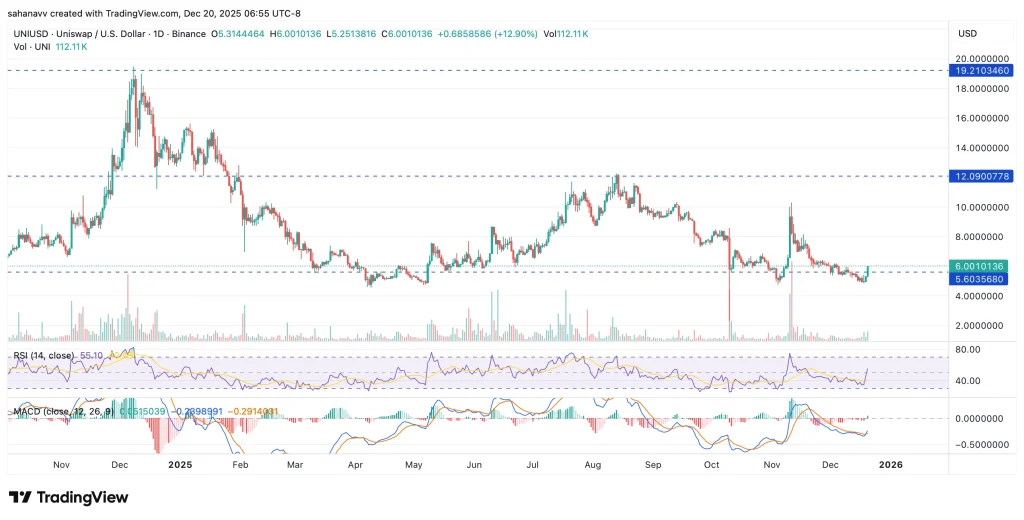
From a technical perspective, UNI’s structure has improved after holding above $5.00, which now acts as a critical support zone. Momentum indicators had been oversold before the rebound, supporting the case for a relief rally.
Key levels traders are watching:
- Support: $5.00–$4.85
- Near-term resistance: $5.60–$5.80
- Higher resistance (if momentum builds): $6.20–$6.50
Holding above the $5.6 region after the vote would keep the bullish structure intact. A rejection back below support could turn the recent MOVE into a short-term “buy the rumor, sell the news” reaction, especially given the thin holiday liquidity around the vote result.
Conclusion
UNI’s recent price strength reflects growing anticipation around a governance decision that could redefine how UNI’s token is valued. The combination of a large token burn and potential fee switch has pushed UNI back onto traders’ radar, even as broader market sentiment remains cautious.
That said, the real test will come after the vote. Whether UNI can hold key support levels and attract sustained participation will decide if this move evolves into a longer-term repricing or fades into consolidation. For now, price behaviour around the $5 zone remains the most important signal to watch.
