AI Trading & Fintech Innovation: The 2025 Revolution in Digital Asset Management

Forget the old guard—AI just rewrote the rulebook.
Algorithms now execute trades in microseconds, spotting patterns no human eye can catch. They bypass emotional decision-making, the perennial weak spot of traditional finance. Portfolio rebalancing happens autonomously, 24/7, reacting to market shifts before the news hits the wire.
Fintech's Frictionless Frontier
Decentralized platforms are cutting out the middleman. Smart contracts automate compliance and settlements, slashing fees and processing times from days to seconds. New regulatory tech (RegTech) solutions are building bridges with cautious institutions, making digital assets less of a wild west and more of a regulated frontier.
The Human Edge in an Automated World
This isn't about replacing people—it's about augmentation. The new fund manager's toolkit is a dashboard of AI insights, freeing them to focus on high-level strategy and asset selection. The game shifts from frantic day-trading to sophisticated oversight of algorithmic systems.
The cynic might say it's just a faster, shinier way to lose money—but the data shows otherwise. Efficiency is up, costs are down, and access is democratized. The future of asset management isn't coming; it's executing trades right now.
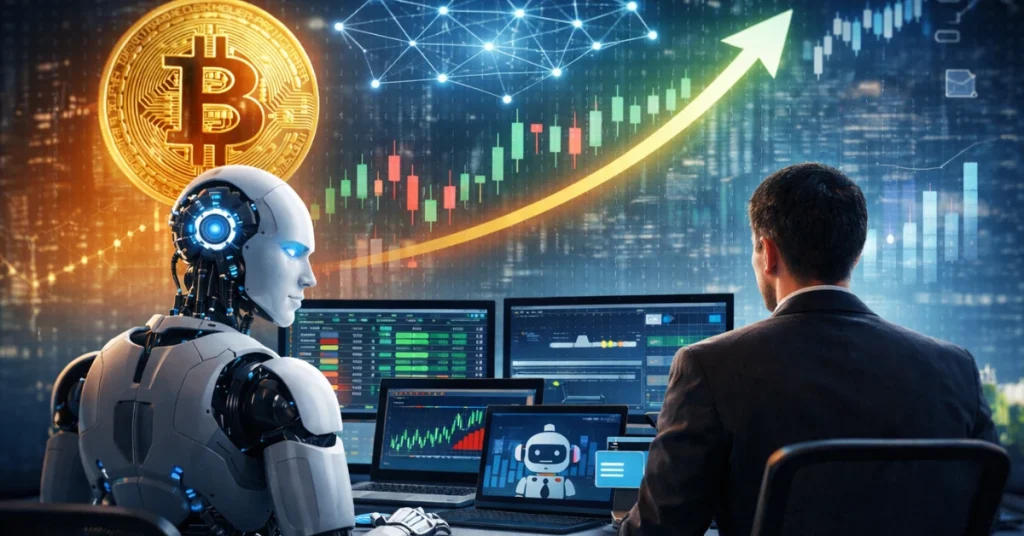
AI is quickly shifting from buzzword to real engine of returns in digital asset markets. To discuss this matter, we sat down with Bryan Benson — a Web3 and fintech veteran with more than 27 years of experience building and scaling businesses across Latin America, the U.S., Europe, and MENA. He served as Managing Director at Binance, leading institutional growth and financial inclusion initiatives in Latin America.
Today, Bryan is the CEO at Aurum, where he focuses on how AI and digital assets can fit into people’s day-to-day money decisions, building Aurum’s set of AI-driven tools that includes trading bots, a neobank-style app, and card products. In this interview, he talks about how AI is changing the way people manage digital assets and what that could mean for everyday investors over the next few years.

1.
At Binance, I witnessed digital assets transition from speculative trading to a more structured, institutional business. Risk teams, market makers, and simple algorithmic strategies started to professionalize what had been a retail-driven market. Today, the industry looks very different. Global assets under management reached approximately $135 trillion in 2024, and many leading managers now see AI as something they rely on every day, not just a test project.
Recent research from McKinsey suggests that AI, including newer generative and agentic systems, could change 25–40% of an asset manager’s cost base, while PwC reports that 80% of asset and wealth managers expect AI to drive revenue growth. In this context, Aurum is building a digital asset ecosystem where AI-native trading, yield tools, and everyday products, such as cards and wallets, coexist in one place, allowing individuals to benefit from the same structural trends that have reshaped institutional desks.
2.
AI systems excel at speed, scale, and consistency. In crypto, bots already handle a large share of global trading volume, and some estimates place the crypto trading bot market at over $40 billion in 2024, with strong growth expected into the next decade. AI engines read order books, derivatives data, and sometimes on-chain signals in milliseconds, while a human needs seconds just to interpret a single chart.
They also apply risk rules the same way every time. Instead of reacting to noise, an AI engine executes predefined sizing, entry, and exit criteria and keeps risk exposures aligned with the plan even in fast markets. By scanning multiple trading pairs and continuously managing positions, AI approaches trading in a more systematic way than manual, discretionary decisions.
Human traders struggle most with decisions after losses or during sharp rallies. The data backs this up. Research on AI-powered mutual funds reveals that, thanks to a combination of reduced behavioural errors and disciplined trade execution, these vehicles tend to exhibit lower turnover, avoid the disposition effect, and deliver better risk-adjusted performance compared to their human-managed counterparts.
AI-based tools codify the plan in advance. Entry conditions, position sizes, and exit rules sit in the model rather than in the trader’s mood. When the market whipsaws, the system follows signals and risk parameters instead of reacting to fear of missing out or the urge to “get back” a loss. At Aurum, that is exactly what we design for: a framework where emotions do not drive execution, and where users can see a transparent strategy with clear statistics rather than a stream of stressful decisions.
Yes, very clearly. Historically, only banks, hedge funds, and a few sophisticated prop desks had the data pipelines, infrastructure, and Quant talent to run meaningful algorithmic strategies. Now, cloud infrastructure, APIs, and generative AI compress that complexity. A 2024–2025 wave of research from BCG, PwC, and others shows that most large asset managers are rolling out AI use cases and see them as transformative for both efficiency and revenue growth.
At the same time, regulators and central banks report that a large majority of financial firms already use AI in some part of their stack. The Bank of England estimates 75% of UK financial services firms are using AI today. Those capabilities are now being packaged into consumer products. Aurum’s service suite aims to give individuals a way to plug into institutional-style execution and risk management through interfaces they can actually understand.
Most mature systems follow a similar pipeline in the background. First comes data ingestion from exchanges, FX venues, and sometimes on-chain sources. That data is cleaned, normalized, and enriched with features such as volatility measures, order-book depth, and cross-asset relationships. Academic and industry research shows that AI models, including DEEP learning architectures, can outperform traditional methods in detecting patterns and forecasting financial variables when they have access to rich datasets.
On top of that data layer, you have strategy models that generate trade signals, risk engines that enforce limits and drawdown constraints, and execution engines that route orders intelligently across venues. The rapid growth of the global algorithmic trading market reflects how much investment is going into this stack. Aurum’s architecture follows the same pattern, then exposes the outputs through simple dashboards and automated workflows.
We know that retail users adopt what they understand and trust. That’s why we start from the interface and work backwards. While our AI solutions run complex models, the user only sees clear metrics such as current allocation, realized and unrealized P&L, and historical performance against transparent risk levels. Activation is a guided flow: fund the wallet, choose a package, confirm risk parameters, and then monitor through a real-time dashboard.
We also design for explainability. People can review basic strategy logic, see how many trades were taken, and track how the bot behaves in different volatility regimes. Globally, regulators and central banks emphasize responsible AI with transparency and human oversight, which lines up with our approach. The goal is a system that feels like a capable co-pilot for managing digital assets and never like a black box.
I expect AI agents to become our digital teammates in finance. They will sit between traditional markets, DeFi, and your everyday apps, constantly scanning opportunities, managing risk, and handling a lot of the heavy lifting that used to require full trading desks. In many ways, this is already happening in the background. AI is in your pocket, in your office, and in your bank, and digital assets are simply the next frontier.
For individuals, the impact shows up in two places. First, productivity and income: AI tools help people launch products faster, create new income streams, and save time in their careers. Second, investing: AI-driven strategies can cut emotional errors and open access to more professional execution. I expect a hockey stick effect as these agents mature, where wealth creation looks less like timing the perfect trade and more like letting intelligent systems work for you every day.
