Why Bitcoin Price Crashed Today? The Real Story Behind the Dip

Bitcoin just took a nosedive—and the market's scrambling for answers. Forget the panic; let's cut through the noise.
Market Mechanics: The Invisible Hand Slaps Back
It's not magic, it's math. When leverage gets too frothy, the system purges itself. Liquidations cascade, stop-losses trigger, and suddenly a 5% dip looks like a 15% collapse. Old-school traders call it a healthy correction. Crypto Twitter calls it the end of the world. Both are wrong—it's just Tuesday.
Macro Tremors Meet Crypto Jitters
Traditional finance never really embraced digital assets—it just learned to rent them. So when bond yields twitch or a central banker clears their throat, capital flees back to its mothership. The correlation isn't perfect, but it's real enough to move billions in minutes. A cynical take? Wall Street still treats crypto like a risky side-hustle—profitable until it's not.
Sentiment: The Most Volatile Asset of All
Fear spreads faster than any blockchain. One influential bearish take, a few over-leveraged whales selling, and narrative flips from 'number go up' to 'abandon ship.' Social media amplifies every tremor into an earthquake. Remember—the crowd is usually right until it's catastrophically wrong.
The Silver Lining You're Not Hearing About
Every crash shakes out weak hands and resets the board. It's the market's brutal way of finding a stronger foundation. Volatility isn't a bug; it's a feature. While paper hands panic, builders keep building. The fundamentals—scarcity, adoption, technological evolution—haven't changed a bit.
So take a breath. This isn't 2018. Infrastructure is stronger, institutions are deeper, and the dip might just be the discount you've been waiting for. Or, as the suits in traditional finance would say right before missing the next rally—'I told you so.'

The crypto market saw a sharp drop on December 15, losing nearly $150 billion in total value. Bitcoin price today fell close to the $85,000 level, while major coins like Ethereum, XRP, and Dogecoin dropped between 4% and 8% in just one day.
The sudden MOVE left many traders surprised, wondering the key reason behind the fall.
Chinese Authorities Tightened the Bitcoin Mining Rule
One major reason behind the fall appears to be new action from China. Authorities reportedly tightened rules on Bitcoin mining again, forcing 1.3 GW of capacity mining operations to shut down.
In Xinjiang alone, around 400,000 miners went offline in a short time. This cut global bitcoin mining power by about 8%.
China has once again tightened regulations on domestic Bitcoin mining.
In December, most mining operations in Xinjiang were shut down, with around ~400K Bitcoin miners taken offline. pic.twitter.com/PXDaVeedLR
When miners lose access to power, their income drops instantly. To cover costs or move operations, some miners sell their Bitcoin holdings, which adds extra supply to the market and pushes prices down in the short term.
ETF Outflows Add to Selling Pressure
At the same time, Bitcoin ETFs saw strong outflows on December 15. Total outflows reached about $357.6 million in a single day. Fidelity led the exits with $230.1 million, followed by Bitwise with $44.3 million and ARK Invest with $34.5 million.
Notably, no major Bitcoin ETF recorded inflows that day, including BlackRock.
Long Leverage Triggers $655 Million in Liquidations
Eventually, heavy leverage in the market made things worse. In the past 24 hours, nearly 188,247 traders were liquidated, with total losses of around $649.4 million.
The largest single liquidation was a $11.58 million BTC position on Binance. As prices fell, forced liquidations pushed Bitcoin even lower in a short time.
In the past 24 hours , 188,247 traders were liquidated , the total liquidations comes in at $649.43 million
The largest single liquidation order happened on Binance – BTCUSDT value $11.58M pic.twitter.com/RuFEphOu2n
Altcoins and Crypto Stocks Felt The Pain
Bitcoin’s price drop spread across the entire crypto market, pulling down major altcoins. Ethereum, XRP, Solana, and other large tokens dropped between 5% and 8% over the last 24 hours.
The weakness also hit crypto-related stocks. Shares of Strategy fell more than 9% at one point, while Coinbase slipped nearly 7%.
What Comes Next for Bitcoin?
Despite the crash, institutional buying did not stop. Strategy added 10,645 BTC, worth about $980 million, bringing its total holdings to 671,268 BTC.
From a technical view, Bitcoin’s daily chart shows the price has broken below a symmetrical triangle pattern but is still holding above a key support zone. The Ichimoku Cloud is now acting as resistance around $90,000 to $92,000.
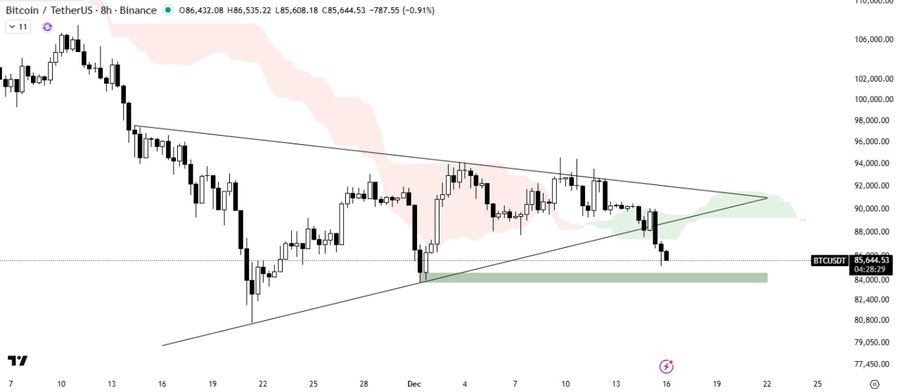
If Bitcoin stays above $85,000, a bounce toward $90,000 is possible. However, a clear break below $84,000 could push the price down toward $80,000.
