Crypto Plunges as BOJ Rate Fears Ignite Global Market Sell-Off

Crypto markets are in the red today, caught in a global risk-asset rout. The trigger? Mounting speculation that the Bank of Japan is finally ready to abandon its long-held negative interest rate policy.
The Domino Effect
It started in Tokyo. Whispers of a hawkish pivot from the world's last major dovish central bank sent shockwaves through traditional finance. Bonds sold off, equities wobbled, and the flight to safety was on. Digital assets, still viewed by many institutions as high-beta risk plays, got hammered in the crossfire. It's a classic liquidity squeeze—when the cheap money tide recedes, it reveals who's been swimming naked.
Not a Crypto-Specific Crisis
Don't mistake this for a blockchain breakdown. Network activity remains robust, and developer commits haven't slowed. This is a macro-driven sentiment crash. Crypto is acting exactly like the volatile, forward-looking asset class it has become—front-running the fear of tighter global financial conditions. One cynical take? Traders are dumping the digital future to buy... well, nothing. Just parking cash and waiting for the next central bank press conference.
The Silver Lining for Believers
For long-term holders, this is familiar volatility. These sell-offs often flush out leverage and weak hands, creating a healthier foundation for the next leg up. True decentralization, after all, isn't supposed to be immune to global interest rate moves—it's supposed to offer an alternative to the system making those moves. The narrative hasn't changed; only the short-term price action has.
The bottom line: Today's crash is a reminder that crypto hasn't decoupled from traditional finance. It's a liquidity story, not a tech failure. The panic is real, but for the bullish, it's just noise against the long-term signal.

The crypto market is extending losses as Bitcoin and altcoins face a sharp Friday sell-off, with prices sliding 5–10% across major tokens. While the timing may feel familiar, the pressure is not random. Markets are reacting to tightening global liquidity conditions, driven largely by renewed concerns over Japan’s interest rate policy and its impact on risk assets worldwide.
BOJ Interest Rate Signals Drain Liquidity From Risk Assets
Investor sentiment turned sharply lower after reports suggested the Bank of Japan could MOVE toward another interest rate hike at its December 18–19 meeting. Japanese bond yields jumped following the news, triggering a pullback across global markets. For years, Japan’s ultra-low interest rates acted as a backbone for cheap global liquidity, allowing funds to deploy capital into higher-risk assets such as equities and crypto.
As expectations shift toward tighter policy, that cheap liquidity is being withdrawn. Funds are reducing exposure, leverage is coming down, and risk assets are bearing the brunt. This has resulted in broad-based selling across stocks, Bitcoin, and altcoins, with the impact amplified by thin liquidity during late-week trading.
Bitcoin Price Crash Deepens as Key Levels Break
Bitcoin’s decline accelerated after it failed to hold critical support near $92,000. Once that level was lost, liquidation pressure spread quickly across derivatives markets, dragging prices lower. The breakdown triggered a familiar pattern seen during illiquid market conditions, where forced selling intensifies moves beyond what fundamentals alone WOULD suggest.
Market watchers are now closely tracking the $86,000 area, with downside risk extending toward a sweep of previous lows in the $78,000–$80,000 range.
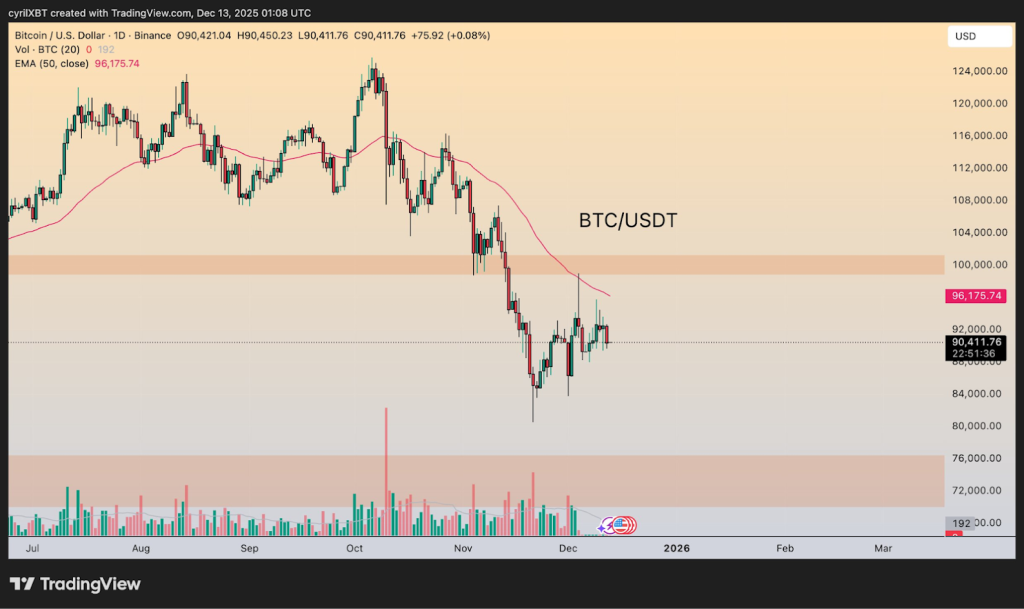
Bitcoin could see another leg lower toward $74,000, where bullish divergence may begin to form.
While a short-term bounce is possible later this month or over the holiday period, expectations remain cautious, with further weakness potentially carrying into January before any sustained recovery takes shape.
What Comes Next for the Crypto Market
The sell-off has also been reinforced by the December 19 quarterly options expiry, a period that often brings heightened volatility and downside pressure before markets stabilize. If the Bank of Japan confirms a rate hike, a sharp but brief sell-off cannot be ruled out. On the other hand, if policymakers delay action, risk assets could see a short-term relief rally into month-end.
For now, the move highlights how closely Bitcoin remains tied to global financial conditions. The current decline is being driven less by crypto-specific developments and more by macro forces reshaping liquidity across markets. As long as uncertainty around interest rates and funding costs persists, volatility is likely to remain elevated.
