India Crypto Tax Shock: ₹88 Lakh Notice Despite Trader’s Massive Losses

A stark warning to India's crypto community: one trader has been hit with a staggering ₹88 lakh tax notice from Indian authorities, even as the trader's portfolio showed an overall loss. This June 2026 incident has sent shockwaves through the market, exposing a critical flaw in how many retail investors structure their crypto transactions. The core issue? A 10% correction in major holdings triggered a taxable event that the trader failed to account for, turning a paper loss into a crippling legal liability.
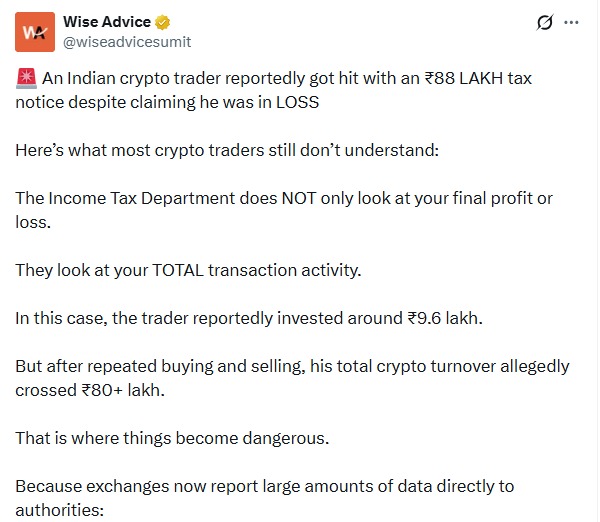
Source: X Account
How India Crypto Tax Notice Targets Turnover, Not Just Profits
The trader reportedly invested around ₹9.6 lakh in crypto. Through repeated buying and selling across multiple sessions, their total transaction turnover allegedly crossed ₹80 lakh — even though the net position was a loss.
That turnover figure is what triggered the India taxation notice.
The Income Tax Department does not only examine your final profit or loss. It examines your total transaction volume, your source of funds, your bank trails, and whether your exchange records match your filings precisely.
In this case, authorities allegedly questioned the following:
Source of funds
Complete bank transaction trails
Matching between exchange data and ITR disclosures
Consistency of TDS records with Form 26AS and AIS
The case reportedly falls under Section 69 — "unexplained investments." When authorities cannot verify the source of funds behind large transaction volumes, they can treat the entire activity as unexplained income. The tax treatment under this provision is severe — effective taxation has historically reached 60–78% in some cases after surcharge and cess. Standard loss logic provides zero protection here.
This is the core misconception destroying traders: "I made losses, so taxes don't matter."
Wrong. Under India's crypto framework, the law under Section 115BBH is already among the strictest in the world — 30% flat tax on gains, 1% TDS on every transaction, no offsetting of losses against gains, and no carrying forward of losses to future years. Poor documentation makes a bad situation catastrophically worse.
India taxation Notice Triggers — What Every Trader Must Fix Now
The broader enforcement picture matters more than this single case.
India's exchanges now report detailed data directly to tax authorities — transaction volumes, PAN-linked activity, TDS deductions, wallet movements, and bank linkages. The Income Tax Department runs AI-based scrutiny systems that cross-reference this exchange data against AIS records, Form 26AS, bank statements, and ITR disclosures automatically. Any mismatch can trigger a notice without any manual intervention.
Critical points most Indian traders still ignore:
Crypto-to-crypto swaps are taxable events. BTC to ETH, ETH to SOL, SOL to USDT — even when no INR ever touches a bank account, each swap is a reportable transaction.
Multiple exchange users face higher risk. Anyone using both Indian exchanges and Binance simultaneously has a complex paper trail that demands meticulous recordkeeping.
DeFi wallets and OTC trades carry the same reporting obligations as centralized exchange activity.
India has already issued thousands of crypto-related notices in recent years using exchange data, PAN linkage, and automated AI scrutiny. The phase where crypto activity could remain undocumented without consequence is over.
The ₹88 lakh notice was not about profits. It was about documentation failure.
Future Outlook — Expert Analysis
The trajectory of India's crypto tax notice enforcement points in one direction: tighter, faster, and more automated scrutiny. As exchanges integrate more deeply with India's financial reporting infrastructure—and as AI-based cross-referencing systems mature—the gap between what traders report and what authorities already know will only narrow.
Tax professionals working with crypto clients consistently flag the same failures: missing records of cost basis, undisclosed crypto-to-crypto swaps, and inconsistent TDS matching. These are not exotic problems — they are the default state for most retail traders who entered crypto without understanding the documentation requirements.
The ₹88 lakh notice serves as a structural warning, not an isolated anecdote. Traders with ₹5 lakh portfolios can face the same scrutiny if their turnover and documentation patterns match the flagging criteria. India's taxation enforcement does not sort by portfolio size — it sorts by data inconsistency.
: This article is for informational and educational purposes only. It does not constitute legal, financial, or tax advice. The case referenced is based on publicly reported information.

Log in to Reply
Log in to comment your thoughtsComments
Related Articles
|Square
Get the BTCC app to start your crypto journey
Get started today Scan to join our 100M+ users