SBI Remit Ripple Payments Network Expands to 26 Japanese Banks in Major Cross-Border Push

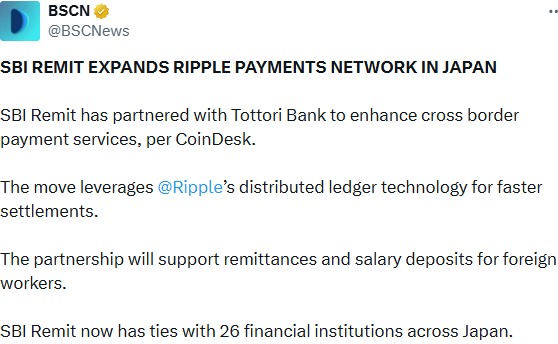
SBI Remit's Ripple-powered payments network has now connected 26 financial institutions across Japan, fundamentally transforming cross-border remittances from a fintech niche into a core local banking service. The latest partnership with Tottori Bank, confirmed on April 20, 2026, specifically targets foreign workers by enabling faster international transfers and direct salary deposits, providing a concrete real-world utility that underscores the network's rapid and deep integration into Japan's financial infrastructure.
X Official
Why Tottori Bank matters for ripple news today
Tottori Bank is not one of Japan’s mega-banks. That is exactly why this story stands out.
When a regional bank joins the SBI Remit Ripple Payments Network, it shows how digital remittance tools are spreading outside top-tier finance names. This matters for workers who send money home and for smaller banks that need faster settlement options without building new rails from scratch.
CoinDesk’s report framed the partnership around improving cross-border transfers and salary deposit support for foreign workers in Japan.
It has long positioned its payment technology around speed, lower friction, and enterprise settlement efficiency.
On its official site, Ripple says Ripple Payments uses blockchain-based infrastructure for cross-border payments.
The company also links that network to digital asset-enabled settlement options in some corridors. That broader backdrop helps explain why the SBI Remit Ripple Payments Network it remains a key part of ripple news today and xrp news today.
60% Cost Savings: Settlements are now 60% cheaper compared to traditional SWIFT.
Worker Focused: Enables instant salary deposits and transfers for foreign workers.
Official Launch: The service officially went live on April 20, 2026.
How Ripple Payments Network supports Japan remittance growth?
The language around this deal points to one clear goal: faster settlement.
Reports on the Tottori Bank partnership said the service uses distributed ledger technology to improve transfer speed. In plain terms, distributed ledger technology, or DLT, is a shared digital record system that lets participants update transaction data across a network. Ripple has repeatedly marketed this setup as a way to cut delays in old cross-border banking systems.
That matters in Japan for one simple reason.
Foreign workers often need steady, low-friction remittance access. If a service can support both overseas transfers and salary-linked deposits, it becomes part of daily financial life, not just an occasional transfer tool. That gives the SBI Remit a stronger story than a pure tech announcement. It ties the service to payroll, worker support, and everyday money movement.
The update also feeds into wider interest around the its Payments Network, XRP Ledger (XRPL), and related settlement infrastructure. While this report focused on payment rails and remittance service expansion, not direct XRP usage by end users, it still keeps Ripple-linked payment adoption in focus for readers searching xrp news today. Its official materials continue to position XRP Ledger as a blockchain built for tokenization and payment use cases, even as enterprise payment implementations can vary by corridor and design.
What this means for SBI Remit and Japans payment market?
This is where the story gets more interesting.
The SBI Remit Payments Network is no longer just a headline about crypto-adjacent banking. It is becoming a story about regional connectivity in Japan. A 26-institution footprint gives SBI Remit more reach, more local banking touchpoints, and a clearer path to scale practical remittance services.
It also shows a quieter shift in market structure.
Instead of waiting for one giant national rollout, payment modernization in Japan may move branch by branch, bank by bank, and worker segment by worker segment. That is slower than hype-driven crypto headlines. It is also more believable. For that reason, the Payments Network story may carry more long-term weight than flashier partnership news with less direct use.
Future Outlook
The next question is whether this model keeps spreading among regional lenders.
If more local institutions join, SBI Remit could move from being a specialist remittance player to a wider payments connector inside Japan’s banking network. That would keep Ripple Payments Network, DLT adoption, and XRPL-linked market interest in the spotlight. The clearest signal now is not hype. It is the steady expansion from one bank relationship to 26.
$1.3B ETF Inflow: Institutional money is pouring into XRP ETFs in 2026.
$2.50 Price Target: Analysts expect XRP to hit $2.50 driven by this steady bank adoption.
Conclusion:
The Tottori Bank tie-up gives the Payments Network a more practical shape in Japan. It connects faster cross-border transfers with payroll support for foreign workers. That makes this story less about branding and more about real financial use, which is often where lasting payment trends begin.This news is for informational purposes only and does not constitute financial advice.

Log in to Reply
Log in to comment your thoughtsComments
Related Articles
|Square
Get the BTCC app to start your crypto journey
Get started today Scan to join our 100M+ users