Aster Tokenomics Update Slashes Monthly Emissions by 97%: A Major Supply Shock for the Derivatives DEX

Aster, a leading derivatives-focused decentralized exchange, has executed a dramatic tokenomics overhaul, slashing its monthly token emissions by 97%. The project has abruptly terminated its previous scheduled ecosystem unlocks, shifting to a purely reward-based distribution model in a move that significantly curbs new supply entering the market. Announced via the project's official channels, this supply-side shock arrives as traders intensely scrutinize token inflation, unlock schedules, and staking incentives across the crypto sector.
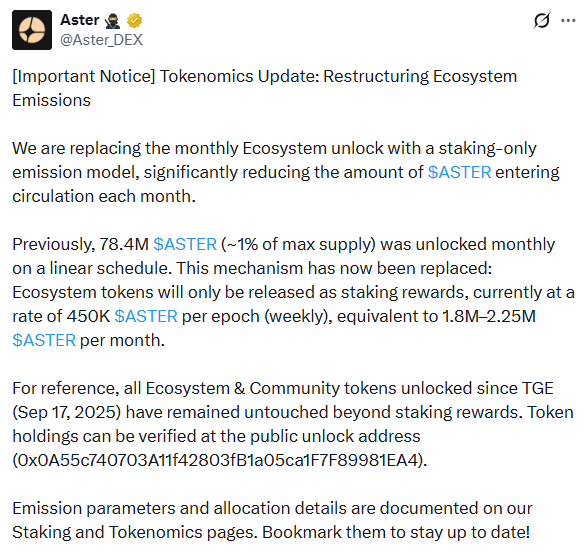
Monthly Unlocks Replaced by Reward Emissions
The main change is easy to follow. The protocol will no longer release 78.4 million each month under a fixed linear schedule. Instead, ecosystem tokens will now enter circulation only through weekly reward emissions.
Project documentation shows the current system distributes 150,000 in base rewards and 300,000 in loyalty rewards per epoch. That brings total weekly issuance to 450,000 tokens . Over a month, that equals roughly 1.8 million to 2.25 million tokens. Compared with the old model, that is about a 97% reduction in monthly emissions.
This part of Aster tokenomics update matters because fewer tokens entering circulation can ease supply pressure. In digital asset markets, heavy unlock schedules often affect short-term sentiment. A slower release pace does not guarantee a price increase, but it does change how traders read dilution risk and future supply flow.
Supply Structure Remains Broadly the Same
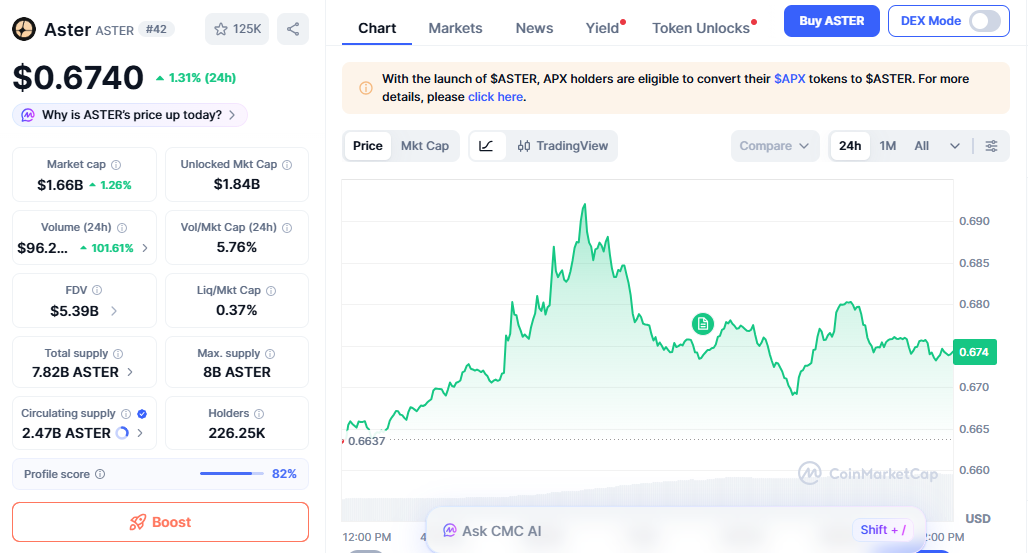
The Aster Tokenomics update changes the release path, not the full supply cap. The protocol still has a maximum supply of 8 billion tokens. Market data also shows circulating supply at about 2.48 billion.
According to the project’s published allocation data, 53.5% of supply, or 4.28 billion tokens, is assigned to airdrops. Another 30%, or 2.4 billion, is reserved for Ecosystem and Community use. The documents also state that 704 million tokens, equal to 8.8% of total circulation, were unlocked
at the token generation event, while the rest of the airdrop allocation vests over 80 months.
The Ecosystem and Community pool had earlier been set to vest over 20 months on a linear basis. That method ran for four months, from October 2025 to January 2026, before being replaced by the current reward model. Treasury allocation remains at 7% and stays locked unless governance approves its use. Team allocation remains at 5%, with a 12-month cliff followed by 40 months of monthly vesting.
The project also said that ecosystem and community coins unlocked since the September 17, 2025 token generation event have remained untouched beyond reward distribution. That detail is important because it supports the team’s effort to present the supply shift as disciplined rather than cosmetic. In that sense, the Aster tokenomics update is also about credibility, not only lower emissions.
Market Reaction to the Supply Shift
The market response was positive, though modest. It is traded near $0.674, with daily volume around $96.6 million. That price move suggests traders viewed the lower emission schedule as supportive in the near term.
Still, a single day of trading does not confirm a lasting trend. In most crypto markets, a reduced unlock rate only has durable value if network use, fee generation, and trader activity remain healthy. Circulation control can improve the narrative, but demand must also hold up.
There is also a wider product backdrop to consider. The roadmap shows the project launched Aster Chain on March 16, 2026, and introduced its reward program on March 20, 2026. That means the supply adjustment arrived soon after new infrastructure and user incentives were rolled out. The broader goal appears to be a closer link between issuance, participation, and platform utility. That gives the Aster tokenomics update more weight than a simple treasury change.
Future Outlook
The Aster tokenomics update could improve how traders view the protocol if the project keeps network activity strong and staking demand grows. Lower emissions, staking rewards, buyback support, and a live Layer 1 chain all give the token a more structured utility story than a simple monthly unlock model. Aster tokenomics update docs say protocol revenue is also used in part for ASTER buybacks, which adds another supply-side factor for the market to watch.
YMYL Disclaimer This article is for informational purposes only and does not constitute financial, investment, legal, or tax advice. Crypto assets are volatile, and readers should review official disclosures and conduct their own research before making financial decisions.