BREAKING: US Bitcoin Reserve Gets Major Boost From New ’Mined in America Act’

A landmark U.S. Senate proposal has sent shockwaves through the digital asset sector, aiming to cement America's dominance in crypto infrastructure. Introduced on March 30, 2026, by Senators Bill Cassidy and Cynthia Lummis, the 'Mined in America Act' seeks to bolster domestic Bitcoin mining and hardware production while providing critical legal clarity for the U.S. Bitcoin Reserve. This strategic legislative move directly ties national industrial policy to federal cryptocurrency strategy, marking a pivotal moment for regulatory certainty and onshore crypto investment.
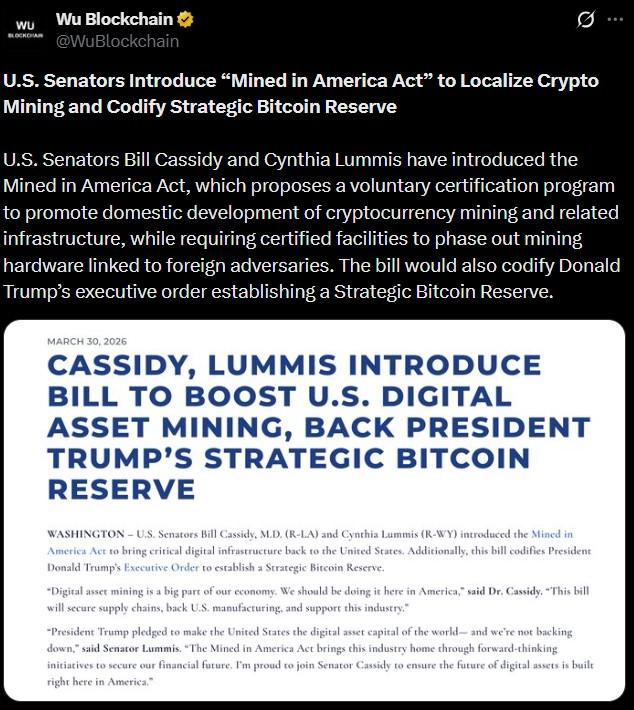
Source: X Official
Introduced in the Senate, but not approved yet
Connects local production with digital asset policy
What the Measure Would Actually Do
The proposal of US Bitcoin Reserve appears broad in scope. It would create a voluntary “Mined in America” certification for crypto facilities and pool operators. It would also push certified groups to move away from hardware tied to foreign adversaries. In addition, it would use existing federal energy and rural development programs to help support that shift.
The US Bitcoin Reserve also directs NIST and the Manufacturing Extension Partnership to help U.S. firms build secure, energy-saving equipment. That means the effort is not only about regulation. It is also about building a stronger local supply base for this industry.
Creates a voluntary U.S.-focused certification program
Supports safer and more efficient machine production
Why Hardware Dependence Is a Big Issue
Supporters say the United States controls a large share of global hash rate, but still relies heavily on foreign-made ASIC hardware. That gap is one of the main reasons this effort is being framed as both an economic and security issue.
This part of the story is important because it shows the wider goal behind the plan. Lawmakers backing the measure argue that a country should not host a major share of network activity while depending on outside suppliers for the machines that power it. That view gives the Mined in America Act a stronger national focus and adds more meaning to the US Bitcoin Reserve discussion.
Seeks to reduce reliance on foreign hardware
Ties crypto infrastructure to supply chain security
The Federal BTC Holding Plan Matters Too
Another key part of the US Bitcoin Reserve is its link to the federal BTC holding plan. The White House had already created a Strategic Bitcoin Reserve by executive order on March 6, 2025. That step said Treasury should manage government-held BTC from forfeiture cases and keep those assets instead of selling them.
Now, this Senate effort tries to turn that action into law. That matters because executive orders can be reversed more easily than acts passed by Congress. If lawmakers move this forward, the US Bitcoin Reserve could gain more legal strength and become harder to undo in the future. This is why many people see the story as more than a hardware or infrastructure update.
Builds on the 2025 executive order
Could make long-term federal BTC custody more durable
What Happens Next From Here
Right now, the proposal is still at an early stage. It must move through committee, gain wider support, pass both chambers, and then be signed before anything changes in legal terms. So at this point, the effect is mostly political and symbolic.
Still, the message is meaningful. It shows that some lawmakers want stronger local production, safer supply chains, and a more lasting federal approach to seized BTC. That alone gives the topic more weight in the market and in policy circles.
No immediate legal change at this stage
Stronger pro-crypto signal from Washington
Conclusion:
The proposal matters because it tries to do two things at once: support domestic crypto infrastructure and give federal BTC holdings a stronger legal base. That makes it more important than a routine policy headline. For now, it remains an early-stage Senate effort, not a final shift in U.S. law. Even so, it strengthens the case for local machine production, safer supply chains, and long-term government custody of digital assets. If it gains traction, the US Bitcoin Reserve could become one of the most closely watched themes in U.S. crypto policy.
