Pi Network Mainnet Enters Critical Upgrade Phase Ahead of April 6 Deadline: What You Need to Know

The Pi Network mainnet has entered a critical upgrade phase with developers issuing a stark warning to users: complete all necessary migration steps before the April 6 deadline or risk losing access to holdings. This mandatory transition comes as the network prepares for its next evolution, with analysts warning of potential 10% volatility in secondary market valuations during the migration window. The upgrade represents the most significant technical overhaul since the network's initial launch, requiring all participants to update wallets and validate transactions through the new protocol.
Highlights:
Desktop node operators must update to v21.2 before April 6 to stay connected to the live chain.
The latest Node desktop version listed on the official page is 0.5.4, and the step is aimed at computer-based operators, not regular mobile miners.
After the Kraken listing pushed the token near $0.29, the price later slipped to about $0.176 on March 28 as market sentiment weakened.
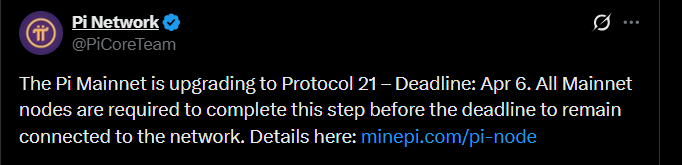
Pi Network Mainnetis back in focus after the project confirmed a required software step for people who run desktop nodes. The official Node page says the blockchain protocol is under upgrade and that all active operators must move to v21.2 before April 6 to remain connected. The update mainly affects users who support the chain through a computer. Those who only mine through the mobile app generally do not need to act on this deadline directly.
Source: X Official
Mandatory Upgrade for Desktop Operators
The latest announcement from Pi Network Mainnet is more about compatibility than a new feature launch. On its official Node page, the project says every live-chain node must complete the upgrade and also lists version 0.5.4 as the newest desktop release. The official X post repeats the same message, warning that operators who miss the deadline may fall out of sync or lose connection.
This makes the change important for Pi Network Mainnet, even if many casual users may not notice an immediate difference. In simple terms, Pi Network Mainnet v21.2 appears to be a required software refresh that helps keep participation smooth and supports the next stage of ecosystem development. Public-facing pages do not offer a full technical breakdown in one place, so the safest summary is that this is a maintenance and readiness step rather than a flashy product update.
Broader Roadmap and Access Progress
The bigger picture comes from the Pi Day 2026 blog. In that post, the team said Protocol 20 lays the foundation for smart contract capabilities and added that more protocol changes are being phased in to align the blockchain with newer versions. That suggests the latest node requirement is part of a wider rollout tied to future ecosystem functions.
User access is another major part of the story. On March 26, the Pi Network Mainnet said second migrations were gradually rolling out. Earlier, on January 30, Pi Network Mainnet also said that more than 700,000 additional users would soon be able to submit KYC applications. These developments matter because migration and identity checks still shape how many people can fully use the live ecosystem. Without those steps, a large share of the community remains limited in what it can do on-chain.
Price Reaction After Kraken Listing
Market action was strong at first, then turned weaker. The Kraken listing sparked fresh interest and helped the token rise to about $0.29. That move drew attention across the crypto market and gave traders a short-term boost in confidence.
Still, the rally did not hold. As the broader market became bearish, the asset also came under pressure. By March 28, CoinMarketCap showed it trading near $0.176, with a market cap close to $1.75 billion and circulating supply near 9.93 billion coins. Much of the current discussion now centers on whether utility can expand fast enough to keep pace with supply growth.
Conclusion:
The latest update from Pi Network Mainnet shows that the project is still in a buildout phase, with technical stability and user access taking priority. The node deadline, KYC expansion, and second migration rollout all point to the same goal: preparing the ecosystem for wider use. For now, Pi Network Mainnet remains a story of infrastructure progress, gradual access, and cautious market attention rather than a major end-user release.
