Binance Australia Hit With $6.9M Fine: Unpacking the Losses, Lawsuits, and What’s Next for Crypto Compliance

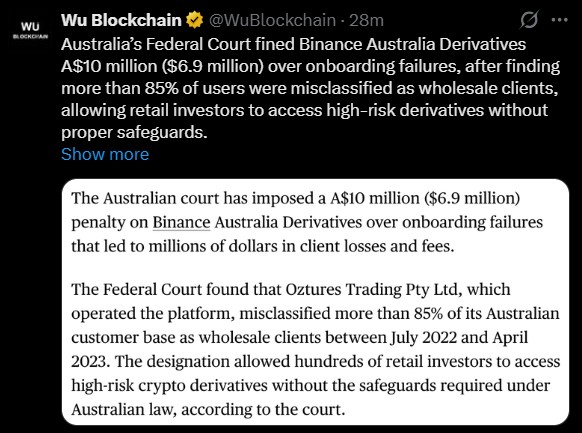
Australia's Federal Court has slapped Binance's local derivatives arm with a A$10 million penalty, delivering a stark compliance warning to the digital asset sector. The ruling, following an ASIC case over retail-client misclassification, comes as regulators globally intensify scrutiny, with legal risk now a pivotal factor shaping crypto market sentiment.
Source: Wu Blockchain
Binance Australia Fine Began With Client Checks
The court found that from July 2022 to April 2023, 524 retail clients were wrongly classified as wholesale clients. That gave them access to high-risk derivatives without the safeguards required under Australian law. Reuters said the group represented more than 85% of the local client base, lost A$8.7 million, and paid A$3.9 million in fees.
ASIC said weak onboarding controls and poor staff training let users keep retrying a multiple-choice test until they passed. In one example, a client was accepted as a professional investor based on self-certification alone. Binance Australia later said it found the issue itself, reported it to ASIC, and fixed it in 2023.
Why the Binance Australia Case Took Years to End?
The story began well before today’s fine. ASIC cancelled the Australian financial services licence for Derivatives in April 2023 after a targeted review of client classification. In December 2024, ASIC sued the firm and said 505 retail investors, or 83% of its Australian client base, had been misclassified during the period cited in the case.
The later court finding referred to 524 clients and more than 85%, showing how the matter developed from the original lawsuit to the final ruling. ASIC also oversaw about A$13.1 million in compensation for affected clients in 2023.
Legal History and Mixed Signals for Binance Australia
The wider legal picture is mixed. Earlier this month, the platform sued The Wall Street Journal for defamation over a report tied to an alleged Iran-related investigation. Around the same time, a New York federal judge dismissed major Anti-Terrorism Act claims, and the exchange later said an Alabama federal court also dismissed related claims there. Still, those wins did not produce a sharp immediate trading response.
Conclusion
The bigger lesson is that compliance failures can stay in the market long after a platform says they are fixed. For regulators, firms, and users, the Binance Australia ruling shows that consumer protection, clear onboarding, and strong controls may shape trust and future growth across digital assets going forward globally.
This article is for news and educational purposes only. It is not financial, investment, or legal advice. Readers should review primary sources and seek professional guidance before making decisions.
